NE LEGAL BUREAU
CHENNAI, AUG 25
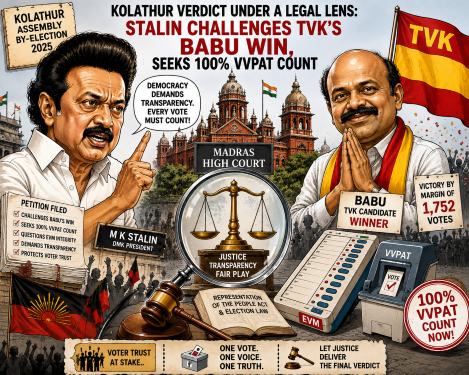
When the final vote is declared, is an election truly over — or does democracy retain a final audit trail through the ballot paper locked inside the VVPAT machine? That question has acquired fresh legal significance in Tamil Nadu, with DMK president M.K. Stalin moving the Madras High Court to challenge the election of TVK candidate V.S. Babu from Kolathur, alleging serious procedural and technical irregularities in the post-election verification of EVMs and VVPAT units.
- DMK president moves Madras High Court to annul V.S. Babu’s election and declare him duly elected from Kolathur
- Petition alleges serious lapses during post-poll EVM verification; Stalin questions August 5 declaration that exercise was completed successfully
- Seeks verification of all 286 EVM sets and complete counting of VVPAT slips in the constituency
- Plea follows verification of 14 selected EVM sets in which Stalin’s authorised representative raised technical and procedural objections
- Election challenge puts spotlight on the integrity, transparency and evidentiary value of post-election EVM verification
Stalin has sought an order declaring Babu’s election void and himself duly elected from Kolathur, besides seeking 100% counting of VVPAT slips and checking and verification of all 286 EVMs deployed in the constituency.
Babu had defeated Stalin by 8,795 votes, polling 82,997 votes against Stalin’s 74,202 in the 2026 Assembly election. The Election Commission subsequently undertook verification of EVMs from 14 polling stations selected by Stalin.
FROM 14 MACHINES TO A DEMAND FOR ALL 286
The legal challenge stems from the post-election verification exercise.
According to Stalin’s petition, after the election results were declared, he nominated senior advocate N.R. Elango as his authorised representative to check and verify the burnt memory/microcontroller of the Control Unit, Ballot Unit and VVPAT pertaining to 14 selected EVM sets used in Kolathur.
During the exercise, Elango allegedly detected what Stalin describes as “grave and alarming irregularities” and immediately brought them to the notice of the District Election Officer.
However, the District Election Officer subsequently declared that the checking and verification exercise had been successfully completed on August 5 in accordance with the prescribed procedure. Stalin has challenged that conclusion, contending that his objections and requests for clarification were not properly addressed.
The controversy had already surfaced during the verification exercise, when the DMK alleged discrepancies in some of the machines examined. The District Election Officer, however, rejected the allegations.
‘Certificates cannot substitute technical failure reports’
In a communication dated August 6, Elango, according to the petition, highlighted specific failures encountered during the verification process.
A key objection was that certificates issued by the engineer could not substitute for technical or failure reports explaining the causes of the failures.
Stalin has therefore contended that the District Election Officer’s conclusion that the exercise had been completed successfully was not sustainable, particularly when the technical concerns raised by his authorised representative had not been adequately answered.
The plea challenges the impugned order as having been passed mechanically, without properly responding to the clarifications sought and objections raised during the verification process.
The petition thus seeks to take the controversy beyond the question of whether an individual machine technically functioned during a post-poll check, and into the larger question of whether the verification process itself was sufficiently transparent, documented and capable of addressing every technical anomaly identified by the candidate’s representative.
What happened inside the verification process?
The dispute assumes significance because the EVM verification was not itself a recount of the election result. Before the exercise began, election officials had clarified that the process involved checking the functionality of machines, including diagnostic checks and mock polls, rather than recounting votes. In the 14 polling stations selected by Stalin, the exercise covered 42 Ballot Units, 14 Control Units and 14 VVPAT units.
The petition now seeks a much wider examination.
Stalin has asked the High Court to direct the authorities to conduct 100% counting of VVPAT slips relating to the Kolathur Assembly constituency and to check and verify all 286 machines deployed in the constituency.
The plea also challenges the District Election Officer’s August 5 order certifying the completion of the verification exercise.
The legal contest could consequently bring into focus the safeguards governing EVM custody, identification, technical verification and VVPAT reconciliation — issues that go directly to public confidence in the electoral process.
The larger question: Can an election have a final audit?
The Kolathur dispute is now larger than the political contest between Stalin and Babu. It places under judicial scrutiny the process through which an electoral system responds when a candidate raises technical objections after the declaration of results.
Stalin’s case is that alleged machine failures and procedural lapses cannot simply be closed by declaring the verification exercise successful without examining the objections raised.
One of the issues cited in the petition, according to legal reporting, concerns a Control Unit that allegedly failed to detect a Ballot Unit bearing Stalin’s name — a circumstance he says raises questions about whether similar problems could have existed elsewhere.
The High Court will therefore have to consider the legal significance of the alleged discrepancies and the reliefs sought by Stalin, including the demand to invalidate Babu’s election and declare Stalin elected.
For the electorate, however, the significance is even more fundamental: whether every legitimate technical objection to an election can be independently examined to the extent necessary to leave no reasonable doubt about the integrity of the mandate.
The Kolathur petition has consequently opened another chapter in the continuing debate over EVM transparency, VVPAT verification and the legal remedies available to a defeated candidate who questions the post-election verification process.