NE BUSINESS BUREAU
NEW DELHI, AUG 24
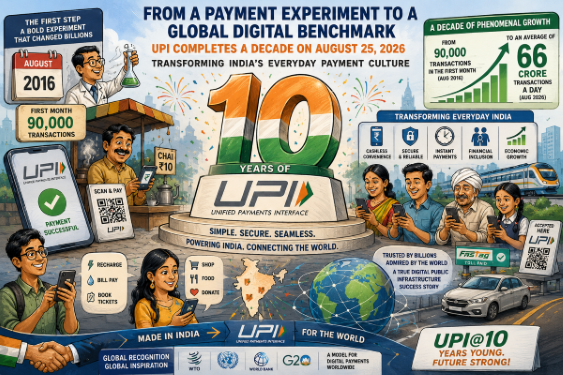
What began a decade ago with barely 90,000 transactions in its first month has grown into a digital payments juggernaut processing an average of 66 crore transactions every day — a transformation that has fundamentally altered the way India pays, transfers and does business.
As the Unified Payments Interface (UPI) completes 10 years on August 25, 2026, the numbers tell a remarkable story of scale: annual transactions have surged from 1.78 crore in FY2016-17 to more than 24,162 crore in FY2025-26, while annual transaction value has vaulted from ₹0.07 lakh crore to around ₹314 lakh crore.
- Ten years after launch, UPI records an almost 13,000-fold explosion in annual transaction volume
- Transaction value rockets from ₹0.07 lakh crore to nearly ₹314 lakh crore, marking a more than 4,000-fold leap
- India’s home-grown payment interface now accounts for nearly 49% of global real-time payment volumes
- July 2026 sets an all-time monthly record with 2,366 crore transactions worth ₹29.88 lakh crore
- UPI goes global, operational in 11 countries and emerging as a model of scalable Digital Public Infrastructure
That translates into an almost 13,000-fold increase in transaction volume and a more than 4,000-fold increase in value — turning UPI from an ambitious payments experiment into the backbone of India’s digital payments ecosystem.
Launched on August 25, 2016 by the National Payments Corporation of India (NPCI) under the regulatory oversight of the Reserve Bank of India (RBI), UPI has also crossed India’s borders. It is now operational in 11 countries and accounted for nearly 49% of global real-time payment transaction volume in 2025, according to the figures released to mark its decade-long journey.
The numbers that rewrite India’s payment story
The sheer velocity of UPI’s expansion is perhaps best captured by its transaction curve.
From 1.78 crore annual transactions in FY2016-17, UPI crossed 24,162 crore transactions in FY2025-26, representing a compound annual growth rate (CAGR) of 188%. Transaction value grew at a CAGR of 155%, from ₹0.07 lakh crore to ₹314 lakh crore.
The platform’s momentum has continued into 2026. Monthly transactions crossed the 2,300-crore mark for the first time in May, touching 2,320 crore. July then established a new record with 2,366 crore transactions, worth a staggering ₹29.88 lakh crore.
The platform’s average daily transaction count has reached approximately 66 crore, underscoring how deeply UPI has penetrated everyday financial activity.
The institutional network has expanded in parallel. The number of banks live on UPI rose from 44 in FY2016-17 to 703 in FY2025-26, while the latest July 2026 figure stands at 741 banks. At the time of launch in April 2016, only 21 banks were on the platform.
UPI now accounts for around 84% of India’s digital payments in FY2025-26, demonstrating its centrality to the country’s rapidly evolving cashless economy.
The ₹500 revolution: how UPI changed everyday commerce
UPI’s biggest disruption may not be found in its headline transaction value, but in the millions of tiny payments taking place every day.
The platform has become deeply embedded in India’s retail economy, particularly through person-to-merchant (P2M) transactions. P2M payments constitute 63% of UPI transaction volume, reflecting the enormous frequency of low-value purchases made through the system.
Indeed, 86% of P2M transactions in FY2026 were below ₹500, illustrating how UPI has moved digital payments into the most ordinary corners of everyday life — from neighbourhood shops and street vendors to restaurants, transport services and small businesses.
Person-to-person (P2P) transactions, meanwhile, account for 71% of total transaction value, indicating UPI’s growing role in facilitating larger transfers between individuals.
Even in P2P transactions, 59% were below ₹500, while 41% were above that threshold, highlighting the platform’s versatility across both micro-payments and higher-value transfers.
This dual character — mass-market micropayments alongside substantial person-to-person transfers — has made UPI one of the most consequential pieces of India’s Digital Public Infrastructure.
From India’s payment engine to a global digital export
UPI’s transformation has not stopped at India’s borders.
The International Monetary Fund (IMF) has recognised UPI as the world’s largest real-time payment system by transaction volume, underlining India’s emergence as a global leader in instant, interoperable and inclusive digital payments.
As of 2025, UPI accounted for nearly 49% of the world’s real-time payment transaction volume, according to the data released for its 10-year milestone.
The platform is currently operational in 11 countries — the United Arab Emirates, France, Bhutan, Sri Lanka, Nepal, Singapore, Mauritius, Qatar, Cambodia, Greece and Maldives.
Its international expansion marks a significant evolution: a system initially designed to solve India’s domestic payment challenges is increasingly becoming a cross-border payments platform and a digital public infrastructure model for the world.
The ecosystem’s institutional breadth has been equally striking. Public sector banks, private banks, small finance banks, payment banks and cooperative banks have joined the network, giving UPI a geographical and demographic reach that extends far beyond India’s major urban centres.
The next decade: Bigger, broader, borderless
UPI’s first decade established the infrastructure. Its second could determine how far that infrastructure can reshape commerce, finance and cross-border payments.
The Government of India has indicated its commitment to expanding the UPI ecosystem by bringing more users and merchants onto the platform, while continuing policy support, technological innovation and measures aimed at deeper financial inclusion.
The significance of UPI therefore extends well beyond the convenience of tapping a phone or scanning a QR code.
In ten years, India has transformed 90,000 transactions in a month into 66 crore transactions in a day — a scale-up that represents not merely the rise of a payment system, but the emergence of a new digital habit for an entire economy.