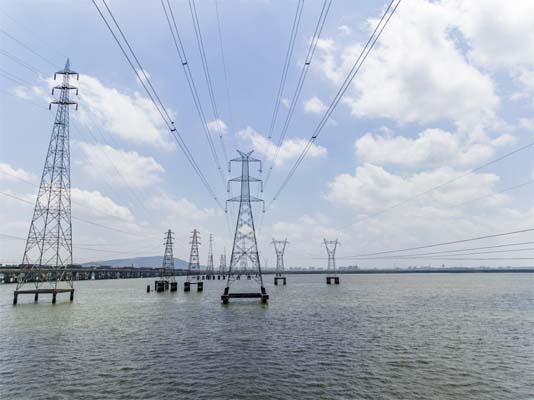
- AESL wins key Maharashtra transmission project through tariff-based competitive bidding
- ₹4,700-crore project to evacuate up to 4,500 MW of pumped-storage potential near Satara
- Network addition includes 562 ckm of transmission lines and 9,000 MVA transformation capacity
- Project to strengthen transmission corridor linking renewable-rich Karnataka with Maharashtra load centres
- AESL transmission orderbook rises to nearly ₹85,000 crore as India accelerates clean-energy build-out
NE BUSINESS BUREAU
AHMEDABAD, AUG 26
A ₹4,700-crore power corridor is set to reshape Maharashtra’s renewable-energy landscape, with Adani Energy Solutions Ltd (AESL) emerging as the lowest bidder for a major transmission project designed to evacuate up to 4,500 MW of renewable and pumped-storage power and strengthen electricity flows between southern and western India.
Green power needs a stronger grid
India’s renewable-energy ambitions are racing ahead—and the power grid must race with them. AESL’s latest ₹4,700-crore transmission win in Maharashtra is aimed at building precisely that missing bridge between green power generation, energy storage and the country’s biggest consumption centres.
Adani Energy Solutions Ltd (AESL), described as India’s largest private transmission and distribution company and part of the Adani portfolio, has won the project to evacuate renewable energy generated in Karnataka to major load centres in Maharashtra. The project will also support the rapidly expanding pumped-storage ecosystem around Satara, Pune and the Mumbai Metropolitan Region (MMR).
Named “Network Expansion Scheme in Western Region to Cater to Pumped Storage Potential near Satara (up to 4500 MW) – Part A”, the project was awarded through the Tariff Based Competitive Bidding (TBCB) route, with AESL emerging as the lowest bidder.
562 CKM lines, 9,000 MVA capacity
Housed under the Special Purpose Vehicle (SPV) Satara Power Transmission Ltd, the project is scheduled to be completed within 36 months.
It will add 562 circuit kilometres (ckm) of transmission lines and 9,000 MVA of transformation capacity to AESL’s portfolio.
With the latest addition, AESL’s cumulative transmission network will rise to 29,739 ckm, while its cumulative transformation capacity will reach 1,43,425 MVA.
The project envisages a 765/400 kV substation at Satara, a Kolhapur-Satara 765 kV double-circuit transmission line, augmentation of the Kolhapur pooling station and associated transmission infrastructure.
Pumped storage gets a transmission backbone
The project assumes significance as pumped-storage power emerges as an important component of India’s strategy to balance intermittent renewable generation.
Explaining the strategic importance of the project, Kandarp Patel, CEO, Adani Energy Solutions Ltd, said:
“Pumped storage projects are emerging as a critical enabler of India’s clean energy transition by providing the flexibility and reliability required to integrate large-scale renewable energy into the grid.”
He said the Satara project would provide the transmission backbone required for both renewable-energy evacuation and energy-storage deployment.
“The Satara transmission project will create a vital transmission backbone to support both renewable energy evacuation and energy storage deployment, strengthening power flows between Southern and Western India.”
Patel added that AESL would continue to focus on transmission infrastructure capable of supporting India’s renewable-energy expansion and long-term decarbonisation objectives.
“AESL remains committed to building future-ready transmission infrastructure that enables renewable energy growth, enhances grid stability and supports India’s long-term decarbonisation goals.”
Orderbook nears ₹85,000 crore
The Maharashtra win further strengthens AESL’s position in India’s rapidly expanding transmission infrastructure market, taking its transmission orderbook to nearly ₹85,000 crore.
The project also comes against the backdrop of India’s target of installing 500 GW of non-fossil energy capacity by 2030, making large-scale transmission networks critical to integrating power generated from geographically dispersed renewable-energy zones.
AESL said it continues to develop specialised transmission schemes designed to connect resource-rich green-energy pockets—including solar, wind and pumped storage—with major industrial and urban load centres across the country.
The Satara project, therefore, is more than another transmission addition: it is designed to strengthen the grid architecture needed to move clean electricity across regions while providing greater flexibility for the integration of renewable and storage capacity.