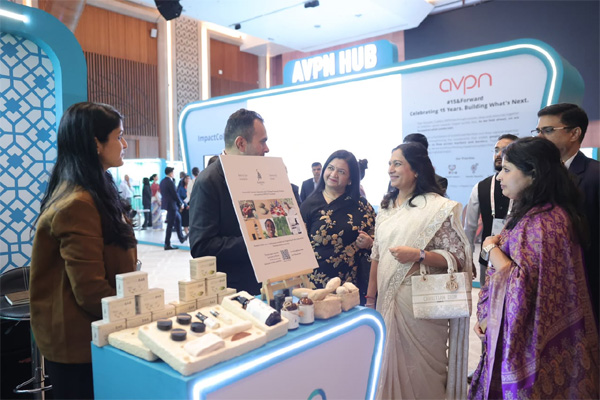
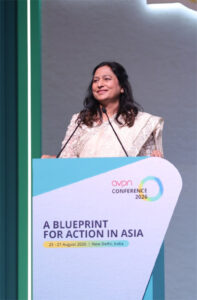
- Adani Foundation hosts AVPN Global Conference welcome dinner at Bharat Mandapam
- Dr Priti Adani calls for a shift from survival funding to “Capital for Capacity”
- Says stronger institutions, skills and systems must power sustainable social impact
- Adani Foundation marks 30 years of grassroots work across 7,200 villages in 22 states
- Global philanthropy leaders urged to collaborate, share knowledge and scale solutions
NE NEWS SERVICE
NEW DELHI, AUG 26:
What if the real measure of philanthropy is not how much money is given away, but how much capacity it creates to make change endure?
That question took centre stage in New Delhi as the Adani Foundation hosted a Welcome Dinner for nearly 2,000 national and international delegates attending the AVPN Global Conference 2026—the first time the flagship gathering of Asia’s social-impact community is being held in India.
Welcoming philanthropists, policymakers, development leaders, social entrepreneurs and corporate representatives at Bharat Mandapam, Dr Priti Adani, Chairperson, Adani Foundation, made a strong case for transforming the way philanthropy is conceived—from funding immediate needs to building the institutions, skills, systems and innovations capable of delivering lasting impact.
“As social challenges become more complex, we must learn from one another, share what works and build partnerships that take impact further,” Dr Adani said, stressing that India’s grassroots experience can offer valuable lessons to Asia and the wider world.
The AVPN Global Conference, organised by Asia’s largest social-impact network, has brought together more than 700 resource providers, innovators and intermediaries from 43 markets, with close to 2,000 participants attending the August 25–26 conference in India.
From “giving” to building capacity
In an address that went beyond conventional philanthropy, Dr Adani argued that the next era of giving must focus on strengthening the ability of communities and institutions to solve problems themselves.
“Our challenge is not scarcity of funds — it is a challenge of strategic allocation,” she said, urging philanthropists to redirect attention towards “Capital for Capacity.”
She called for greater funding for behavioural change, institution building, skill development, innovative solutions, climate action and stronger social systems rather than concentrating solely on short-term survival.
“While funding for survival is certainly important, the need of the hour is to shift to sustainable impact,” Dr Adani said, describing the shift towards capacity-building as the defining feature of the next era of giving.
Her message built on an idea she had raised at the AVPN Global Conference in Hong Kong in 2025—the creation of a Unified Collaboration Platform that would allow philanthropic organisations across Asia to share experience, knowledge and successful models.
India’s grassroots model takes centre stage
Dr Adani also positioned India’s development journey as a story of decentralised innovation, grassroots entrepreneurship and local problem-solving.
She said India’s transformation was increasingly being powered by youth, women, local entrepreneurs and innovators outside traditional metropolitan centres.
“From metros to mandis, from campuses to small towns, India is now innovating everywhere,” she said, pointing to startups working on challenges ranging from waste management and climate change to drinking water, healthcare and agriculture.
She cited the Vande Bharatam initiative launched by Adani Group Chairman Gautam Adani as an example of this entrepreneurial energy. More than 26,000 startups applied to the nationwide search for innovative ideas, with many proposing solutions aimed at social and environmental impact.
At the same time, Dr Adani cautioned that the world is confronting a paradox: unprecedented technological capability and capital coexist with climate instability, widening access gaps and growing concerns over the harmful effects of excessive technology and social-media use.
30 years, 13 million lives
The AVPN engagement coincides with the Adani Foundation completing 30 years of grassroots development.
Established in 1996, the Foundation says its programmes now span education, healthcare, skilling, livelihoods, disability inclusion, community infrastructure, sports and grassroots climate action, reaching more than 7,200 villages across 22 states and over 13 million lives.
The Adani family, led by Gautam Adani, has also committed ₹60,000 crore towards healthcare, skilling and higher education. The plans include Adani Health Cities with 1,000-bed hospitals, research facilities and medical colleges, with the first phase coming up in Mumbai and Ahmedabad, besides a proposed 200-bed hospital in Pirpainti, Bihar.
The Foundation is also pursuing initiatives in eye care, vocational skilling, higher education and women-led entrepreneurship, including an ambition to empower more than one million women entrepreneurs across India.
“Philanthropy is not about changing people’s lives”
Dr Adani drew on a grassroots example to illustrate what capacity-building can achieve.
She narrated the story of Kiran Harinkhede of Churdi village in Maharashtra, who benefited from the Foundation’s Livestock Development initiative through improved cattle breeding and animal healthcare.
Better cattle increased Kiran’s milk production, enabling her to join a women-run dairy enterprise. She now sells 25–28 litres of milk a day to a collection centre, with her increased income helping fund her children’s education.
For Dr Adani, Kiran’s journey captures the essence of effective philanthropy.
“Philanthropy is not about changing people’s lives. It is about giving them the leverage to change their own,” she said.
She linked such economic empowerment to the broader meaning of independence, describing the freedom of choice, opportunity and upward mobility enjoyed by women like Kiran as a deeper expression of freedom.
The philanthropy challenge for Viksit Bharat
Dr Adani said India’s aspiration of becoming a developed nation by 2047 cannot be achieved through larger budgets alone.
“Viksit Bharat will not be built by larger budgets alone — it will be built by stronger institutions,” she said, adding that programmes must be supported by the people and systems capable of making successful interventions endure and scale.
She concluded with a call that placed the responsibility squarely on philanthropy: India has the ambition, communities have the ideas, young people have the energy, and nonprofits have trust and reach.
“Philanthropy must now provide the capacity,” she said.