- Targeting cancer from within: IITGN researchers engineer gold nanorods to home in on the endoplasmic reticulum, a vital cellular machinery
- Two-pronged attack: Nanorods combine targeted delivery of cisplatin and indomethacin with near-infrared light-triggered heat
- Stress pushed to the limit: The platform activates ER stress, reactive oxygen species, autophagy and ultimately apoptosis in cancer cells
- Promising laboratory results: Cell studies show reduced viability across colon, cervical and breast cancer models, with negligible toxicity in non-cancerous cells under experimental conditions
- From Petri dish to patients remains a long road: Animal studies, toxicity and pharmacokinetic assessments are still needed before clinical potential can be established
NE SCIENCE & TECHNOLOGY BUREAU
GANDHINAGAR, AUG 27
What if cancer treatment could be designed not merely to reach a cancer cell, but to strike at one of its most vulnerable internal command centres? Researchers at the Indian Institute of Technology Gandhinagar (IITGN) are exploring precisely that possibility with a nanoscale platform that combines targeted drug delivery and light-triggered heat therapy to attack cancer cells from within.
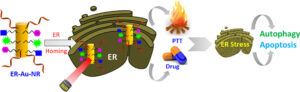
The researchers have developed gold nanorods engineered to specifically target the endoplasmic reticulum (ER) — the cellular structure responsible for protein production and processing — while simultaneously carrying therapeutic agents and generating heat when exposed to near-infrared light.
The study, published in the Journal of Materials Chemistry B, is titled “Endoplasmic reticulum-targeted gold nanorod for chemo-photothermal therapy induces ER stress-mediated autophagy and apoptosis in cancer cells.”
At the heart of the research is an emerging concept known as organelle-targeted nanomedicine, in which therapeutic systems are designed to reach specific structures inside cells rather than simply delivering drugs to the cell as a whole.
Turning the cell’s own machinery into a therapeutic target
The ER plays a crucial role in maintaining cellular function. But when excessive stress disrupts its normal operation, it can trigger biological pathways that eventually result in cell death. The IITGN team sought to exploit this vulnerability by designing a nanomaterial capable of concentrating therapeutic activity at the ER.
Corresponding author Prof Sudipta Basu, Professor in IITGN’s Department of Chemistry, explained the thinking behind the approach: “One of the questions that motivated us was whether we could make a nanomaterial do more than simply carry a therapeutic molecule. We wanted to understand whether its design could also influence how and where that treatment interacts with a cancer cell.”
To achieve this, the researchers used gold nanorods, nanoscale structures known for their ability to absorb near-infrared light and convert that energy into heat.
The nanorods were functionalised with the chemotherapy drug cisplatin, the anti-inflammatory drug indomethacin, and dansyl-sulfonamide. The latter serves a dual purpose: helping direct the nanorods towards the ER and enabling subcellular imaging.
According to the researchers, the work represents the first reported integration of gold nanorods with these drugs for ER-targeted cancer treatment, bringing chemotherapy and photothermal therapy together in a single platform.
Light adds a second strike
The significance of the design lies in its dual mechanism.
Once the nanorods accumulate at the ER, the therapeutic agents can exert their effects while near-infrared irradiation generates localised heat. This photothermal effect adds another source of stress to already vulnerable cancer cells.
In cell-culture experiments, the nanorods rapidly accumulated in the ER and disrupted the cellular protein-processing machinery. This produced substantial ER stress, reflected in elevated levels of several stress-associated markers.
When the cells were additionally exposed to near-infrared light, the researchers observed increased generation of reactive oxygen species (ROS) — molecules capable of causing oxidative stress and cellular damage.
The biological response then progressed through a cascade involving autophagy, the process by which cells break down and recycle damaged components, followed by apoptosis, a controlled form of cell death.
In effect, the researchers were able to combine where the treatment acts with how the treatment is activated, creating a platform designed to intensify stress specifically inside cancer cells.
Promising results across three cancer models
The team tested the nanoplatform in cell models of colon cancer, cervical cancer and breast cancer.
The ER-targeted gold nanorods substantially reduced cancer-cell viability under the experimental conditions, while showing negligible toxicity towards non-cancerous cells.
Lead author Asima Sahu described the cellular-level findings as one of the most rewarding aspects of the research:
“For me, one of the most rewarding aspects of this work was seeing a carefully designed nanoscale system translate into measurable changes at the cellular level. It reinforced how small changes in material design can have meaningful biological consequences.”
Second author Dipannita Chowdhury said the work points towards a broader philosophy for designing future nanomedicines:
“The study has also made us think more broadly about how we can design nanomedicines around the biology of a disease, rather than simply adapting existing treatments to a new delivery system.”
A promising concept — but not yet a cancer treatment
Despite the encouraging laboratory findings, the researchers caution that the technology remains at an early stage.
The experiments were conducted in cell cultures, and therefore do not establish whether the nanorods can safely reach tumours in a living organism, selectively accumulate within cancer cells, remain stable and effective in the body, or eventually be eliminated safely.
Animal studies will be required to investigate these questions, alongside detailed assessments of toxicity, pharmacokinetics, biodistribution and therapeutic efficacy.
Only after such studies can researchers determine whether the platform has realistic potential for eventual clinical development.
The importance of the IITGN work, therefore, lies not in claiming a new cancer cure, but in demonstrating a different way of thinking about cancer nanomedicine: rather than simply transporting a drug into a tumour, can the treatment be engineered to recognise and exploit a specific vulnerability inside the cancer cell itself?
The gold-nanorod platform offers one possible answer. By combining organelle targeting, chemotherapy and light-induced thermal damage, the research demonstrates how material engineering and cell biology can converge to create increasingly precise therapeutic strategies.
Whether that precision can survive the far more complex environment of a living body remains the next — and much harder — question.