

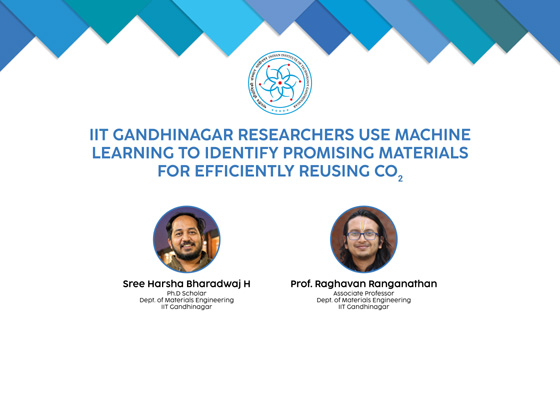
- Machine-learning-accelerated computational screening identifies three high-entropy MBenes that could drive CO₂-to-CO conversion without external electrical push
- From 56 five-metal combinations to 18 viable candidates and three standout compositions, IITGN researchers map a new catalyst landscape
- Cr, Nb, Zr, Mo, Ti, Hf and Ta combinations exploit the ‘cocktail effect’ to activate stubborn CO₂ molecules
- Potential pathway for renewable-powered carbon recycling, with experimental synthesis and electrochemical validation now the next crucial step
- Research opens a new frontier in AI-assisted materials discovery for carbon capture, utilisation and conversion technologies
NE ENVIRONMENT BUREAU
GANDHINAGAR, AUG 28
What if the question is no longer simply how to capture carbon dioxide, but what we can make it do once we have captured it? And what if artificial intelligence and atom-thin materials could help find the answer?
Researchers at the Indian Institute of Technology Gandhinagar (IITGN) are exploring precisely that possibility, using computational materials science and machine-learning-assisted screening to identify three ultrathin, high-entropy two-dimensional materials that show promise for converting CO₂ into carbon monoxide (CO)—an important building block for fuels and industrial chemicals.
The study, published in npj Computational Materials, brings together two intriguing ideas in materials science—MBenes and high-entropy materials—to create a new class of potential electrocatalysts for CO₂ reduction.
What makes the findings particularly striking is the computational prediction that the three shortlisted materials can support a downhill CO₂-to-CO reaction at zero applied potential, meaning the calculations indicate that the conversion does not require an additional electrical push under the modelled conditions. The researchers stress, however, that these are computational predictions and that experimental synthesis and electrochemical testing remain essential next steps.
The CO₂ problem gets a new question
Carbon dioxide is usually framed as a waste gas that must be captured and kept out of the atmosphere. Burning fossil fuels for electricity, transport and industrial activity continues to add substantial quantities of CO₂ to the atmosphere.
But could captured CO₂ instead become a circular carbon resource?
That question has driven growing interest in electrochemical CO₂ reduction, particularly because such processes can potentially be coupled with renewable electricity and operated under relatively mild, water-based conditions.
Among the possible products, carbon monoxide is especially attractive. CO is a major chemical-industry building block and can be combined with hydrogen to produce syngas, which in turn has applications in fuels, chemicals and energy systems.
The problem is fundamental: CO₂ is an exceptionally stable molecule. Breaking its bonds and activating it requires an efficient catalyst capable of transferring the right amount of energy and charge without creating undesirable products.
That is where IITGN’s new computationally identified materials enter the picture.
When two materials strategies collide
The researchers have combined the distinctive characteristics of MBenes with the compositional diversity of high-entropy materials.
MBenes are atomically thin, two-dimensional transition-metal borides. Their exposed surfaces offer potentially useful sites for chemical reactions, while the boron component can influence the electronic behaviour of neighbouring metal atoms.
They are related to the more widely studied MXenes, another family of two-dimensional materials known for useful electrical and chemical properties.
High-entropy materials, meanwhile, deliberately bring several principal elements together. Rather than relying on one dominant metal, their chemically diverse surfaces can provide different environments for different stages of a catalytic reaction.
The IITGN study asks a provocative question: could putting several metals together in an MBene create a catalyst whose different atoms effectively divide the catalytic workload?
According to Sree Harsha Bharadwaj H, “While previous studies have identified promising MBene catalysts, they generally require an extra electrical boost or generate more complex products such as methane and methanol.”
The first author, a fourth-year PhD scholar in IITGN’s Department of Materials Engineering, explained the thinking behind the research: “Hence, we thought about combining the positives of MBenes with those of high-entropy alloys and explored high-entropy MBenes for CO₂ reduction.”
The strategy also deliberately targets CO rather than more complex carbon products, making the proposed pathway particularly relevant to carbon-utilisation systems in which captured CO₂ could become a feedstock for further chemical conversion.
56 combinations enter the computational funnel
The scale of the computational search highlights why machine-learning-assisted materials discovery can be valuable.
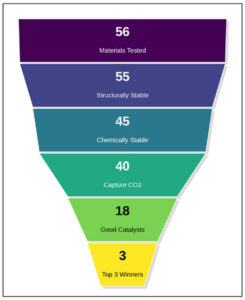
The researchers considered all 56 equiatomic five-metal combinations drawn from an eight-element pool—Ti, V, Cr, Mo, Nb, Ta, Zr and Hf. A multi-stage computational funnel combining density functional theory calculations, formation-energy screening, electronic-structure analysis and free-energy profiling, accelerated by a MACE machine-learning interatomic potential, was used to progressively narrow the field.
The screening ultimately reduced the 56 compositions to 18 viable candidates.
Three emerged as particularly promising:
- CrNbZrMoTiB₅
- MoZrHfNbCrB₅
- MoZrHfTaCrB₅
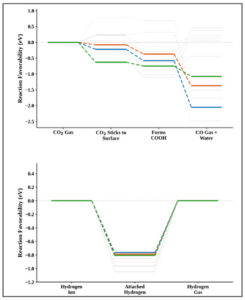
All three showed computationally favourable, downhill free-energy profiles for CO₂-to-CO conversion at zero applied potential.
In simple terms, the calculations suggest that these materials could activate CO₂ without requiring the additional electrical input that many catalytic systems need.
The ‘cocktail effect’: when every metal gets a job
Why should mixing several metals work better than relying on one?
The researchers point to the so-called “cocktail effect” in multi-element materials.
Imagine trying to open a tightly sealed jar. Too little force achieves nothing; too much may cause damage. The trick is to have the right combination of grip and force.
A similar principle appears to emerge at the atomic level in these high-entropy MBenes.
The computational analysis indicates that chromium can provide a preferred site for CO₂ adsorption, while zirconium and hafnium can donate electron density towards the chromium-centred active site. This electronic cooperation helps stabilise the key COOH* intermediate involved in the reaction.
In other words, the atoms may not all be doing the same job. Instead, their different electronic characteristics could allow them to work together—one helping bind the molecule, another helping transfer charge and another helping stabilise reaction intermediates.
That ability to break away from the conventional behaviour of single-metal catalysts is one of the most intriguing aspects of the study.
From captured carbon to useful carbon
The potential significance extends beyond a laboratory catalyst.
Carbon monoxide produced from captured CO₂ can serve as an intermediate for producing a range of fuels and chemicals. One important downstream product is syngas, a mixture that can be used in chemical synthesis and energy applications.
If such CO₂ conversion technologies can ultimately be coupled with renewable electricity, they could form part of a broader carbon capture, utilisation and conversion ecosystem, in which carbon is not simply removed from an industrial stream but circulated back into productive use.
That vision is still some distance from commercial deployment. Catalyst stability, real-world reaction rates, selectivity, synthesis, scalability and performance under operating conditions all need to be established experimentally.
For the IITGN researchers, therefore, the present work represents a materials-discovery roadmap rather than a finished technology.
A computational breakthrough that now needs a laboratory test
Dr Raghavan Ranganathan, Associate Professor in IITGN’s Department of Materials Engineering and Principal Investigator of the Computational Molecular Engineering Group, sees the broader possibility clearly.
“This possibility is thought-provoking as such approaches may contribute to a future in which captured CO₂ can be circulated back into the economy. While our calculations establish a promising picture, future studies should consider experimental synthesis and electrochemical testing.”
That caveat may be as important as the discovery itself.
The research does not claim that the three materials have already demonstrated industrial CO₂ recycling. Instead, it shows how machine learning, first-principles calculations and high-entropy materials design can dramatically narrow an enormous materials search space and identify candidates worthy of experimental investigation.
The study also illustrates the growing convergence of artificial intelligence and materials science: rather than experimentally making thousands of possible materials and testing them one by one, computational tools can help identify the most promising candidates first.
For a climate challenge as enormous as CO₂ accumulation, that ability to search smarter before building in the laboratory could prove as important as the catalyst itself.
The researchers acknowledged the Param Ananta supercomputing facility at IITGN, supported by the National Supercomputing Mission, for providing the computational resources used for the simulations.