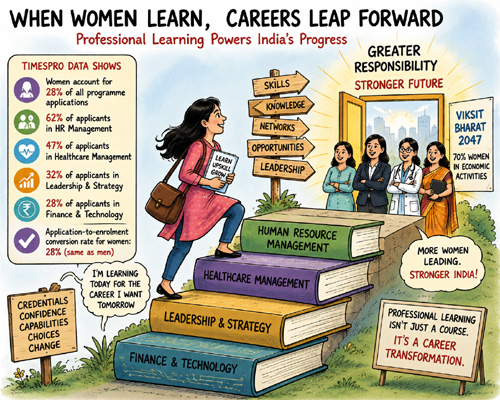
- Women account for 28% of all TimesPro programme applications, signalling a stronger appetite for structured career advancement
- HR emerges as a women-led learning frontier with 62% of applicants, while healthcare follows closely at 47%
- Leadership and strategy attract 32% women applicants; finance and technology register 28%, pointing to wider ambitions
- Equal 28% application-to-enrolment conversion rate for women and men highlights strong follow-through
- Professional learning increasingly becomes a strategic career lever as India pursues a more inclusive, women-powered workforce
NE WOMEN EMPOWERMENT BUREAU
MUMBAI, AUG 28
What happens when professional learning stops being merely a way to add another certificate to a résumé and becomes a deliberate strategy for deciding how far a career can go? TimesPro’s latest application data offers an intriguing answer: increasingly, Indian women are using learning to redraw the boundaries of their professional ambitions.
Women now account for 28% of all programme applications on TimesPro, with their participation extending across healthcare, human resources, leadership, finance, technology and project management. The pattern is particularly striking in sectors linked to people, organisations and care, but the numbers also show women making their presence felt in disciplines such as finance, technology and strategy, where female representation has traditionally been more uneven.
The trend arrives at a time when women’s economic participation has moved increasingly to the centre of India’s development agenda. The Union Budget 2025–26 placed women-led development within the broader Viksit Bharat vision, with an ambition of having 70% of women engaged in economic activities by 2047.
But achieving that ambition involves far more than bringing women into the workforce. The larger challenge is enabling them to stay, advance, lead and assume greater responsibility across industries.
That is where professional learning could become a significant career lever.
Structured, credential-backed programmes can enable professionals to deepen domain expertise, acquire capabilities for evolving roles and strengthen their credibility as they navigate career transitions, leadership responsibilities and increasingly technology-driven workplaces.
HR leads the women’s learning surge
The strongest female participation in the TimesPro data appears in human resource management, where women constitute 62% of programme applicants—making them a decisive majority.
The number is significant because HR itself has evolved dramatically. Once viewed largely through an administrative lens, the function today sits closer to the heart of organisational strategy, talent management, workplace culture, employee experience and business transformation.
Women’s strong presence in HR learning therefore reflects not simply participation in an established domain, but an appetite to strengthen expertise in a function increasingly influential in shaping organisations.
Healthcare management follows closely, with women accounting for 47% of applicants. The figure mirrors women’s substantial presence in healthcare while pointing towards growing interest in developing management capabilities alongside domain expertise in a sector undergoing rapid professionalisation and transformation.
The ambition extends beyond traditional boundaries
The data becomes even more revealing when it moves into disciplines where gender representation has historically been less balanced.
Women account for 32% of applicants to leadership and strategy programmes, indicating that professional learning is increasingly being viewed as a route towards broader decision-making and managerial responsibility.
In finance and technology, women represent 28% of applicants—a signal that their learning choices are not confined to traditionally female-dominated professional domains.
The figures collectively suggest a widening career canvas: women are not merely seeking to deepen existing expertise but are also building capabilities that could help them transition into leadership, strategy and technology-oriented roles.
Applying is only half the story—follow-through matters
Another data point adds weight to the trend.
The application-to-enrolment conversion rate for women stands at 28%, exactly the same as for men.
That parity is significant. It suggests that once women make the decision to explore professional learning, their follow-through is comparable with that of male applicants.
The numbers therefore tell a story not merely of interest but of intent—women are evaluating structured professional education, applying for programmes and converting that interest into enrolment at a rate comparable with men.
Learning as a career strategy
Dr. Brillian S.K., Chief People Officer and Head – Places & Processes, TimesPro, said, “What interests me most is not only where women are applying, but the seriousness with which they are making those choices. We are seeing women invest in capabilities that can broaden the scope of their careers, from people leadership and healthcare to finance, AI-led technology and strategy. It tells us that professional learning is becoming an important part of how women prepare themselves for greater responsibility and longer-term career progression.”
Her observation captures the larger significance of the data.
The numbers are not simply about how many women are enrolling in individual programmes. They point towards a changing relationship between learning, employability and career ambition.
For women navigating an evolving labour market, professional education can provide a structured pathway to refresh skills, acquire new capabilities, build confidence in unfamiliar domains and strengthen their readiness for more complex roles.
It cannot, by itself, eliminate the structural barriers that affect women’s workforce participation or career progression. But credible and relevant professional learning can become one component of a much broader ecosystem that helps women remain competitive, move across functions and prepare for leadership.
From participation to progression
India’s aspiration for a more women-powered economy ultimately depends on what happens after women enter the workforce.
Can they remain?
Can they move into higher-value roles?
Can they cross traditional sectoral boundaries?
Can they acquire the skills demanded by technology-led workplaces?
And can learning become a bridge between employment and leadership?
TimesPro’s application data offers an early glimpse of how women may be answering some of those questions themselves.
The emerging pattern is unmistakable: women are increasingly approaching professional learning not as a peripheral qualification, but as a deliberate investment in career mobility, capability and future responsibility.
And if that momentum continues, the classroom—physical or digital—could become one of the less obvious but increasingly important arenas in which India’s women-led workforce transformation is being shaped.