NE NEWS SERVICE
NEW DELHI/KATHMANDU, AUG 27
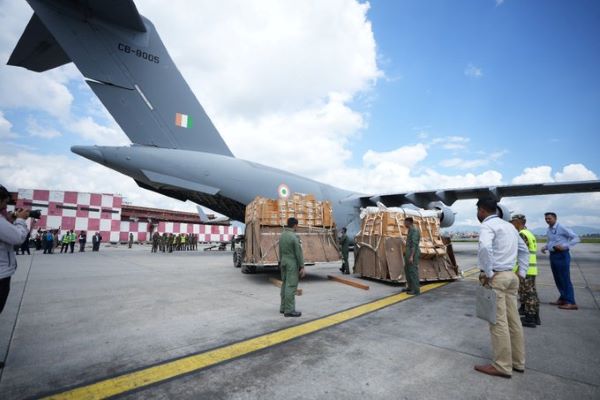
When floodwaters erase roads, homes and entire stretches of a pilgrimage route, the first response cannot wait for the waters to recede. It has to reach survivors while there is still hope. In a swift humanitarian response to Nepal’s devastating flash floods, India has sent a second aircraft loaded with 37.5 tonnes of relief material, medicines and food packets, even as the death toll climbed to 162 and hundreds — including a large number of Indians — remained unaccounted for.
A helping hand from India
The second consignment of 37.5 tonnes of HADR material, medicines and food packets has been handed over to Mr. Mahabir Pun, Minister for Science, Technology and Innovation to support Nepal’s flood relief and rescue efforts.
India remains committed to… pic.twitter.com/pYAp4YBjMX
— Randhir Jaiswal (@MEAIndia) August 27, 2026
The latest airlift follows an initial 10-tonne consignment dispatched on Wednesday, taking India’s relief assistance to 47.5 tonnes in two days.
- Aid takes to the skies: India sends a second relief flight carrying 37.5 tonnes of HADR material, medicines and food packets, following Wednesday’s 10-tonne consignment
- A neighbour in distress: New Delhi remains in close coordination with Kathmandu as rescue teams race to locate hundreds missing after the Bhote Koshi–Trishuli disaster
- “We will continue to strongly support”: Jaishankar reaffirms India’s commitment as the death toll reaches 162 and the scale of devastation continues to emerge
- 300 Indians among those untraced: Nepal’s Foreign Minister Shisir Khanal says nearly 300 Indian tourists are among thousands reported missing, many of them Kailash Mansarovar pilgrims
- Help for families amid the heartbreak: Indian Embassy activates emergency channels while Nepal’s authorities and tourism agencies strengthen assistance for stranded and missing travellers
The disaster has developed into a major cross-border humanitarian emergency, with the raging waters of the Bhote Koshi and Trishuli river systems tearing through communities, damaging infrastructure and cutting vital routes near the Nepal-Tibet border.
External Affairs Minister S Jaishankar underlined that India’s response would continue for as long as necessary.
“A second flight has just taken off, carrying 37.5 tonnes of HADR material, medicines & food packets for Nepal.”
He added: “India remains in close and continuous touch with the Nepalese authorities. We will continue to strongly support the ongoing relief efforts.”
From aid flight to a lifeline
The second sortie marks a rapid escalation of India’s humanitarian assistance as rescue operations confront an unprecedented challenge.
The first consignment of 10 tonnes was formally handed over by India’s Ambassador to Nepal Naveen Srivastava to Nepal’s Minister for Culture, Tourism and Civil Aviation Khadka Raj Poudel.
The relief material is intended to support communities hit by flooding and landslides, providing essential supplies at a time when normal supply chains have been severely disrupted.
The response reflects the practical side of India’s Neighbourhood First approach — translating diplomatic solidarity into food, medicines and emergency supplies when a neighbouring country is facing catastrophe.
India’s assistance comes as Nepal struggles to assess the full extent of the destruction. Reports indicate that entire settlements, bridges, roads and other infrastructure have been swept away or damaged, while rescue teams are working in extremely difficult terrain.
162 dead — and the number of missing still moving
Nepal Police said Thursday that 162 bodies had been recovered from areas downstream of the Bhote Koshi and Trishuli river systems, with recoveries reported across districts including Rasuwa, Nuwakot, Dhading, Chitwan, Gorkha, Tanahu and both Nawalparasi districts.
But the death toll tells only part of the story.
Nepal’s Foreign Minister Shisir Khanal said nearly 300 Indians were among thousands reported missing.
“Thousands of families have lost homes and are missing as of now. We are still trying to ascertain the full extent of the disaster.”
The figures have continued to evolve as rescue teams reach previously inaccessible areas. Reuters reported that nearly 1,500 people were missing across Nepal and Tibet, including more than 700 foreign nationals, underscoring the extraordinary international dimension of the catastrophe.
Indians among those caught in the pilgrimage corridor
The disaster has struck a route used by tourists and pilgrims travelling towards Kailash Mansarovar, turning a sacred journey into an agonising search for missing family members.
Earlier estimates indicated that at least 133 Indians and 37 NRIs were among nearly 500 people reported missing, with at least 50 Indians identified as Kailash Mansarovar pilgrims. Later, Nepal’s Foreign Minister put the number of missing Indian tourists at nearly 300, illustrating how rapidly the situation has been evolving.
Among those unaccounted for is an 80-member group associated with the Isha Foundation, according to Sadhguru Jaggi Vasudev, who has appealed for permission to travel to the affected Gyirong area with a small team of volunteers.
The tragedy has therefore acquired a deeply personal dimension for families across India and several other countries.
Embassy turns into a help desk for anxious families
As the rescue operation continues, the Embassy of India in Kathmandu has been coordinating with the Nepalese authorities to locate and assist affected Indian nationals.
The embassy issued emergency contact numbers for families seeking information about Indians caught in the disaster:
+977 985 131 6807
+977 970 910 7500
The Nepal Tourism Board has also activated emergency channels, including 1234, hotline 1144 and Tourist Police number 9851289445. For Indians seeking assistance from China, the Embassy of India in Beijing has provided WhatsApp contact at 0086 185 1428 4905.
The Kathmandu mission has said it remains engaged with the Nepal government and that rescue and relief efforts are being strengthened in coordination with the authorities.
For families waiting thousands of kilometres away, these numbers are more than helplines. They are currently the only available bridge between uncertainty and information.
A disaster that crossed borders — and demands a collective response
The scale of the destruction has also made clear that this is not simply a conventional monsoon flood.
The latest reporting indicates that the catastrophe was triggered by a glacial collapse/debris flow in the Himalayan region, sending an enormous surge downstream and devastating communities along the Nepal-Tibet border.
The flood destroyed roads and bridges, disrupted hydropower infrastructure and isolated communities precisely when rescue teams needed access most urgently.
The continuing danger is compounded by difficult terrain, unstable river systems and the possibility of further flooding.
That is why the speed of humanitarian assistance matters.
Food has to reach those who have lost kitchens. Medicines have to reach those who have lost access to hospitals. Rescue equipment has to reach places where roads no longer exist. And information has to reach families who have been left staring at silent telephones.
India’s helping hand — from the sky to the ground
India’s second relief flight is consequently more than another cargo movement.
It is a signal that humanitarian assistance must move at the speed of disaster.
From the first 10-tonne consignment to the latest 37.5-tonne airlift, New Delhi has sought to combine emergency relief with diplomatic and consular support for those caught in the catastrophe.
The next challenge will be even harder: ensuring that relief material reaches devastated communities, strengthening search-and-rescue operations and accounting for those still missing.
For Nepal, the Himalayan disaster has left behind a landscape of mud, debris and shattered lives.
For India, it has created another urgent responsibility — to stand beside a neighbour when the neighbour needs a helping hand most.
And as rescue teams continue their search, the most important cargo moving across the Himalayas is not merely food or medicine.