NE DEFENCE BUREAU
NEW DELHI, AUG 28
India has built the muscle to manufacture more defence equipment at home. Now it is widening the gateway to sell that capability to the world — with a sweeping overhaul of defence export procedures designed to cut red tape, open markets, accelerate overseas business and turn ‘Make in India’ into a stronger source of foreign-exchange earnings.
The Department of Defence Production, Ministry of Defence has undertaken a comprehensive set of reforms to simplify the Defence Export Standard Operating Procedure (SOP) and the Open General Export Licence (OGEL) framework, in line with Prime Minister Shri @narendramodi’s vision…
— रक्षा मंत्री कार्यालय/ RMO India (@DefenceMinIndia) August 28, 2026
The Department of Defence Production, Ministry of Defence, has unveiled a comprehensive set of reforms to the Defence Export Standard Operating Procedure (SOP) and the Open General Export Licence (OGEL) framework, marking a significant push to make Indian defence manufacturers faster, more flexible and more competitive in international markets.
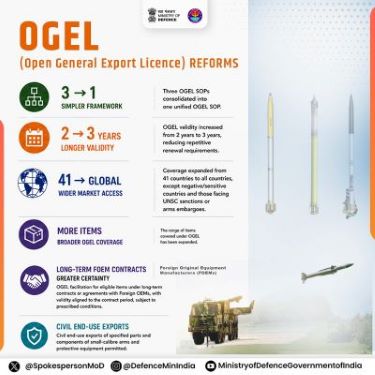
India simplifies its #DefenceExport SOP and Open General Export License (OGEL) framework to reduce procedural burden, expand global market access and empower Indian defence manufacturers.
• OGEL validity extended 2 → 3 years
• Coverage expanded from 41 countries to almost all… pic.twitter.com/Z2XUvWFhMh— Ministry of Defence, Government of India (@SpokespersonMoD) August 28, 2026
- Big SOP and OGEL reforms slash procedural friction, widen overseas market access and give Indian defence makers a faster route to international business
- Less paperwork, longer licences and wider country coverage strengthen India’s pitch as a trusted global defence manufacturing partner
- OGEL validity extended from two to three years as three separate procedures are merged into one unified framework
- Coverage jumps from 41 countries to virtually the entire global market, excluding sensitive, sanctioned and embargoed destinations
- MSMEs get greater room to chase international tenders, exhibitions and legitimate export opportunities
- ₹1.78 lakh crore record defence production and ₹38,424 crore exports provide the springboard for the next big leap: earning more foreign exchange
The reforms, undertaken under the guidance of Defence Minister Rajnath Singh, seek to reduce repetitive procedural requirements, facilitate quicker access to overseas markets and enable Indian companies to respond more effectively to international business opportunities.
The larger objective is clear: build an Indian defence industry that is not merely self-reliant, but export-driven, globally competitive and capable of generating substantial foreign-exchange earnings.
Red tape gets a strategic trim
Under the revised Defence Export SOP, stakeholder consultation has been dispensed with for exports of non-lethal defence items to most destinations, while appropriate safeguards remain for sensitive countries.
A major facilitation has also been introduced for international tenders and exhibitions.
Stakeholder consultation has been dispensed with for exports of all items for international tenders and exhibitions, allowing Indian companies to showcase their products and pursue overseas opportunities more expeditiously.
In the high-speed global defence marketplace, where tenders and procurement windows can open and close quickly, such procedural flexibility could prove particularly valuable.
For Indian manufacturers, the reform means a greater ability to respond when the opportunity arises rather than after the opportunity has passed.
OGEL gets a one-stop makeover
The Open General Export Licence is at the centre of the reform package.
OGEL is a standing, one-time export authorisation that enables eligible exporters to self-generate export authorisations for multiple consignments of specified defence items, eliminating the need to seek a separate authorisation for every consignment.
The government has now moved to make this mechanism simpler and more predictable.
Three existing OGEL SOPs covering major platforms and equipment, parts and components, and intra-company transfer of technology have been consolidated into one unified OGEL SOP.
For exporters, the message is simple: fewer procedural lanes, one common framework.
Two years becomes three
The validity of OGEL has been increased from two years to three years.
The longer validity period reduces the frequency of renewals and associated compliance requirements, allowing eligible exporters to plan international business with greater certainty.
For companies operating in global supply chains, where contracts, production schedules and shipments often extend over long periods, that additional year can provide meaningful administrative flexibility.
41 countries to a global market
Perhaps the most striking change is the expansion of OGEL geographical coverage.
The framework has been expanded from 41 countries to all countries, except negative or sensitive nations and those facing UN Security Council sanctions or arms embargoes.
The reform potentially gives Indian defence manufacturers access to a far larger universe of legitimate international markets while retaining restrictions where strategic and national-security concerns require them.
The objective is therefore not unrestricted exports.
It is wider legitimate access with safeguards intact.
A new window for global OEM deals
The revised framework also creates a new provision for Indian companies that have long-term contracts or agreements with Foreign Original Equipment Manufacturers (FOEMs).
OGEL may be granted for eligible items and the particular FOEM, with its validity aligned with the underlying contract or agreement, subject to prescribed conditions.
The provision could facilitate greater continuity for Indian companies participating in international manufacturing and defence supply chains.
The range of items covered under OGEL has also been expanded, providing eligible exporters with greater flexibility.
The revised framework further permits civil-end-use exports of specified parts and components of small-calibre arms and protective equipment, creating additional legitimate avenues for international business.
MSMEs get a bigger export window
India’s defence manufacturing ecosystem includes a large network of MSMEs, many of which have developed specialised components, technologies and engineering capabilities.
For these companies, the cost of navigating repeated authorisations can be particularly significant.
Reducing repetitive procedures and expanding market access could help smaller manufacturers respond more rapidly to international tenders, exhibitions and overseas buyers.
That could be crucial in transforming India’s defence MSME network from a largely domestic supplier base into a stronger participant in global supply chains.
The potential payoff is not merely more contracts.
It is more production, greater economies of scale, more jobs, deeper technology capability and higher export earnings.
Security remains the red line
The government’s export facilitation push does not remove national-security controls.
The revised framework continues to retain appropriate safeguards for sensitive items, technologies and destinations.
Countries subject to UN Security Council sanctions or arms embargoes, as well as specified negative and sensitive destinations, remain outside the expanded OGEL coverage.
The policy therefore seeks to strike a deliberate balance: facilitate what can safely be exported and tightly control what must remain protected.
₹1.78 lakh crore production. Now, the global market
The reforms come as India’s defence manufacturing sector is already operating at record levels.
Defence production has reached an all-time high of ₹1.78 lakh crore, while defence exports touched a record ₹38,424 crore in FY 2025-26.
That creates an unusually powerful platform for the next phase of India’s defence-industrial journey.
The challenge now is to convert manufacturing scale into international market share.
Every additional export contract can mean more foreign exchange flowing into India, larger production runs for domestic manufacturers, stronger global credibility for Indian brands and deeper integration into international defence supply chains.
Atmanirbharta now needs an export engine
India’s defence strategy has undergone a fundamental transformation over the past decade.
The emphasis was initially on reducing dependence on imports and building domestic manufacturing capability.
That foundation has now created a new opportunity.
Atmanirbharta can become the platform for export-led growth
The latest SOP and OGEL reforms are designed to remove some of the procedural barriers standing between Indian manufacturers and global buyers.
The ultimate test will be whether Indian companies can convert the new flexibility into contracts, exports, foreign-exchange earnings and enduring global market presence.
The opportunity is enormous.
India has built the factories. It has developed the technology. Production is at record levels. Exports are rising.
Now comes the bigger challenge — turning ‘Made in India’ defence capability into a global revenue engine.