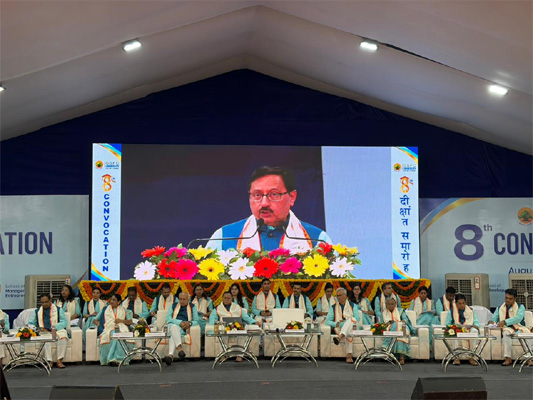
- Padma Bhushan Dr V. K. Saraswat urges 815 graduates to turn knowledge, technology and innovation into solutions for a changing India
- GSFC University President P. K. Taneja tells graduates: “Your degree marks not an end, but the beginning”
- Women steal the academic spotlight, capturing 12 of 17 Gold Medals at the 8th Convocation
- Chief Guest calls for continuous learning, scientific temperament, digital skills, critical thinking, resilience and uncompromising integrity
- University expands from two programmes to 26, with more than 3,400 students and strong industry-academia engagement
NE EDUCATION BUREAU
VADODARA, AUG 29
“Your degree marks not an end, but the beginning”—with those morale-boosting words, GSFC University President P. K. Taneja sent 815 graduates into a future of opportunities and responsibilities, while Chief Guest Padma Bhushan Dr V. K. Saraswat challenged them to go a step further: keep learning, keep innovating and use their knowledge to help build a technologically stronger and self-reliant India.
The message resonated powerfully at the 8th Convocation Ceremony of GSFC University at Fertilizernagar, Vadodara, where 815 students received their degrees and were urged to view graduation not as the culmination of education but as the launchpad for a lifetime of learning, innovation and nation-building.
The ceremony also produced a striking academic achievement by women graduates, who secured 12 of the 17 Gold Medals, underlining their outstanding performance across the University’s academic programmes.
“Your degree marks not an end, but a beginning”
Addressing the graduating batch, P. K. Taneja, IAS (Retd.), President, GSFC University, congratulated all 815 graduates, including the 17 Gold and 15 Silver Medallists, while acknowledging the contribution of parents, faculty members and mentors behind their success.
His message was both celebratory and challenging.
“Your degree marks not an end, but the beginning of a journey of opportunities, aspirations and responsibilities.”
Taneja urged the graduates to carry forward the University’s three strategic pillars—Industry-Aligned, Technology-Driven and Future-Ready—as they enter professional life.
“As you step forward, remain Industry-Aligned, Technology-Driven and Future-Ready. Continue to learn, adapt and grow, but never lose sight of the importance of character and quality.”
He also called upon the graduates to become proud representatives of the institution wherever their careers take them.
“We expect each of you to carry the values of GSFC University with pride and become an outstanding ambassador of the University wherever your journey takes you.”
The President’s message effectively transformed the traditional convocation farewell into a call to lifelong learning, professional excellence and personal character.
Saraswat’s pep talk: Turn knowledge into national power
The keynote challenge came from Padma Bhushan Dr V. K. Saraswat, former Director General, DRDO and former Member of NITI Aayog, who urged the graduates to recognise that their degrees carry a responsibility far greater than personal career advancement.
His central message was unmistakable: knowledge has value only when it is converted into innovation, solutions and social impact.
“Your degree is not merely a qualification; it is a responsibility to use knowledge, innovation and technology to create meaningful impact.”
With India pursuing the ambitious goal of Viksit Bharat @ 2047, Saraswat told the young graduates that their generation would occupy a defining position in the country’s technological and economic transformation.
“As India moves towards Viksit Bharat @ 2047, your generation will play a defining role.”
But the former DRDO chief’s message was not simply about technology.
He urged the graduates to develop a mindset of continuous learning and adaptation in a world where technological change is accelerating rapidly.
“Continue to learn, adapt and innovate, but never compromise on integrity and character.”
His advice placed scientific and technological capability alongside the human qualities needed to use that capability responsibly.
“Let your knowledge solve meaningful problems, let your leadership inspire others, and let your success contribute to the progress of our nation.”
Women take centre stage with 12 gold medals
The academic honours at the convocation delivered another powerful message.
Of the 17 Gold Medals awarded to outstanding performers, 12 went to female students.
The achievement places the University’s women graduates firmly in the spotlight and demonstrates the increasingly strong role being played by women in technology, science, management and other professional disciplines.
A total of 15 Silver Medals were also conferred.
The 815 graduating students comprised 488 male and 327 female students, representing the School of Technology, School of Science, and School of Management and Entrepreneurship.
The medal tally offered a particularly encouraging signal to young women aspiring to careers in science, technology, engineering and management.
From two programmes to 26: A university in transformation
The convocation also provided an occasion to take stock of GSFC University’s evolution over the past 11 years.
According to Taneja, the University has grown from two academic programmes to 26 programmes, with its student strength now exceeding 3,400.
The transformation has been driven around three strategic pillars:
Industry-Aligned.
Technology-Driven.
Future-Ready.
The University has sought to strengthen these pillars through industry collaborations, experiential learning, research, innovation and specialised learning facilities.
The institution’s industry-oriented approach has also translated into strong placement outcomes, with 100% placement achievement reported in B.Tech Chemical Engineering, B.Tech Fire & EHS and M.Sc Chemistry.
The emphasis reflects a broader shift in higher education—from simply awarding degrees to preparing students for rapidly changing professional environments.
From classroom knowledge to real-world solutions
Saraswat appreciated GSFC University’s emphasis on experiential learning and industry engagement, along with its research initiatives and specialised learning infrastructure.
His message to the graduates reinforced why these elements matter.
Today’s professionals are entering a world where artificial intelligence, advanced manufacturing, digital technologies, automation, climate challenges and emerging scientific disciplines are constantly reshaping the workplace.
In such an environment, a degree can open the first door—but adaptability determines how far a graduate travels.
Saraswat therefore emphasised scientific temperament, digital skills, critical thinking, collaboration and resilience, while placing integrity and character at the top of the list.
His appeal was ultimately to transform education into action: identify meaningful problems, develop solutions and use professional success to create value for society.
815 graduates, countless futures
The 8th Convocation marked the transition of 815 students from university life into diverse professional and academic pathways.
Some will enter industry. Others will pursue higher education and research. Some may become entrepreneurs, while others will build careers in specialised professional fields.
But the messages from the dais converged on a common theme: the real test of education begins after graduation.
The certificate can confirm what a student has learnt.
The years ahead will reveal what the graduate chooses to do with that knowledge.
For GSFC University, the challenge now is to ensure that its expanding academic ecosystem continues to produce graduates who are not merely employable, but innovative, ethical, adaptable and capable of contributing to India’s development.
A convocation with a larger calling
The ceremony brought together members of the University’s Governing Body and Board of Management, government officials, senior GSFC Limited and GSFC University officials, industry leaders, faculty and non-teaching staff, graduating students and their parents.
Vice Chancellor Professor G. R. Sinha presented the University Report, outlining the institution’s academic growth, achievements, research initiatives, industry engagement and student-development milestones.
Registrar Manish Pradhan proposed the vote of thanks, expressing gratitude to the Chief Guest, dignitaries, University leadership, staff members, parents and graduates.
But beyond the ceremonial robes, medals and degrees, the 8th Convocation left the graduating class with a more demanding assignment.
Keep learning. Keep questioning. Keep innovating. Build character. Solve real problems. And make success count for something larger than yourself.
For the 815 graduates, the campus chapter may have ended.
The real examination has just begun.