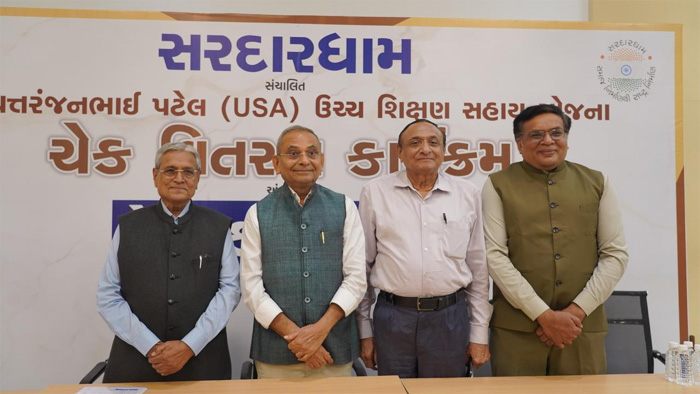
- Higher-education assistance reaches meritorious, economically needy students across Gujarat, with medical, IIT, engineering and other professional courses in focus
- Scheme opens its doors to students of all castes and communities, turning financial aid into an instrument of equal opportunity
- Sardar Patel’s historic call for financial grants to ease educational disadvantage finds a contemporary echo in Sardardham’s initiative
- 205 medical aspirants, 661 engineering/IIT/architecture students and 284 others among 1,150 beneficiaries of ₹5-crore assistance
R MANICKAVASAGAM
AHMEDABAD, AUG 29
A brilliant student should not have to abandon a dream because the family cannot afford the journey to the classroom. That simple but powerful proposition lies at the heart of Sardardham’s latest education initiative—₹5 crore in assistance aimed at ensuring that merit gets the opportunity to flourish, irrespective of caste or community.
In a significant investment in education, social mobility and inclusive growth, Sardardham has extended higher-education assistance totalling ₹5 crore to 1,150 meritorious and economically needy students for the academic year 2026-27 under the Dr. Chitranjanbhai Patel (USA) Higher Education Assistance Scheme.
The initiative assumes added significance because Sardardham explicitly opens the scheme to students of all castes and communities in Gujarat, with selection based on academic merit, economic need and verification of eligibility.
It is an approach that turns philanthropy into something much larger than financial charity: an investment in human potential.
When money must not decide who gets to study
Pramukh Sevak Gagji Sutaria said the beneficiaries were selected on the basis of academic performance and parental income.
“We have selected 1,150 students on the basis of Higher Secondary Examination marks and the parental income. The scholarship will be offered during the entire course of their study.”
That commitment to assistance throughout the course is particularly important for families facing the continuing financial burden of professional and higher education.
For a student who has earned admission through merit, the biggest obstacle can sometimes begin after the examination—with tuition fees, books, accommodation and other recurring educational expenses.
The Sardardham model seeks to address precisely that gap.
Its official scholarship framework states that the programme is designed to support “needy and meritorious students from all communities”, helping them pursue higher studies and build a strong academic and professional foundation. It describes education as “the most powerful tool of social upliftment.”
Patel’s words, a timeless message
The philosophy behind such assistance finds a striking resonance in the words of Sardar Vallabhbhai Patel, the Iron Man of India, during the Constituent Assembly debates of August 28, 1947.
While placing before the Assembly a provision concerning a statutory commission to study the difficulties of socially and educationally backward classes and recommend measures, including financial grants, Patel said:
“This is also an administrative provision for the benefit of the oppressed and the backward classes.”
Patel’s words were spoken in a specific constitutional context and should not be presented as though he were commenting on a modern scholarship programme. Yet the underlying principle remains remarkably relevant: financial support can be an instrument for removing educational disadvantage and expanding opportunity.
That principle finds a contemporary expression in Sardardham’s effort to ensure that economic weakness does not extinguish academic ambition.
1,150 students, a broad educational canvas
The ₹5-crore assistance package reaches students across a wide range of higher-education disciplines.
| Course / stream | No. of students |
| Medical | 205 |
| Engineering / IIT / Architecture | 661 |
| Pharmacy | 29 |
| Other Science streams | 31 |
| BCA / Other General streams | 224 |
| Total | 1,150 |
The numbers reveal the scale and diversity of the intervention.
As many as 661 students pursuing engineering, IIT and architecture constitute the largest group, while 205 medical students represent another substantial cohort of future doctors.
Pharmacy, science, BCA and other general streams are also covered, allowing students with different academic aspirations to benefit.
The scheme’s official eligibility framework covers higher-education pathways, including medical, engineering, pharmacy, architecture, IIT, IIM and other recognised courses.
From one donor’s vision to a collective education movement
The initiative has its roots in financial support provided by Dr. Chitranjan Patel, a US-based Gujarati, for bright students requiring financial assistance for higher education. Sardardham says the scholarship began in 2024 and is open to students across Gujarat’s castes and communities. (Sardar Dham)
The 2026-27 assistance has also received support from several donors, including Chimanbhai J. Agrawal, Dr. K. R. Shroff Foundation, AIA CSR Foundation, Meghmani Family and Poonamchandbhai Patel, among others.
Their contributions demonstrate the power of collaborative philanthropy: when individual generosity is channelled through an organised platform, it can reach hundreds of deserving young people simultaneously.
The message to other philanthropists is equally compelling—supporting education creates a multiplier effect that can continue for generations.
Why inclusive growth begins with education
Sardardham’s decision to make the scheme available to students from all castes and communities is perhaps its most consequential social dimension.
Its official scholarship portal expressly says students from any caste or community in Gujarat who are economically weaker and meritorious can apply. The stated annual family-income ceiling for the current scheme is ₹6 lakh, while applications are assessed on academic merit, family income, eligibility and document verification.
This approach places the emphasis where it arguably belongs: on the student’s potential and need.
A student who becomes a doctor, engineer, architect, scientist, entrepreneur or other professional does not merely change his or her own economic circumstances. That achievement can strengthen an entire family and, ultimately, contribute to the larger economy and society.
Education therefore becomes the bridge between individual merit and collective progress.
The real return on ₹5 crore
The most important question is not how much money has been distributed.
It is what that money can set in motion.
One scholarship can help a student complete medical school. Another can help an aspiring engineer remain in college. Another can enable a young person to pursue IIT or architecture. Each represents a potential professional, employer, innovator, researcher, teacher or public servant of tomorrow.
The return on such philanthropy cannot be captured immediately in financial statements.
It appears years later—in patients treated, technologies developed, businesses created, students taught, families uplifted and communities strengthened.
That is why the ₹5-crore commitment should be viewed not merely as assistance but as social investment.
A message to every stakeholder
For students, the message is clear: merit deserves an opportunity.
For parents, it is reassurance that financial hardship need not automatically close the doors of higher education.
For educational institutions, it is a reminder that access and excellence must travel together.
For philanthropists and corporates, it is an invitation to invest more deeply in human capital.
And for society, it is a powerful reminder that inclusive growth becomes meaningful only when opportunity reaches those who have the ability and determination to make use of it.
Sardardham’s initiative also carries an important message for Gujarat itself.
A prosperous Gujarat cannot be built only through physical infrastructure and economic investment. It must also be built through educated young minds capable of carrying the State’s next phase of development.
The ₹5 crore being distributed today may therefore be only the beginning.
If even a fraction of the 1,150 beneficiaries return the favour by helping another deserving student tomorrow, the original contribution will acquire a life far beyond its monetary value.
That is how a scholarship becomes a movement. That is how philanthropy becomes social transformation. And that is how merit, when supported by opportunity, can become the foundation of a more inclusive Gujarat.