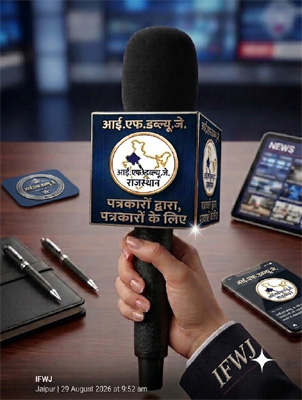
- IFWJ Rajasthan to launch ‘Journalists For Journalists’ youtube channel in October
- New platform to put pressure, harassment, professional insecurity and grassroots media issues in public domain
- Self-funded initiative to bring journalists from across Rajasthan together and amplify voices of the media fraternity
NE NEWS SERVICE
JAIPUR, AUG 30
When journalists find that the issues affecting their own fraternity are struggling to find space in the very media they serve, the answer may lie in creating a new space where they can speak for themselves. Against the backdrop of growing concerns over pressure on journalists, threats to independent reporting and the shrinking space for dissenting voices, the Rajasthan unit of the Indian Federation of Working Journalists (IFWJ) is preparing to launch a dedicated digital platform for the media fraternity.
The initiative, aptly conceived as “Journalists for Journalists,” will take shape as the IFWJ Rajasthan YouTube channel, scheduled to go live in October.
Rather than functioning merely as another digital news outlet, the proposed platform seeks to become a collective voice for journalists, bringing into the public domain professional challenges, instances of pressure and harassment, attacks on press freedom, restrictions on reporting and concerns that often remain underreported.
‘Journalists must speak for themselves’
IFWJ Rajasthan President Upender Singh Rathore said the initiative emerged from the growing need for journalists to collectively articulate the difficulties confronting them.
“It is high time that journalists united and spoke about the harsh realities they face day in and day out,” Rathore said.
He pointed out that journalists often encounter situations in which issues affecting them receive inadequate coverage, particularly when powerful individuals or institutions are involved.
Rathore cited his own experience of staging a 19-day protest against those in power, saying that despite the prolonged nature of the agitation, several media organisations provided little or no coverage, which he attributed to fear and pressure.
“I can understand that a media organisation may have its own limitations. Having something of our own, therefore, felt more necessary than ever,” he said.
That experience, he suggested, strengthened the case for a platform in which journalists themselves could document and discuss issues affecting the profession without waiting for conventional media organisations to take them up.
A microphone without a muzzle
The proposed channel is being designed as an independent space where journalists can raise matters concerning the media fraternity without external pressure.
“A channel run by journalists, for journalists, will not be under pressure from anyone,” Rathore said.
The platform will focus on the realities of journalism beyond headline-making events—including administrative pressure, threats, harassment, restrictions on reporting, professional insecurity and challenges faced by journalists working at the grassroots level.
It is also expected to provide journalists from Rajasthan’s towns, villages and remote districts an opportunity to bring their experiences directly to a wider audience.
The emphasis, therefore, will be not merely on press freedom as an abstract principle, but on how that freedom is experienced—or constrained—in the everyday working lives of journalists.
From newsmakers to news subjects
The initiative comes at a time when journalism itself is undergoing a profound digital transformation. While social-media and video platforms have dramatically expanded opportunities for independent publishing, they have also created new challenges relating to credibility, professional security and editorial independence.
Against this backdrop, IFWJ Rajasthan believes journalists need platforms through which their own professional rights, safety, dignity and working conditions remain visible in public discourse.
The organisation stressed that its proposed YouTube channel is not intended simply to become another news channel competing for digital attention.
Its larger objective is to build a collective, self-driven media platform where journalists can document issues affecting the profession, discuss press-freedom concerns and provide visibility to voices that may otherwise remain unheard.
With journalists from different districts expected to participate in content creation and reporting, the initiative could also help bridge the gap between major media centres and journalists working in smaller towns and rural Rajasthan.
Self-funded, collective and statewide
The platform will initially operate on a self-funded model, with journalists associated with the initiative contributing according to their individual capacity towards its operational requirements.
The model is intended to reinforce the organisation’s emphasis on independence and collective ownership.
The IFWJ Rajasthan unit expects journalists from across the State to contribute to the channel’s content, reporting and other activities.
The proposed launch in October will mark the beginning of an experiment in journalist-led digital advocacy, with the platform seeking to keep questions of press freedom, professional rights and journalists’ safety firmly within public conversation.
For IFWJ Rajasthan, the philosophy behind the initiative is straightforward: if journalists’ own problems are not being heard loudly enough, they must create the space—and the microphone—to speak for themselves.