NE NEWS SERVICE
NEW DELHI, AUG 30
What if a history website could make a young Indian curious about forgotten empires? What if a quarter-acre farm could become a flower business reaching Delhi and Mumbai? What if girls from 108 countries could jointly dream of sending a student-built satellite around the Moon? And what if creativity—not just campaigns—could become a weapon against drug addiction?
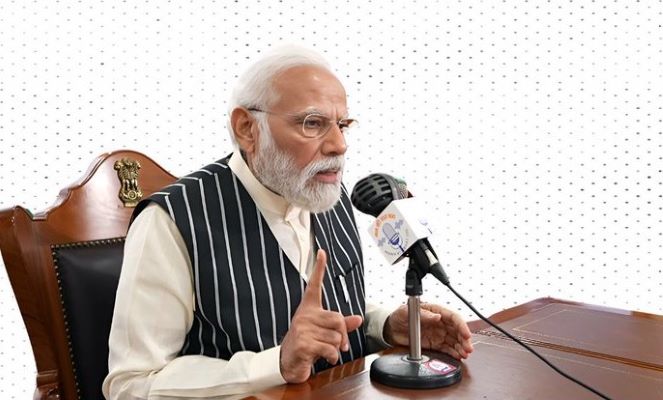
- In 137th ‘Mann Ki Baat’, PM spotlights young changemakers turning curiosity into technology, creativity into social action and dreams into enterprise
- Mumbai engineer-turned-marketer Krishna Seshadri uses technology to make India’s complex history accessible and engaging
- ‘Nasha-mukt Yuva for Viksit Bharat’ campaign gets youth call to fight addiction through music, theatre, content and creativity
- Mission ShaktiSAT brings 12,000 girl students from 108 countries into satellite technology and innovation
- From Nagaland’s flower farmer to Odisha’s forest protectors, grassroots stories emerge as new models of empowerment
- ‘Vocal for Local’, cleanliness and women-led street businesses add economic and social dimensions to PM’s youth-centric message
These were among the questions at the heart of Prime Minister Narendra Modi’s 137th episode of ‘Mann Ki Baat’, in which he turned the spotlight on ordinary Indians whose small ideas are becoming extraordinary instruments of social change.
The overarching message was unmistakably youth-centric: India’s transformation is not being driven only by large institutions or government programmes, but also by young citizens who experiment, create, volunteer, innovate and refuse to accept that change must always begin somewhere else.
When technology makes history come alive
One of the most striking stories was that of Mumbai-based Krishna Seshadri, an engineer who later pursued an MBA and entered marketing but retained his childhood passion for history.
His response was unconventional: instead of merely studying history, he used technology to reinvent the way people encounter it.
His website, bharatrajya.com, enables users to select a year and explore which rulers controlled different parts of India at that time.
Explaining his motivation, Seshadri said: “I always wanted to do something on history – how to make it interesting and I felt there was immense scope for improvement and change in how we teach history… we could present history to reach people as a story.”
He argued that conventional teaching often concentrates disproportionately on particular empires, leaving several remarkable dynasties and personalities relatively obscure.
He specifically cited the Cholas, Pallavas, Karkota dynasty of Kashmir and Ahoms, who preserved their culture and value system in Assam for centuries.
His three historical personalities of choice were equally revealing—Rajaraja Chola or Rajendra Chola, Hemu and Tribhuvan Mahadevi.
Hemu, he noted, rose from being an ordinary merchant to an empire-builder and military thinker, fighting 23 battles and winning 22.
Tribhuvan Mahadevi, meanwhile, emerged as a powerful woman ruler after her husband was killed in battle, stabilising the Bhaumakara kingdom and strengthening it sufficiently to rule Kalinga and adjoining areas.
Modi particularly appreciated the website’s “correction” tab, through which users can suggest corrections and new features.
Seshadri said the platform deliberately remained collaborative because “we are bound to make mistakes – we aren’t the best.”
A drug-free india needs creative soldiers
The PM then turned to the ‘Nasha-mukt Yuva for Viksit Bharat’ campaign, calling for a national movement to keep young people away from addiction.
“Its goal is absolutely clear: drug-free youth; a drug-free India.”
But rather than limiting the campaign to conventional awareness programmes, Modi issued a challenge to the country’s creative generation.
“Can you come up with a powerful slogan for a drug-free India? Can our young musicians create songs that convey the message of a drug-free life?”
He also urged students and theatre groups to create short plays portraying both the dangers of drugs and the road to recovery.
“You can use your creativity as a medium for social change.”
The campaign’s designated hashtag is #NashaMuktYuva.
12,000 girls, 108 countries, one space dream
The most futuristic segment of the episode was Mission ShaktiSAT, which Modi presented as an extraordinary example of girls carrying their dreams from Earth towards outer space.
As many as 12,000 girl students from 108 countries are getting an opportunity to learn satellite technology and participate in innovation.
The second phase was launched at Gautam Buddha University in Greater Noida on National Space Day, with around 100 female students from India and other countries participating, including students selected from remote regions of India.
The ambition is extraordinary: preparations are underway to send a satellite developed entirely through the participation of female students into lunar orbit.
Modi expressed confidence that many of these students would eventually establish themselves in science, technology and innovation.
When a small business becomes women’s empowerment
The episode also highlighted the less visible economic revolution taking place on India’s streets.
Modi said women account for approximately 46% of PM SVANidhi beneficiaries, amounting to around 35 lakh women expanding their businesses through the scheme.
He narrated the stories of Babita Sharma of Ghaziabad, whose small stall selling flowers, earthen lamps and worship materials evolved into a proper shop after she received financial assistance, and T S Ningamma of Bengaluru, whose idli-dosa-sambar venture expanded after SVANidhi support.
The PM summed up the wider impact:
“When a woman’s business grows, the future of her entire family advances along with it.”
Two young friends, four ghats and a tonne of plastic
In Patwai village of Uttar Pradesh’s Rampur district, Akash and Rohan saw their locality drowning in garbage.
They picked up garbage bags.
Others joined them.
The result was ‘Clean-up Patwai’, a youth team that has cleaned four Ganga ghats, removed more than a tonne of plastic waste and worked on ponds and public spaces.
The story reinforces a recurring theme of the episode: citizenship can begin with something as simple as picking up the first bag of waste.
The PM also cited the recent Amarnath Yatra, where more than 400 metric tonnes of waste were collected and processed, over 16,000 pilgrims pledged to maintain cleanliness and more than 10,000 received the ‘Responsible Yatri’ certificate.
In an innovative experiment, dung from horses and mules used during the pilgrimage was converted into biogas to light the ‘Swachh Jyot’.
A flower hobby blooms into a market
From Nagaland’s Phek district came another lesson in converting passion into enterprise.
Vesalu Puro, raised in a farming family, began cultivating flowers in 2021.
After receiving scientific training from a Krishi Vigyan Kendra, she planted thousands of gladiolus bulbs on just a quarter-acre.
More than 5,000 flowers bloomed in her first attempt.
Her flowers, once restricted to local markets, now travel to Delhi and Mumbai.
Her journey, Modi said, demonstrates that when passion meets hard work and proper guidance, entirely new possibilities emerge.
- When forest conservation becomes livelihood
- In Odisha’s Debrigarh region, Maithili Bhue moved from collecting forest produce for household needs to participating in Debrigarh Eco-Tourism.
- Her transformation inspired other women.
- Today, more than 60 women are involved in forest conservation, wildlife protection, grassland development and eco-tourism.
- The PM’s message was simple:
- “It is possible to protect nature while also achieving prosperity in life.”
- Farmers find a new ‘recipe’ in avocado
The episode also showed how changing consumer preferences can open new agricultural opportunities.
Farmers in Andhra Pradesh, Tamil Nadu and Karnataka are experimenting with avocado cultivation.
Varadaraj of Kadappa learnt about the crop through YouTube and has produced nearly four tonnes, selling directly to local shops.
Chandrashekharan of Kodaikanal began cultivating avocado on half a hectare, while farmers in Chikkamagaluru are growing it alongside coffee and black pepper.
Modi offered a memorable formulation:
“We often hear about the avocado toast in city restaurants, but through this very avocado, our innovative farmers have discovered a new recipe for earning.”
From the tricolour to ‘vocal for local’
The PM also highlighted the patriotic spirit surrounding August, including National Handloom Day, Quit India Movement anniversary, Partition Horrors Remembrance Day, Independence Day and National Space Day.
This year, he noted, more than 8 crore Tiranga selfies were uploaded, while the ‘Suryapath Tiranga’ initiative carried the Tricolour across Indian missions and posts from Fiji through Asia, Africa and Europe to San Francisco.
With Janmashtami, Vishwakarma Puja and Deepawali approaching, Modi renewed his call for ‘Vocal for Local’, urging citizens to prefer products made in India.
He stressed that the idea extends beyond buying earthen lamps:
“The path to India becoming self-reliant will be paved only by taking pride in products made in India.”
A legacy that connects past, present and future
The episode also paid tribute to legendary Bengali actor Uttam Kumar, whose birth centenary will be observed on September 3.
Recalling Nayak and Satyajit Ray’s appreciation of Uttam Kumar’s emotional depth and dignity, Modi invoked his perseverance, philanthropy and refusal to give up despite early setbacks.
“Mahanayak Uttam Kumar cheerodin maanusher hridaye Raj Korben.”
The tribute fitted naturally into the larger message of the episode: legacies are built through persistence, creativity and the ability to connect with people.
From a young man’s history website to girls designing a lunar mission, from street vendors and farmers to forest protectors and cleanliness volunteers, the 137th Mann Ki Baat presented an India in which small initiatives are increasingly becoming launchpads for larger change.
And its most powerful youth message may have been implicit:
Do not wait to become powerful before you create change. Start with what you know, what you love and what you can do—and let the idea grow.