NE NEWS SERVICE
NEW DELHI/CHENNAI/KATHMANDU, AUG 31
When roads have vanished, bridges have been swept away and entire communities have been cut off by raging Himalayan waters, the race to rescue survivors has become a race against time—and India has emerged as one of the key pillars of the unfolding humanitarian response in Nepal.
The catastrophic flash floods that tore through Nepal on August 26 have left a trail of death, destruction and uncertainty, with 734 deaths reported and 2,498 people still out of contact, according to Nepal’s National Disaster Risk Reduction and Management Authority (NDRRMA). Rescue operations are continuing across some of the most difficult and inaccessible terrain in the Himalayas, even as fresh warnings over rising water levels threaten to complicate the mission.
- 219 of 319 Tamil Nadu residents rescued; search for 100 continues as India’s humanitarian mission expands
- Fourth IAF relief flight lands with 11 tonnes of aid, tunnel-rescue experts and forensic team
- 68.5 tonnes of relief airlifted; India also sends equipment for 230-foot modular bridge and seven bailey bridges
- DNA experts join mission to identify victims; Indian technical teams help reach trapped workers
- Nepal on high alert as Bhote Koshi River rises again, threatening to complicate search and relief operations
At the heart of the crisis is also an urgent effort to bring home stranded Indians. In Tamil Nadu, 219 of 319 residents who travelled to Nepal have been rescued, while authorities are continuing efforts to trace the remaining 100.
Tamil Nadu Minister Rajmohan said the rescued residents were being brought back in batches, with 33 scheduled to reach Coimbatore from Delhi on Monday evening and another six expected to arrive in Chennai later that night.
“Of the 319 people who travelled from Tamil Nadu in different groups, 219 are safe. They will return by Monday night,” Rajmohan said.
He described the catastrophe as being of international magnitude, pointing to the extraordinarily difficult terrain and the possibility that bodies and personal belongings could have been carried hundreds of kilometres downstream.
“This is an international catastrophe, a massive disaster, and the gravity of it is enormous,” he said.
Tamil Nadu’s war room, India’s wider rescue network
The Tamil Nadu Government has established a dedicated war room at Tamil Nadu House in New Delhi to collate information on stranded residents, coordinate with the Centre and Nepalese authorities and keep anxious families informed.
Of a 57-member group that travelled through a Kumbakonam-based travel agency, 21 have already been rescued and brought safely to Chennai, while efforts continue to locate the remaining 36.
The whereabouts of 49 residents from Chromepet who travelled as part of the Mahadevi Yatra group are yet to be confirmed.
Another group of about 150 Tamil Nadu residents reached Kathmandu through the China border and is returning to India on different flights, while 39 others have been confirmed safe.
Minister for Non-Resident Tamils Welfare K. Thennarasu has remained in Delhi to monitor the rescue operation and facilitate the return of those still stranded.
The Tamil Nadu effort is unfolding within a much larger Indian and Nepalese rescue architecture involving diplomatic officials, security forces, military personnel, helicopters, technical experts and specialised disaster-response teams.
India’s fourth relief flight: Rescue expertise takes centre stage
India has significantly expanded its assistance to Nepal with the arrival in Kathmandu of its fourth relief flight carrying 11 tonnes of humanitarian supplies, specialised tunnel-rescue personnel and forensic experts equipped for DNA analysis.
The Indian Air Force C-130 aircraft carried a tunnel technical contingent equipped for search-and-rescue operations, along with forensic specialists and equipment to help identify victims whose remains may be difficult to establish.
External Affairs Minister S. Jaishankar said: “The fourth Indian flight has touched down in Kathmandu. It brings essential supplies and technical capabilities to support Nepal’s ongoing rescue and relief operations.”
The latest consignment includes blankets, sleeping bags, tarpaulins, plastic sheets and hygiene kits, besides specialised rescue and forensic equipment.
With the latest dispatch, India has airlifted 68.5 tonnes of relief material to Kathmandu, including essential medicines, portable generator sets, food packets, water-purification tablets and technical equipment.
“Our support to the relief and rescue efforts continues,” Jaishankar said.
From saving lives to restoring lifelines
India’s response is not confined to emergency supplies.
With roads and bridges destroyed across the flood-hit Himalayan landscape, India is also helping Nepal restore the physical lifelines needed to sustain rescue and relief operations.
Sixteen trucks carrying equipment for a 230-foot Single Lane Modular Steel Bridge have reached Nepal, while equipment for seven additional Bailey bridges is to be supplied, along with technical teams to assist with their installation.
The significance is immediate: restoring road connectivity means opening corridors through which ambulances, food, medicines, rescue teams and essential supplies can reach communities cut off by the floods.
The devastation has already severed critical transport links. A section of the Prithvi Highway, the major road connecting Kathmandu with Pokhara and western Nepal, was washed away by the Trishuli River at Krishnabhir. Nineteen motorable bridges were reported destroyed.
The disaster has also severely affected Nepal’s hydropower infrastructure, with multiple operational and under-construction projects damaged.
Indian experts join high-risk tunnel rescues
Among the most daunting rescue challenges are hydropower project sites where workers are believed to remain trapped.
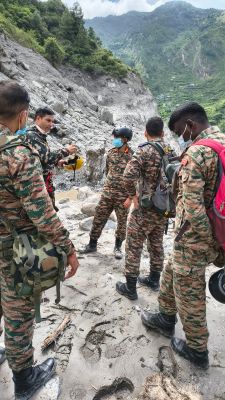
Nepalese security forces have been conducting repeated rescue missions, while an 11-member Indian team is assisting in evacuating workers trapped in difficult tunnel environments.
At the Trishuli hydropower project, Nepalese security personnel, assisted by Indian tunnel experts, have been working to locate tunnel access points and reach those trapped despite heavy rain and dangerous conditions.
This specialised intervention underscores a critical dimension of India’s assistance: not merely sending relief, but sending the expertise and equipment needed to reach people whom conventional rescue operations cannot easily access.
Forensics bring a second form of rescue—identifying the dead
Update on Indian Nationals rescued in Nepal as of 1730 hrs on 30 August, 2026
Indians rescued : 149
Please see names below ⬇️ pic.twitter.com/f5olP2chxa
— Randhir Jaiswal (@MEAIndia) August 30, 2026
As rescuers continue searching for survivors, another painful task has emerged—giving names and identities to those who did not survive.
Indian Ambassador to Nepal Naveen Srivastava met members of the Indian Forensic Team deployed in Nepal to assist Nepali counterparts in analysing DNA samples and identifying mortal remains.
The Ministry of External Affairs said: “Ambassador Naveen Srivastava met members of the Indian Forensic Team deployed to Nepal. The team will work alongside their Nepali counterparts in analysing DNA samples to assist in identifying the mortal remains of the victims of the recent flash floods.”
Srivastava said the forensic experts would support analysis of DNA samples of victims of the tragedy in Rasuwa and reiterated India’s continuing commitment to Nepal’s relief efforts.
Thus, India’s humanitarian response is extending from searching for survivors to identifying victims, from supplying food to rebuilding bridges, and from emergency evacuation to restoring connectivity.
Bhote Koshi rises again as Nepal faces new flood threat
Even as rescue teams press into devastated areas, the crisis remains dangerously fluid.
The NDRRMA warned on Sunday that the water level in the Bhote Koshi River had risen again, urging residents and rescue personnel to take precautionary measures.
“The water level in the flooded Bhotekoshi River has risen to some extent; all concerned are urged to take precautionary measures,” the agency said.
The warning has added another layer of urgency to an already perilous rescue mission, with intermittent rain, unstable terrain, damaged roads and bridges and disrupted communication networks continuing to impede access.
Fears of additional flooding have also been heightened by developments around a lake formed on the Chinese side following the Himalayan glacier collapse. Although the immediate threat of a catastrophic breach appeared to recede as the lake began shrinking, reports of another landslide and the formation of a fresh “dam lake” have prompted further evacuation and caution.
A nation searching, a region responding
Nepal has mobilised nearly 20,000 security personnel for search-and-rescue operations, while helicopters continue repeated sorties to evacuate stranded people and deliver relief supplies.
Nepal Foreign Minister Shisir Khanal said thousands had already been rescued and that search and rehabilitation operations remained underway as the country stayed on “high alert.”
Hundreds of injured people have been admitted to hospitals, while Nepal has released emergency funds for badly affected districts and municipalities.
Food and non-food supplies are being moved into inaccessible areas by road and air, although the destruction of bridges and highways has made the logistics exceptionally difficult.
The scale of the disaster is reflected in the continuing search for thousands of missing people, including foreigners, hydropower workers, pilgrims and travellers caught in the sudden Himalayan catastrophe.
India’s message: Rescue, relief, rebuild
For India, the Nepal operation has become a comprehensive humanitarian mission—rescue the stranded, reach the trapped, feed the displaced, identify the dead, restore broken connectivity and help Nepal stand back on its feet.
The rescue of Tamil Nadu residents is one visible strand of that effort; the deployment of Indian tunnel specialists and forensic experts, the airlifting of 68.5 tonnes of relief material and the movement of bridge-building equipment represent the broader dimensions of India’s support.
The disaster has transformed familiar Himalayan routes into zones of devastation. Yet amid the wreckage, the response is increasingly becoming a story of cooperation—Nepalese security forces working alongside Indian specialists, governments coordinating across borders and relief aircraft converting the distance between the two neighbours into a humanitarian air bridge.
For families still waiting for a phone call, every helicopter sortie, every rescue team and every reopened road carries the same message: the search is not over.
And for Nepal, as the mountains remain unstable and the waters continue to threaten, the most important operation now is not simply recovery—but keeping hope alive long enough for rescuers to reach everyone they can.