NE DEFENCE BUREAU
NEW DELHI, SEPT 3
India has unveiled a 10-year strategic playbook to transform defence diplomacy into a more proactive instrument of its global engagement, with the new ‘RAKSHA’ document placing strategic partnerships, military capacity building, indigenous defence exports and maritime security at the heart of the country’s international security outreach.
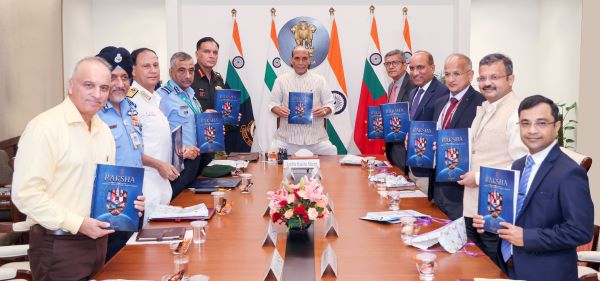
Watch | Raksha Mantri Shri Rajnath Singh releases ‘RAKSHA’, a document on defence diplomacy, in New Delhi on September 03, 2026.. pic.twitter.com/gElJuQ8NB7
— Ministry of Defence, Government of India (@SpokespersonMoD) September 3, 2026
Defence Minister Rajnath Singh released the ‘RAKSHA’ document on defence diplomacy in New Delhi on Thursday, unveiling a comprehensive framework that sets out India’s strategic roadmap and vision for global defence partnerships over the next decade.
- New document charts a decade-long roadmap for deeper global defence partnerships and a stronger Indian security footprint
- Focus shifts from traditional diplomacy to proactive strategic engagement, capacity building and defence cooperation
- Make-in-India emerges as a key pillar to position India as a trusted global defence manufacturing and export hub
- Maritime security gets special thrust as India reinforces its role as Net Security Provider and First Responder in the Indian Ocean Region
- Defence diplomacy positioned as a core instrument of India’s foreign policy, with peace, stability and a rules-based order as the larger objectives
The document signals a significant evolution in India’s approach to defence diplomacy—from conventional security cooperation towards long-term, structured and proactive strategic engagement designed to advance national security interests while contributing to global peace and stability.
At its core, RAKSHA seeks to align India’s national security objectives with deeper international cooperation, creating sustained partnerships with friendly countries and strengthening India’s role in an increasingly complex and rapidly changing global security environment.
Four pillars of India’s defence diplomacy
The strategic blueprint identifies four major areas of focus:
Strategic Partnerships
India will seek to deepen bilateral and multilateral security cooperation, strengthening defence relationships and building enduring strategic partnerships with countries sharing common security interests.
Capacity Building
Greater emphasis will be placed on joint military exercises, training programmes, institutional cooperation and the sharing of best practices with friendly nations. The objective is to build interoperability, professional capabilities and stronger defence-to-defence relationships.
Indigenous Defence Exports
The document gives a major push to Make-in-India defence platforms and systems, with India seeking to emerge as a reliable global defence manufacturing and export hub. Defence exports are envisaged not merely as an economic opportunity but also as an instrument of strategic partnership.
Maritime Security
India’s role as a Net Security Provider and First Responder in the Indian Ocean Region is to be strengthened, underscoring the country’s growing strategic responsibilities across the maritime domain.
From partnerships to strategic influence
The RAKSHA framework comes against the backdrop of an evolving global security landscape marked by geopolitical realignments, emerging threats and growing competition in the strategic domain.
The document seeks to provide India with a clear and actionable vision for the next decade, enabling defence diplomacy to complement the country’s wider foreign-policy objectives.