NE EDUCATION BUREAU
NEW DELHI, SEPT 5
The nation paused on Teachers’ Day to honour the men and women who do far more than teach lessons — they shape minds, protect childhood, kindle curiosity and quietly mould the citizens of tomorrow. On a day recalling the birth anniversary of former President, philosopher and teacher Dr Sarvepalli Radhakrishnan, President Droupadi Murmu honoured the country’s distinguished educators, while Prime Minister Narendra Modi interacted with the National Teachers Awards winners and urged teachers to become more attentive to the social and emotional challenges confronting children.
- On Teachers’ Day, President Murmu honours 82 educators while PM Modi urges teachers to protect children from drugs, screen addiction and loss of curiosity
- Gujarat’s and Tamil Nadu’s award-winning educators add lustre to national celebrations; innovators turn classrooms into laboratories of learning
- PM asks teachers to look beyond marks, understand children’s behaviour and become alert guardians against substance abuse
- Excessive screen time a growing concern; Modi advocates sports, physical games and creative pursuits to reclaim childhood
- President Murmu: “Education is the most effective means of realizing the ideal of equality of opportunity enshrined in our Constitution”
- From syllabus to skills and values, teachers asked to nurture curiosity, dignity of labour, morality and sensitivity for Viksit Bharat
The celebrations acquired special significance for Gujarat and Tamil Nadu, whose educators figured among the national awardees. Gujarat’s representation included Nitin Kumar Mahendrakumar Pathak among school teachers and higher-education awardees Mithun Radhakrishna of IIT Gandhinagar and Sarvaiya Jayrajsinh Indrajitsinh of National Forensic Sciences University, Gandhinagar. Tamil Nadu’s awardees included Thanga Raj M, Amutha J, Sasikala S of PSG Polytechnic College and Kannan Rathinam of Sakthi Polytechnic College.
82 educators, one national salute
The National Teachers Awards 2026 recognised 82 teachers and educators drawn from three departments — 48 teachers from the Department of School Education and Literacy, 21 teachers/faculty members from higher educational institutions and polytechnics, and 13 skill trainers from the Ministry of Skill Development and Entrepreneurship.
The awardees brought to the national platform an extraordinary range of teaching innovations and experiences designed to make learning more engaging, inclusive and relevant. Their interaction with the Prime Minister at his residence at 7, Lok Kalyan Marg offered an opportunity to share classroom experiences and creative approaches that have produced meaningful outcomes.
Modi: Look beyond marks—look at the child
#TeachersDay is about appreciating the strong contribution of teachers to our society. It is also a day to pay homage to Dr. S. Radhakrishnan.
Here is what happened when the National Teachers' Awards winners were invited to 7, LKM yesterday…. pic.twitter.com/LtXTvHiQoQ
— Narendra Modi (@narendramodi) September 5, 2026
The Prime Minister urged teachers to look beyond the academic performance of students and pay attention to their behaviour, circumstances and everyday lives.
With the traditional joint-family structure changing, he said teachers increasingly have an important role in the lives of children.
He made a particularly strong appeal regarding drug addiction among young students, asking teachers to remain alert to behavioural changes, identify the reasons behind them and help affected children overcome the habit.
The message effectively expands the teacher’s role from an instructor preparing students for examinations to a trusted adult capable of recognising distress before it becomes a crisis.
Reclaim childhood from the screen
The Prime Minister also flagged excessive screen time as a major concern.
He urged teachers to engage with parents on how much time children spend on mobile phones and whether they continue using devices late into the night.
His prescription was not merely to restrict technology but to replace excessive screen use with healthier alternatives — sports, physical games and creative activities.
The larger message was unmistakable: childhood must not be allowed to disappear behind a glowing screen.
“Preserving the innocence of childhood”
Modi stressed that preserving the innocence of childhood is an important responsibility of teachers.
Children, he said, possess an innate curiosity, and teachers can make a significant contribution to their development by nurturing and appropriately channelising that curiosity.
This philosophy also resonates with the President’s message that teaching is not simply the transmission of information but a responsibility to develop the whole human being.
President Murmu has said: “Education is the most effective means of realizing the ideal of equality of opportunity enshrined in our Constitution.”
She emphasised that school education is the foundation of the education system and that teachers have a crucial role in nurturing children’s intellectual, physical and moral development.
Take learning beyond the textbook
Modi also invoked the National Education Policy and stressed the importance of taking children outside classrooms and exposing them to real-world skills and different forms of work.
Teachers, he said, should go beyond the syllabus and help inculcate values such as dignity of labour.
The approach fits into a larger vision of education in which academic achievement is complemented by practical skills, social awareness, creativity and values.
The President too underlined the importance of academic excellence, skill development and entrepreneurship, describing them as critical to India’s development and its ambition to emerge as a knowledge superpower and the skill capital of the world.
Gujarat and Tamil Nadu add their own chapters
The Teachers’ Day celebrations carried particular pride for Gujarat and Tamil Nadu.
From Gujarat, Mithun Radhakrishna of IIT Gandhinagar was recognised for innovative teaching, interdisciplinary education, research-led learning and student mentoring, while Sarvaiya Jayrajsinh Indrajitsinh of National Forensic Sciences University, Gandhinagar, received the national recognition in Forensic Pharmacy and Food Forensics.
Read Also:
From Gujarat’s classrooms to TN’s labs, teachers turn knowledge into a national movement
Radhakrishna’s observation captures the changing role of the teacher in the digital era: “The teacher can no longer be primarily a transmitter of information because information is available instantly.” His emphasis is on helping students ask better questions, evaluate answers critically and develop independent judgement.
Tamil Nadu’s awardees reflected the State’s educational diversity, spanning school education and technical institutions — Thanga Raj M, Amutha J, Sasikala S and Kannan Rathinam. Their recognition placed the State’s classroom and technical-education contributions alongside the country’s finest educators.
A President remembers her teachers—and students
At the National Teachers Awards ceremony, President Murmu brought a deeply personal dimension to the occasion by recalling her own teachers.
“I feel happy to be here among the teachers. I still recall my teachers; it was due to their love and affection that I succeeded in life and am standing here today,” she said.
She also remembered students she had taught at the Sri Aurobindo Integral Education Centre in Rairangpur, Odisha, acknowledging that she herself had learnt much from them.
“I consider the love and affection I received from my students to be one of the greatest achievements of my life,” she said.
The President paid tribute to Savitribai Phule and her contribution to the education of girls, adding another powerful dimension to Teachers’ Day — education as an instrument of social transformation.
“Our teachers breathe life into the education system”
The President linked the teacher’s responsibility directly to the national development agenda.
She said India’s journey towards Viksit Bharat can be achieved only through a world-class education system.
“Our teachers breathe life into the education system,” she said, stressing that not a single student should be deprived of opportunities for quality education.
She called upon teachers to instil knowledge, inspiration, morality and sensitivity through affection and dedication.
The President also drew attention to children from economically disadvantaged families, first-generation learners, shy students, talented youngsters lacking self-confidence and children with special needs.
For such children, she said, it is the special responsibility of teachers to instil confidence and uplift them.
Radhakrishnan’s legacy, India’s future
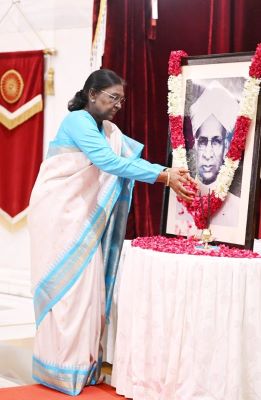
Earlier on Saturday, President Murmu paid floral tributes to Dr Sarvepalli Radhakrishnan at Rashtrapati Bhavan on his birth anniversary. Prime Minister Modi too paid homage to Radhakrishnan and described Teachers’ Day as a day to appreciate the strong contribution of teachers to society.
From the philosopher-teacher whose birth anniversary became synonymous with Teachers’ Day to today’s educators using technology, recycled materials, community participation and innovative pedagogy, the journey reflects a changing India.
But the essence remains unchanged.
A teacher does not merely fill a child’s mind with knowledge; a great teacher gives the child the confidence to discover what lies within.
And that may be the most enduring lesson of Teachers’ Day 2026.