NE EDUCATION BUREAU
NEW DELHI, SEPT 5
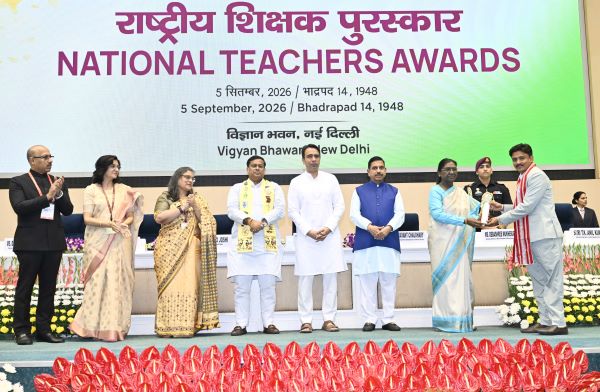
The guru-shishya tradition met the innovation age at Vigyan Bhawan on Teachers’ Day as President Droupadi Murmu honoured 82 educators whose work is redefining what a teacher can mean beyond the four walls of a classroom. For Gujarat and Tamil Nadu, the occasion carried a special resonance, with teachers and faculty members from both States earning national recognition for their contributions to school education, research, innovation and skill development.
President Droupadi Murmu conferred National Awards on teachers from across the country on Teachers’ Day. The President said that by diligently focusing on the intellectual, physical, and moral development of children in the early grades, our teachers can prepare future… pic.twitter.com/ogUwDMwZ9a
— President of India (@rashtrapatibhvn) September 5, 2026
LIVE: President Droupadi Murmu's address at the presentation of National Awards to teachers on the occasion of Teachers’ Day in New Delhi https://t.co/obyhWUyeC3
— President of India (@rashtrapatibhvn) September 5, 2026
Among the 48 school teachers honoured nationally, Nitin Kumar Mahendrakumar Pathak of Rangpur Primary School, Gujarat, and Thanga Raj M of Panchayat Union Primary School, Puliyampatti, Tamil Nadu, were recognised for their contributions to school education. Tamil Nadu’s representation extended to the higher-education category through Sasikala S of PSG Polytechnic College, Coimbatore, and Kannan Rathinam of Sakthi Polytechnic College, Erode.
- President Murmu honours 82 educators on Teachers’ Day; Gujarat and Tamil Nadu among the states leaving a distinctive imprint on the National Teachers Awards 2026
- Gujarat’s Nitin Kumar Mahendrakumar Pathak honoured among 48 school teachers; IIT Gandhinagar’s Mithun Radhakrishna and NFSU’s Sarvaiya Jayrajsinh also make the State proud
- Tamil Nadu’s Thanga Raj M and KVS teacher Amutha J recognised in school education, while PSG Polytechnic’s Sasikala S and Sakthi Polytechnic’s Kannan Rathinam shine in higher education
- From mobile science labs and QR-coded botanical learning to girl-child empowerment, awardees demonstrate that innovation can begin with the simplest classroom idea
- President Murmu: “Education is the most effective means of realizing the ideal of equality of opportunity enshrined in our Constitution”
- Academic excellence, skill development and entrepreneurship vital for India’s journey towards Viksit Bharat, says President
Gujarat also made its presence felt strongly in higher education, with Mithun Radhakrishna, Associate Professor of Chemical Engineering at IIT Gandhinagar, and Sarvaiya Jayrajsinh Indrajitsinh of National Forensic Sciences University, Gandhinagar, selected among the 21 National Award to Teachers recipients from higher educational institutions and polytechnics.
82 teachers, 82 stories of changing lives
President Murmu conferred National Teachers Awards on 48 school teachers, while another 21 teachers/faculty members from higher educational institutions and polytechnics were recognised under the expanded National Award to Teachers framework. The remaining awardees represented the skill-development ecosystem. The school-teacher selection covered 27 States, seven Union Territories and six Central Government organisations, following a three-stage selection process at district, State and national levels.
The awardees demonstrated an extraordinary range of interventions — from technology-enabled STEM learning and community-supported nutrition to campaigns that bring children back to school and initiatives that help disadvantaged girls remain in education.
Short documentaries depicting the exemplary work of the awardees were also showcased during the ceremony, bringing alive the impact of their innovations and commitment.
Gujarat’s classroom innovators take the national stage
Nitin Kumar Mahendrakumar Pathak of Rangpur Primary School represented Gujarat among the 48 school-teacher awardees.
Gujarat’s higher-education institutions added another dimension to the State’s achievement. Mithun Radhakrishna of IIT Gandhinagar, a Chemical Engineering faculty member, was recognised for innovative teaching, interdisciplinary education, research-led learning and student mentoring.
Reflecting on the recognition, Radhakrishna said: “My first reaction was a mixture of surprise, gratitude and happiness.” He described teaching as something he had always taken personally and said the recognition made him think of the students and teachers who had shaped his own journey.
His teaching philosophy is particularly relevant in an era when information is available instantly. As he put it: “The teacher can no longer be primarily a transmitter of information because information is available instantly.” The educator’s role, he said, is increasingly to help students ask better questions, evaluate answers critically, connect ideas and develop independent judgement.
The other Gujarat higher-education awardee, Sarvaiya Jayrajsinh Indrajitsinh of National Forensic Sciences University, Gandhinagar, was recognised in Forensic Pharmacy and Food Forensics.
Tamil Nadu’s teaching tradition meets innovation
Tamil Nadu too had a strong presence in the awards. Thanga Raj M, from Panchayat Union Primary School, Puliyampatti, Tenkasi district, was among the 48 school teachers honoured nationally. Amutha J, a teacher at PM SHRI Kendriya Vidyalaya No. 2, Madurai, also figured among the school-teacher awardees under the Kendriya Vidyalaya Sangathan category.
Read Also:
The State’s higher-education contingent comprised Sasikala S of PSG Polytechnic College, Coimbatore, recognised in Electrical and Electronics Engineering, and Kannan Rathinam of Sakthi Polytechnic College, Erode, recognised in Physics.
The four Tamil Nadu awardees underline the breadth of the State’s educational ecosystem — from primary classrooms and Kendriya Vidyalayas to technical and higher education.
When a cart becomes a laboratory
The stories behind the awards were as inspiring as the medals themselves.
Ravi Jaiswal of Government Model High School, Chandigarh, was recognised for developing low-cost and scalable learning interventions including a CV Raman Dome Theatre, a Mobile Science Lab on a cart and an outdoor Science and Knowledge Park using recycled materials.
In Rajasthan, Divyendu Sen of Mahatma Gandhi Government School, Jhalawar, pioneered initiatives including a Virtual Biology Laboratory, AI-enabled biology education and ‘Tree Talk’, a QR-code-based botanical learning system designed to make advanced STEM learning accessible to government-school students.
In Chhattisgarh, Sunita Yadav combined community participation with foundational literacy through initiatives, including Nyota Bhojan and Ghar-Ghar Pustak Vachan.
And in Maharashtra, Kunda Jayawant Bachhav used what she called ‘Educational Parenting’ to provide financial and academic support to more than 150 underprivileged girls, helping prevent early marriages and opening pathways to higher education.
These stories collectively demonstrate the changing face of Indian education — where a teacher is increasingly an innovator, mentor, community mobiliser, technology adopter and social reformer.
Murmu recalls the teachers—and students—who shaped her
Addressing the award ceremony, President Murmu spoke not merely as the country’s constitutional head but as a former teacher recalling the influence of her own educators.
“I feel happy to be here among the teachers. I still recall my teachers; it was due to their love and affection that I succeeded in life and am standing here today,” she said.
The President also remembered the students she had taught at the Sri Aurobindo Integral Education Centre in Rairangpur, Odisha, saying she had herself learnt a great deal from them.
“I consider the love and affection I received from my students to be one of the greatest achievements of my life,” she said.
The President paid tribute to Savitribai Phule and her contribution to girls’ education, reinforcing the message that education is not simply about literacy but about expanding opportunity and dignity.
Teachers as architects of an equal India
President Murmu said education is “the most effective means of realizing the ideal of equality of opportunity enshrined in our Constitution.”
She credited teachers with helping India achieve a negligible primary-school dropout rate and emphasised that school education forms the foundation of the entire education system.
While knowledge and skills can be acquired at any stage, she said lessons in good conduct imparted during childhood have a particularly lasting impact. Teachers, therefore, have the responsibility of nurturing the intellectual, physical and moral development of children from the early grades.
She also highlighted the challenges faced by students from economically disadvantaged families, first-generation learners, children moving from village schools to large city institutions, shy students, talented youngsters lacking self-confidence and children with special needs.
For all such students, she said, it is the special responsibility of teachers to instil confidence and uplift them.
From classroom excellence to Viksit Bharat
The President underlined that academic excellence, skill development and entrepreneurship are critical to India’s development.
“Establishing India as the skill capital of the world, and transforming it into a knowledge superpower, is among our national priorities,” she said.
She linked the role of teachers directly with India’s larger development journey, stressing that the goal of building a Viksit Bharat can be achieved only through a world-class education system.
“Our teachers breathe life into the education system,” the President said, emphasising that not a single student should be deprived of opportunities for quality education.
She urged teachers to nurture not only knowledge but also inspiration, morality and sensitivity among students through affection and dedication.
The award is a salute to the teacher beyond the textbook
The National Teachers Awards 2026 thus celebrated something larger than academic achievement. They recognised teachers who have transformed ordinary classrooms into laboratories of curiosity, communities into partners in education and disadvantaged children into confident learners.
For Gujarat and Tamil Nadu, the honours carried an added message: the future of Indian education is being shaped not only in elite institutions but also in primary schools, polytechnics, village classrooms and laboratories where teachers continue to experiment, innovate and inspire.
And on a day dedicated to the teacher, the President’s words offered perhaps the most fitting tribute — that the finest educators do not merely teach lessons; they help create the citizens India hopes to become.