- ₹35,000-crore development push combines rail, freight, connectivity, energy and manufacturing
- PM calls 2,800-km Dedicated Freight Corridor “the lifeline of a rapidly developing India”
- Vadodara emerges as a manufacturing hub from C-295 aircraft to rail coaches and engineering
- Solar, nuclear, critical minerals and rare earths positioned as foundations of India’s AI future
- PM links infrastructure expansion with jobs, skills, free competitive-exam coaching and India@2047
NE INFRASTRUCTURE BUREAU
VADODARA, SEPT 8
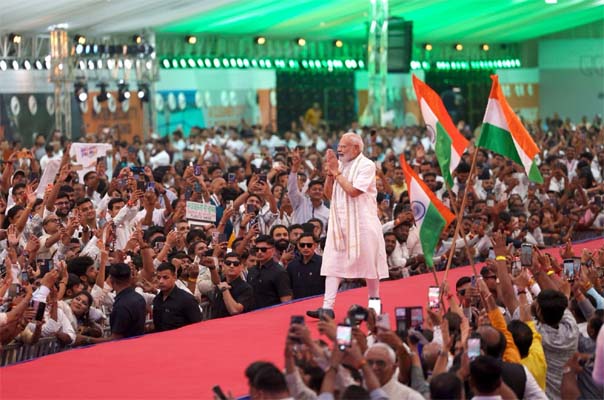
A ₹35,000-crore infrastructure blitz unveiled in Vadodara on Tuesday was presented not merely as a collection of projects, but as a blueprint for an India that moves faster, manufactures more, creates millions of jobs and builds the technological muscle needed to compete globally.
Prime Minister Narendra Modi laid foundation stones, inaugurated and dedicated to the nation development projects worth more than ₹35,000 crore, using the occasion to connect the expansion of railways and freight corridors with manufacturing, clean energy, artificial intelligence, skills and the larger mission of building a Viksit Bharat by 2047.
“We are strengthening India’s infrastructure to move people and goods faster, create new opportunities and power economic growth,” Modi said.
The Prime Minister placed the completion of the 2,800-km Dedicated Freight Corridor (DFC) at the centre of his infrastructure narrative, describing it as “the lifeline of a rapidly developing India.”
He also delivered perhaps the sharpest summation of the country’s industrial ambition: “From chips to ships, India is now building a new manufacturing future.”
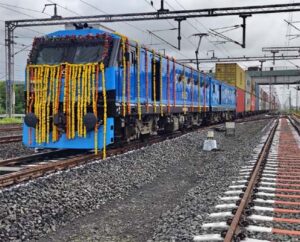
2,800-km freight backbone reshapes India’s logistics map
Highlighting the completion of the 2,800-km Eastern and Western Dedicated Freight Corridors, Modi said the achievement represented a historic infrastructure milestone for 21st-century India.
“This historic task for 21st-century India has been accomplished,” he said, pointing to Vadodara’s special significance as the city associated with Gati Shakti University and the completion of the final links of the massive freight network.
He said the government had given fresh momentum to the project after 2014 and demonstrated its execution capability by completing the 2,800-km corridor.
“We gave it momentum and demonstrated it by completing the work of the 2800-kilometer corridor,” Modi said.
The DFC separates freight movement from passenger traffic, allowing substantially greater capacity for cargo trains. According to the Prime Minister, more than 430 freight trains can now operate daily, while journeys that earlier took around 30 hours by road can be completed in about 10-12 hours on the freight network.
The result, he said, would be faster cargo movement, lower fuel consumption, reduced freight costs and environmental gains.
“The investment was made on one track, but it yielded numerous benefits,” Modi said.
From farms to markets, freight speed becomes economic power
The impact of faster freight movement, Modi stressed, extends well beyond ports and industrial centres.
For farmers, particularly those producing perishable commodities, transportation speed can determine whether produce reaches markets at the right time and at the right price.
Flowers, fruits and vegetables from eastern and western India can now be moved more quickly to major markets and mandis, strengthening the connection between agricultural production and consumption centres.
“This has immensely benefited the farmers,” Modi said.
He highlighted the operational significance of a double-stack container freight train from JNPT to Vadodara, noting that a single such train carried cargo equivalent to more than 250 trucks.
“Large quantities of goods will now be able to reach from one corner of the country to another rapidly,” he said.
The freight corridor, therefore, is emerging as more than a railway project—it is a critical piece of India’s logistics architecture, linking ports, production centres, markets and agricultural regions.
Rail reaches new frontiers as jobs multiply
The infrastructure push also extends into regions that have historically remained outside the mainstream railway network.
Modi highlighted the launch of new rail services benefiting areas including Chhota Udepur and Alirajpur, covering tribal regions of Gujarat, Madhya Pradesh and Maharashtra.
“Rail is now reaching those parts of India where it had not reached for decades,” he said.
The Prime Minister also linked railway modernisation to employment generation, pointing to a railway budget of more than ₹2.75 lakh crore and the cascading economic activity generated by infrastructure construction.
From houses for the poor to ports, roads, metros and gas pipelines, he said, large infrastructure investments create demand for industries and businesses around them.
“The expenditure happening on the modernization of the railways is creating thousands upon thousands of new jobs,” Modi affirmed.
The message was that infrastructure spending is not simply government expenditure—it creates a multiplier effect across construction, manufacturing, logistics, services and employment.
Vadodara’s industrial DNA meets India’s manufacturing ambition
Modi used Vadodara’s industrial history to illustrate India’s manufacturing transition.
The city, he noted, has evolved over roughly 150 years, moving from textiles to petrochemicals and subsequently emerging as a major MSME centre.
Its latest distinction is particularly strategic: Vadodara is now associated with the production of India’s first domestically manufactured C-295 military transport aircraft.
“The first flight of the C-295 aircraft has already seen the sky here,” Modi said.
He also pointed to India’s expanding railway manufacturing capabilities. Since 2014, the country has produced 50,000 modern coaches and nearly 2.5 lakh wagons, alongside growing production of locomotives, metro coaches and other railway equipment.
“India has become a major manufacturer of rail coaches, metro coaches, and rail engines,” he said.
The broader message was unmistakable: India is seeking to move from being a large market for manufactured goods to becoming a major global manufacturing base.
“From chips to ships”: energy and AI become the next infrastructure frontier
The Prime Minister broadened the infrastructure narrative from physical connectivity to the strategic infrastructure required for the digital and clean-energy economy.
He highlighted India’s rapid expansion in domestic solar PV manufacturing, the growth of renewable energy and the 200-GW capacity achieved in the sector.
He cited the Kadana Dam floating solar project and the PM Surya Ghar Muft Bijli Yojana, under which 55 lakh families across the country, including 11 lakh in Gujarat, have become electricity producers.
“India is now writing a new saga of manufacturing from chip to ship,” Modi asserted.
He also underlined the need for a robust electricity ecosystem to support emerging technologies such as data centres and artificial intelligence.
International efforts to secure uranium, critical minerals and rare earth elements, he said, are part of preparing the country for the next technological frontier.
“All this hard work is being done solely to secure the future of the country’s youth,” Modi said.
Skills, AI and youth placed at centre of India@2047
The infrastructure vision was ultimately linked by Modi to India’s demographic dividend.
He stressed that conventional degrees alone are no longer enough in a rapidly changing global economy and called for continuous skill development and upgrading.
“It has become a massive necessity for the youth to possess skills and for those skills to be upgraded,” he observed.
He also announced a major initiative to provide free coaching for competitive examinations, aimed at easing the financial burden on poor and middle-class families.
“The government itself will take care of the coaching of our youth,” Modi affirmed.
Artificial intelligence, meanwhile, was presented as a capability that must extend beyond the IT sector into agriculture, healthcare, robotics, manufacturing and entrepreneurship.
“We want our younger generation to be ready for AI,” he said.
Modi concluded with a call to sustain the development momentum until 2047.
“The youth of India walks with the roar of truth,” he said, while reiterating the larger national objective: “We must relentlessly ensure India becomes developed.”
From freight corridors and railways to aircraft, solar power, critical minerals and AI, Vadodara’s development showcase thus became a much larger statement of intent—a push to build the physical, industrial, energy and human infrastructure of a developed India.