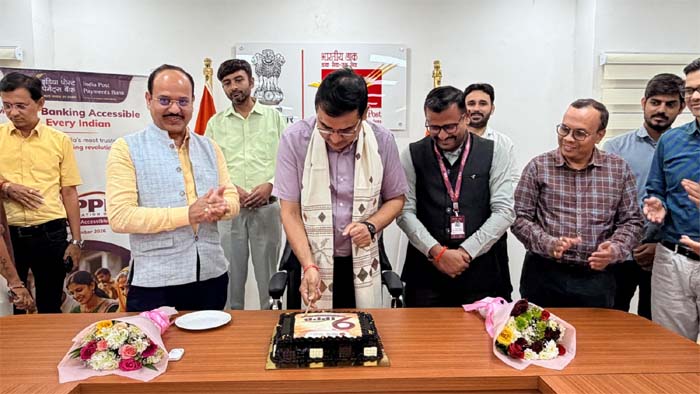

“As the world’s largest doorstep banking network, India Post Payments Bank has made ‘last-mile service’ the new hallmark of financial inclusion,” says Postmaster General, North Gujarat Region, Krishna Kumar Yadav, during the IPPB 9th Foundation Day celebrations in Ahmedabad — NE Photo
NE BUSINESS BUREAU
AHMEDABAD, SEPT 10
13.25 crore customers, 77% rural accounts and 48.8% women customers underline IPPB’s expanding role in digital and doorstep financial inclusion
What does it take to make a bank truly accessible to the last person in the queue—the villager without a nearby branch, the senior citizen who cannot travel easily, or the family waiting for a government benefit to reach its account? For India Post Payments Bank (IPPB), the answer has been to take banking to the doorstep.
Marking its 9th Foundation Day, IPPB showcased its expanding footprint in digital banking, doorstep services and financial inclusion, with its customer base growing from around 56 lakh in 2018-19 to 13.25 crore today. Of these, around 77% of accounts are in rural India and 48.8% of customers are women, highlighting the bank’s growing reach among traditionally underserved sections.
The Ahmedabad programme was inaugurated by Postmaster General, North Gujarat Region, Krishna Kumar Yadav, who said IPPB had transformed the idea of last-mile banking by combining the extensive reach of the postal network with digital technology.
“As the world’s largest doorstep banking network, India Post Payments Bank has played a significant role in bringing millions of citizens, particularly those residing in rural and remote areas, into the mainstream of banking and financial services by leveraging the extensive network of the Department of Posts and the power of digital technology,” Yadav said.
He said IPPB’s growth from around 56 lakh customers in 2018-19 to 13.25 crore customers today reflects the scale of its financial-inclusion mission. Around 10% of India’s bankable population is connected with IPPB, while nearly 12% of Direct Benefit Transfer (DBT) beneficiaries receive benefits under various government schemes through the bank, he said.
The bank is also expanding its digital footprint. IPPB ranks fourth in the country in UPI AutoPay, while in terms of the number of UPI outward transactions, it ranks ninth among banks, Yadav said.
Taking financial inclusion beyond the branch
IPPB Assistant General Manager, Gujarat Circle, Sandeep Kumar, said the bank was focused on making financial services more inclusive, accessible and convenient by taking them closer to people’s everyday lives.
Gujarat Circle currently has 45.50 lakh operational IPPB accounts, of which Aadhaar has been seeded in around 26 lakh accounts, he said.
The scale of doorstep banking is particularly visible across North Gujarat. IPPB Chief Manager Abhijit Jibhkate said more than 9.62 lakh IPPB accounts are operational across the region.
Through doorstep banking services, 3.13 lakh people have availed themselves of general insurance services, while 7.52 lakh customers have benefited from doorstep mobile-number updation.
Under the Child Enrolment Lite Client (CELC) initiative, more than 83,000 children have been enrolled for Aadhaar through doorstep services.
More than 1.80 lakh customers have received DBT payments totalling ₹53 crore, while approximately 79,000 Digital Life Certificates have been generated so far.
The bank’s digital adoption is also gathering pace, with around 2.18 lakh customers using mobile banking for online transactions and nearly 92,000 customers using virtual debit cards.
In another example of integration between postal savings and digital banking, around 1.25 lakh Post Office Savings Bank customers have linked their accounts with IPPB, enabling seamless transactions.
Nearly 5.10 lakh customers have linked their Aadhaar with IPPB accounts to receive DBT benefits and access doorstep cash withdrawals through postmen, Jibhkate said.
The programme was attended by Assistant Director Ritul Gandhi, Senior Manager IPPB Priyanka Kumari, Assistant Superintendents Jinesh Patel, Ramesh Patel and Ronak Shah, Postal Inspector Payal Patel, Bhavin Prajapati, Siddharth Rawal and Santosh Kumar, along with other postal officials and IPPB customers.