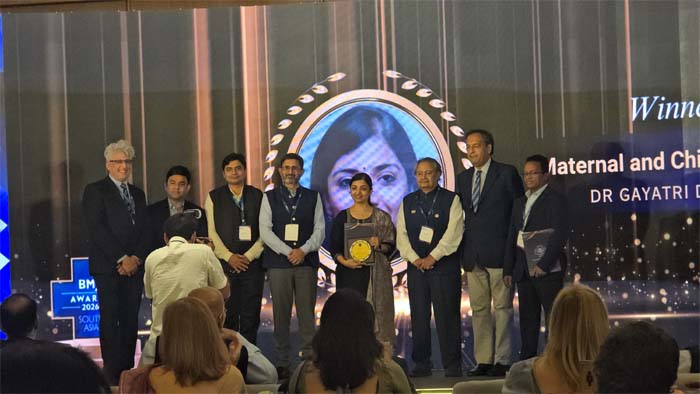
- Gujarat initiative recognised for cutting maternal mortality by more than 50% and stillbirths by 61% among pregnant women with sickle cell disease
- ‘SMALL STEP’ model screened around 35,000 deliveries and managed over 700 high-risk SCD pregnancies between 2016 and 2025
- Jhagadia-based team demonstrates that evidence-based specialist care can work even in remote, resource-constrained settings
- Dr Gayatri Desai-led initiative selected from more than 700 entries across South Asia
- Model combines screening, treatment, counselling and postpartum care to tackle a high-risk challenge among tribal women
NE HEALTH BUREAU
AHMEDABAD, SEPT 10
What if saving a mother’s life in one of Gujarat’s tribal communities does not always require a high-cost tertiary hospital—but the right diagnosis, timely intervention, evidence-based protocol and compassionate care close to home? That question lies at the heart of SEWA Rural’s award-winning maternal-health model, which has now earned international recognition after demonstrating measurable improvements in outcomes for pregnant women living with sickle cell disease (SCD).
The Bharuch-based voluntary organisation has won the BMJ Awards South Asia 2026 in the Maternal and Child Health Team of the Year category for its pioneering initiative, “SMALL STEP: Saving Mothers and Little Lives — Sickle Cell Screening, Treatment, Education in Pregnancy and Postpartum.” The initiative was led by Dr Gayatri Desai, Medical Director and Head of the Department of Gynaecology at SEWA Rural. BMJ lists the project among the finalists in the 2026 Maternal and Child Health category and describes the category as recognising integrated projects that improve access and affordability of maternal and child health services.
The recognition comes after SEWA Rural’s care model reported a more than 50% reduction in maternal mortality and a 61% reduction in stillbirths among women with SCD. The initiative was selected from more than 700 entries across South Asia, according to the organisation’s reported award details. The BMJ Awards are designed to recognise healthcare work demonstrating measurable impact on patients, communities or health systems.
The challenge: When pregnancy meets sickle cell disease
In southern Gujarat, sickle cell disease presents a particularly serious challenge for tribal communities.
According to data cited by SEWA Rural, an estimated 17% of the tribal population carries the sickle cell trait, while nearly 1.5% of women delivering at healthcare facilities are estimated to have active SCD.
The scale of the challenge became starkly visible when SEWA Rural assessed more than 10,500 tribal deliveries between 2016 and 2019.
Nearly one in 10 deliveries resulted in stillbirth, while around 70% of babies had low birth weight. Women with SCD also required blood transfusions at substantially higher rates and faced a significantly elevated risk of maternal death.
For a rural healthcare team, the data was not simply a statistic.
It was a warning that the existing system had to change.
From data to a dedicated care pathway
SEWA Rural responded by strengthening the identification, monitoring and treatment of pregnancies complicated by SCD.
Between 2016 and 2025, the organisation screened around 35,000 deliveries and managed more than 700 high-risk pregnancies involving SCD at its hospital in Jhagadia.
The team developed a dedicated care pathway bringing together obstetric and haematology care, supported by standardised clinical protocols.
Depending on individual risk, women received targeted blood transfusions, referral support through government hospitals and, in high-risk cases, structured second-trimester hydroxyurea therapy and prophylactic anticoagulation.
The approach was not confined to the hospital.
SEWA Rural worked with tribal families to co-design counselling strategies addressing stigma, fears surrounding screening and concerns about regular clinical follow-up.
The result was a model that sought to combine clinical science with something equally important in rural healthcare:
trust.
The numbers tell the story
The impact of the intervention was measurable.
Maternal mortality fell by more than 50%.
Stillbirths declined by 61%.
Blood-transfusion requirements also fell significantly, with the rate declining from 68.8 to 47.8 per 100 person-months.
For a community facing the combined challenges of geography, limited resources, stigma and a serious inherited blood disorder, the reductions represent more than clinical indicators.
They represent mothers who survived and babies who had a better chance to survive.
‘High-standard care does not have to depend on high-cost infrastructure’
Highlighting the significance of the recognition, Dr Gayatri Desai said the award underscored the possibility of delivering evidence-based specialised care even in remote and resource-constrained settings.
“Historically, pregnant women with sickle cell disease in remote areas faced tragic outcomes due to late diagnosis and limited access to specialised care. This recognition by the British Medical Journal demonstrates that high-standard, evidence-based clinical care can be successfully adapted to rural, low-resource settings without relying on high-cost infrastructure,” she said.
The quote captures the larger significance of the SEWA Rural experience.
The achievement is not simply that a rural institution treated a difficult medical condition.
It is that a rural care model produced measurable outcomes against a disease that can turn pregnancy into a life-threatening journey.
Small step, big lesson for India
The BMJ recognition places the SEWA Rural initiative in a wider South Asian context.
The official BMJ Awards platform says its 2026 awards recognise work that delivers meaningful and measurable improvements in patient outcomes, healthcare delivery and community health. The awards also emphasise evidence-based, ethical and patient-centred care. (South Asia Awards)
SEWA Rural’s experience fits that philosophy closely: identify the problem through data, develop a practical care pathway, involve families, measure outcomes and adapt the model to the realities of the community.
The organisation believes the experience can be adapted and scaled to improve maternal and newborn outcomes among tribal women living with sickle cell disease in other parts of India.
That may ultimately prove to be the award’s most important legacy.
For Gujarat’s tribal communities, SMALL STEP has shown that a small intervention, when built on evidence, empathy and persistence, can produce a very large outcome.
And sometimes, in maternal healthcare, one small step really can mean the difference between a life saved and a life lost.