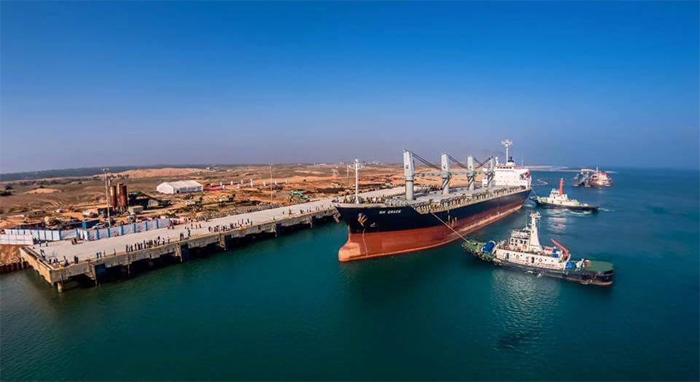
- APSEZ emerges highest bidder for Paradip Port’s CQ-I and CQ-II berths under a 30-year concession
- New 18 MMT mechanised dry bulk capacity to lift APSEZ’s overall portfolio to 671 MMT
- Paradip entry strengthens the group’s 140 MMT East Coast network spanning Haldia, Dhamra, Gopalpur and Gangavaram
- Strategic gateway to mineral-rich eastern and central India supports APSEZ’s ambition to handle 1 billion tonnes of cargo by 2030
NE BUSINESS BUREAU
AHMEDABAD, SEPT 10
For India’s rapidly expanding industrial heartland, the race is no longer simply about owning ports—it is about controlling the integrated logistics corridors that connect mines, factories and markets. In a strategic move to deepen that network, Adani Ports and Special Economic Zone Limited (APSEZ) has emerged as the highest bidder for two dry bulk berths at Paradip Port in Odisha.
The Letter of Award (LoA) for the development and operation of CQ-I and CQ-II berths gives APSEZ a major foothold at India’s second-largest major port and one of the country’s most important bulk cargo gateways on the eastern seaboard.
The project, to be developed under the Public-Private Partnership (PPP) model, will add 18 Million Metric Tonnes (MMT) of mechanised dry bulk capacity to APSEZ’s portfolio, taking its total capacity to 671 MMT and strengthening its pathway towards its stated ambition of achieving 1 billion tonnes of cargo throughput by 2030.
Paradip adds a strategic piece to East Coast network
Under the 30-year concession, APSEZ will develop the CQ-I and CQ-II berths with state-of-the-art mechanised cargo-handling systems, deep-draft berths and large-scale storage infrastructure.
The Paradip win gives APSEZ access to a strategically important industrial and mineral-rich hinterland and complements its existing 140 MMT capacity across Haldia, Dhamra, Gopalpur and Gangavaram.
The company said the addition will strengthen its ability to tap long-term cargo growth while expanding its integrated port, logistics and marine services across eastern and central India.
Ashwani Gupta, Whole-time Director and CEO, APSEZ, said: “The Paradip concession will strengthen APSEZ’s presence on the East Coast and expand our access to one of India’s most important industrial and mineral-rich hinterlands. With Paradip, APSEZ’s network grows to 16 ports and terminals across India’s 11,000-km coastline, strengthening our ability to deliver integrated port, logistics and marine solutions through the country’s most comprehensive transport infrastructure platform.”
From bulk cargo gateway to industrial growth engine
Located amid a mineral-rich hinterland and major steel-producing clusters, Paradip is India’s second-largest major port and a vital gateway for bulk commodities.
The new terminal is expected to strengthen APSEZ’s ability to handle rising volumes of coal, limestone and other dry bulk commodities, while extending its reach into core industrial and manufacturing clusters across eastern and central India.
The strategic importance goes beyond additional berth capacity.
With the region witnessing industrial expansion and growing demand for bulk cargo, a stronger logistics network around Paradip could help connect mineral resources and industrial production with domestic markets more efficiently.
Capacity expansion meets rising cargo demand
The project comes against the backdrop of high utilisation across India’s East Coast ports, as cargo volumes continue to grow.
The combination of hinterland steel-capacity expansion and the government’s push towards greater use of domestic coal is expected to sustain demand for dry bulk handling infrastructure.
Against this backdrop, the additional mechanised capacity at Paradip could help ease regional bottlenecks and provide greater logistics capacity for India’s industrial growth.
For APSEZ, the project represents another step in building a geographically diversified port network that links cargo generation centres, ports and inland logistics corridors.
The Paradip concession thus becomes more than an incremental capacity addition: it strengthens APSEZ’s East Coast architecture while giving the company another strategic gateway into one of India’s most resource-rich and industrially important hinterlands.