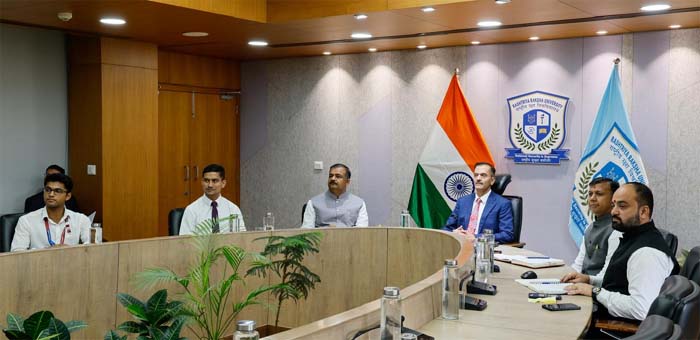
- More than 400 participants converge in Lucknow as police, CAPFs, defence, academia and industry join hands to reshape technology-enabled policing
- RRU-led summit translates Prime Minister Narendra Modi’s SMART Policing vision into a platform for technology, training, research and institutional reform
- Live demonstrations showcase AI, predictive policing, data analytics, drones, counter-drone systems, cybersecurity, digital forensics and OSINT
- Uttar Pradesh Police and Prison Department anchor discussions in operational realities, alongside CRPF, ITBP, SSB, Assam Rifles, NDRF and NIA
- Police Technology Mission, India seeks to turn policing challenges into indigenous research and technology solutions for a Viksit Bharat 2047
NE EDUCATION BUREAU
LUCKNOW, SEPT 10
What happens when the police station meets the laboratory, the start-up ecosystem and the defence technology world? The answer was on display in Lucknow on Thursday, where the 3rd Police Technology Summit 2026 brought policing, technology, academia and industry together to push India’s SMART Policing agenda from vision to operational reality.
Organised by Rashtriya Raksha University (RRU), in collaboration with the AIC RRU Incubation Foundation, the summit at the Atal Auditorium of Dr Shakuntala Misra National Rehabilitation University sought to advance Prime Minister Narendra Modi’s vision of SMART Policing through technology, training, institutional reform and community engagement.
The summit underscored a changing paradigm in law enforcement: the future of policing will depend not merely on manpower and conventional methods, but increasingly on how intelligently institutions can deploy data, artificial intelligence, surveillance, digital forensics, drones and indigenous technologies while retaining public trust.
The Prime Minister’s SMART Policing vision envisages policing that combines firmness with sensitivity, strategic capability with responsiveness, and technology with transparency and public trust. The Lucknow summit translated that vision into a collaborative platform connecting policing institutions with researchers, innovators, academia and industry.
Under the guidance of Union Home Minister Amit Shah and National Security Adviser Ajit Doval, the initiative seeks to strengthen policing capabilities and build lean, effective and technology-enabled institutions. Within this framework, the Police Technology Mission, India connects operational policing requirements with research, technology and indigenous innovation.
Why Lucknow matters
Holding the third edition in Lucknow gave the summit a distinct operational relevance. The scale and complexity of policing in Uttar Pradesh provided an important backdrop for examining technology adoption, institutional capacity and police-community engagement.
The strong participation of the Uttar Pradesh Police and Uttar Pradesh Prison Department further anchored the discussions in ground realities, ensuring that technology was examined not merely as an innovation showcase but through the prism of actual policing requirements.
As an academic institution dedicated to policing and national security, RRU occupies a unique position at the intersection of policy, operational experience, research and technology.
The summit’s theme, “Initiative Towards Shaping the Technology in SMART Policing,” reflected this approach, with deliberations focusing on the responsible use of technology to strengthen decision-making, operational effectiveness, accountability and citizen-oriented policing.
The summit was inaugurated virtually by Prof. (Dr.) Bimal N. Patel, Vice-Chancellor, Rashtriya Raksha University.
Dr. Manjari Chandra, Campus Director, RRU Lucknow Campus, highlighted the University’s commitment to supporting national priorities in policing and security through education, research, training and innovation.
Bhagwan S. Srivastava, ADG, Technical Services, Uttar Pradesh Police, was the Chief Guest, while Anil Kumar, IG, Central Reserve Police Force, attended as Guest of Honour.
400-plus participants, one technology ecosystem
More than 400 participants, including over 200 personnel from Police, Central Armed Police Forces, Defence and security organisations, took part in the summit, alongside academicians, researchers, innovators, technology experts and industry representatives.
The participating organisations included the Uttar Pradesh Police, Uttar Pradesh Prison Department, Sashastra Seema Bal (SSB), Central Reserve Police Force (CRPF), Indo-Tibetan Border Police (ITBP), Assam Rifles, National Disaster Response Force (NDRF), National Investigation Agency (NIA), Punjab Police, Uttarakhand Police, Central Command and NCC.
IIT Kanpur and Babasaheb Bhimrao Ambedkar University, Lucknow, were among the academic institutions participating in the summit.
The Uttar Pradesh Police and Uttar Pradesh Prison Department formed the largest contingents, while members of the Prantiya Raksha Dal participated as special guests.
From AI to counter-drones
A major attraction was the technology exhibition and live demonstrations, where institutions, start-ups and technology providers showcased emerging applications designed to address contemporary policing challenges.
The technologies on display included Artificial Intelligence, predictive policing, data analytics, drone and counter-drone systems, cybersecurity, digital forensics, smart surveillance, CCTV technologies and Open-Source Intelligence (OSINT).
The focus was not simply on what technology can do, but on how it can be responsibly integrated into policing systems to improve decision-making, operational effectiveness, accountability and citizen services.
The summit also opened avenues for joint research, training, internships, technology validation and police-academia-industry collaboration.
This strengthens RRU’s role as an institutional bridge capable of converting challenges emerging from the field into research questions, technology solutions and deployable innovations.
From technology showcase to policing transformation
The significance of the summit therefore extended beyond an exhibition of emerging technologies.
Its larger proposition was that SMART Policing requires an ecosystem—one in which police forces articulate operational challenges, academia develops knowledge, researchers test solutions, start-ups innovate, industry scales technology and institutions ensure responsible implementation.
Through the Police Technology Mission, India, RRU is seeking to build precisely such a collaborative framework.
The third edition of the summit connected national vision with institutional action, policing with academia, technology with operational need, and law enforcement with the community.
As India moves towards the Viksit Bharat 2047 goal, the emerging challenge is no longer whether technology will enter policing, but how intelligently, responsibly and inclusively it can be made to work for both the police and the citizen.