- Vadodara Bullet Train Station to connect the city’s education, industrial and employment ecosystem with Ahmedabad, Surat and Mumbai
- Station above Platform 7 will create seamless interchange between Bullet Train, Indian Railways and the GSRTC Central Bus Depot
- 534-metre FOB with travelators to become a crucial link between the high-speed rail station, railway station and bus depot
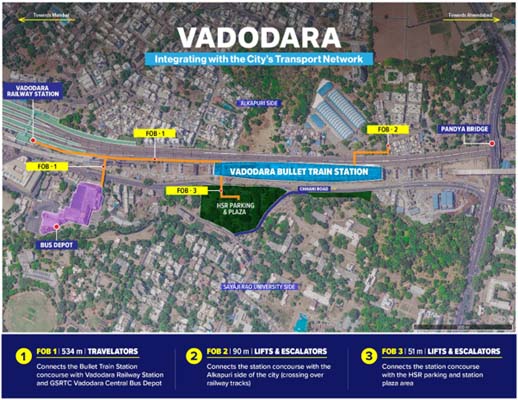
- Three integrated FOBs, dedicated parking, pick-up and drop-off zones and modern passenger facilities designed around seamless mobility
- Banyan Tree-inspired architecture reflects Vadodara’s identity while natural light, sky views and open passenger spaces shape the new gateway
NE RAILWAY BUREAU
VADODARA, SEPT 10
For a city where classrooms, laboratories, factories and start-ups increasingly shape the aspirations of its young population, speed is becoming more than a transport advantage—it is an opportunity multiplier. And Vadodara’s upcoming Bullet Train Station is being designed to make that connection tangible.
The Vadodara Bullet Train Station is set to become a new mobility gateway for students, young professionals, researchers, entrepreneurs and business travellers, bringing high-speed rail directly into the city’s existing transport ecosystem and opening faster connections to major centres along the Mumbai–Ahmedabad corridor.
Vadodara has long been one of Gujarat’s important education and knowledge hubs, with institutions such as Maharaja Sayajirao University of Baroda (MSU), Gati Shakti Vishwavidyalaya (GSV), Indian Institute of Information Technology, Vadodara (IIIT) and private universities including Navrachana University, Parul University and Sumandeep Vidyapeeth.
But the city’s opportunity landscape extends well beyond classrooms.
Its industrial and economic ecosystem spans engineering, manufacturing, pharmaceuticals, chemicals and emerging sectors, creating opportunities for employment, entrepreneurship, research, internships and professional exposure.
That makes mobility particularly important.
For thousands of students and young professionals, travelling to another city can mean accessing a university, appearing for an examination, attending an interview, pursuing an internship, conducting research, meeting a prospective employer or simply maintaining links with family.
The Bullet Train promises to compress the distance between these opportunities and Vadodara.
Not just high speed—the right connections
The Vadodara Bullet Train Station will strengthen this mobility by bringing high-speed rail into the city’s existing transport network.
Faster and more seamless connectivity towards Ahmedabad, Surat and Mumbai is expected to widen the geographical horizon for students and professionals, allowing them to access opportunities across the corridor while remaining better connected to Vadodara.
But the real differentiator is not merely the speed of the train.
It is how passengers reach the train—and where they can go after getting off it.
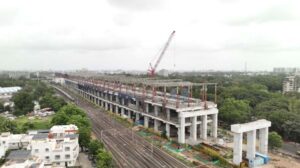
The station is being constructed above Platform No. 7 of Vadodara Railway Station, enabling direct integration between the Bullet Train and the Indian Railways network.
Its location also facilitates connectivity with the Western Railway station and the city and interstate bus depot, creating the foundation for a multi-modal transport hub.
For passengers, that means the journey can increasingly be viewed as one integrated movement rather than a series of disconnected transfers.
A 534-metre bridge to seamless mobility
Three Foot Over Bridges will reinforce this integration and reduce the friction involved in changing transport modes.
The most significant is FOB 1, a 534-metre-long connection linking the Bullet Train station with Vadodara Railway Station and the GSRTC Central Bus Depot.
Equipped with travelators, the facility is designed to make the interchange between rail and bus services easier and more comfortable.
FOB 2, measuring 90 metres, will connect the station with the Alkapuri side of the city, crossing over the railway tracks.
FOB 3, measuring 51 metres, will connect the station with the station parking and plaza, with lifts and escalators provided for passenger convenience.
Together, the three links are designed around a simple proposition: the high-speed journey should not be slowed down by the last few hundred metres of interchange.
Designed around the passenger
The station’s passenger facilities are planned to make the entire travel experience more convenient, not merely faster.
These include comfortable waiting areas, restrooms and retail facilities, dedicated pick-up and drop-off zones, separate parking facilities for cars, buses and autos, and a modern station plaza with passenger waiting spaces, landscaping and clear wayfinding.
Such integration is particularly relevant to students and young travellers, who often combine multiple modes of transport during a single journey.
The station can therefore become more than a point where passengers board a high-speed train—it can function as a mobility interface connecting rail, road, city and opportunity.
A gateway rooted in Vadodara
The station’s architecture is also intended to give the infrastructure a distinctly local identity.
Its design draws inspiration from the Banyan Tree, reflecting Vadodara’s association with the Vad tree.
Passenger areas have been conceived to admit ample natural light and provide external sky views, creating an environment that is open, contemporary and comfortable.
The architectural idea is significant: even as Vadodara prepares to join a new era of high-speed mobility, its new gateway seeks to retain a visual connection with the city’s own character.
From education to opportunity
The larger promise of the Vadodara Bullet Train Station lies in what it can enable beyond transportation.
A student could reach an educational opportunity in another city more efficiently. A young professional could expand the radius of employment possibilities. A researcher could access another institution or laboratory. An entrepreneur could connect with a larger commercial ecosystem.
In that sense, the station represents a shift from transporting people faster to connecting people with possibilities sooner.
The Vadodara Bullet Train Station is therefore not merely another railway infrastructure project. It is being positioned as a new gateway for youth mobility, economic opportunity and multi-modal connectivity, putting a city already rich in education and industry firmly on the fast track to the future.