
NE LEGAL BUREAU
NEW DELHI, SEPT 10
A State celebrated as a model for development, governance and public policy faces a compelling question from a very different quarter: can the “Gujarat model” also become a model for the welfare and retirement security of those who educate its next generation? The Supreme Court’s decision to examine a plea seeking a national framework for private-school teachers has now brought that larger question into sharp legal and policy focus.
The Supreme Court on Thursday agreed to hear a petition seeking a comprehensive national policy and appropriate statutory framework for the welfare, social security and post-retirement protection of private-school teachers across the country.
- Supreme Court notice to Centre, States, UTs and NCTE opens a national debate on uniform welfare and post-retirement protection for private-school teachers
- With 37.3 lakh teachers in recognised private unaided schools, plea seeks a national welfare board covering pension, provident fund, gratuity and grievance redressal
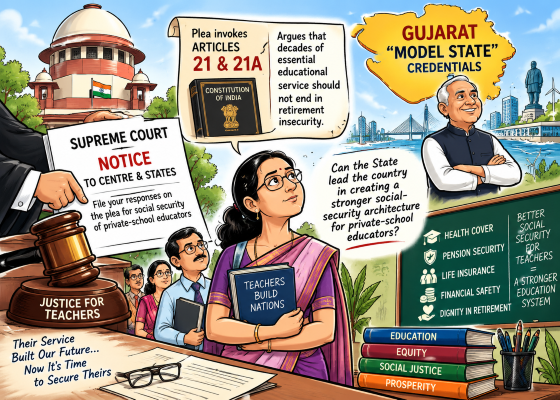
- Gujarat’s “model state” credentials add a compelling dimension: can the State lead the country in creating a stronger social-security architecture for private-school educators?
- Plea invokes Articles 21 and 21A, arguing that decades of essential educational service should not end in retirement insecurity
- Petitioner flags disparities in service conditions and welfare benefits arising from differing State laws, institutional practices and contractual arrangements
- Supreme Court’s 2022 gratuity ruling for teachers provides a significant legal backdrop to the fresh call for comprehensive post-retirement protection
A bench of Justices Vikram Nath and Sandeep Mehta issued notices to the Centre, all States and Union Territories and other respondents, including the National Council for Teacher Education (NCTE), seeking their responses to the plea.
The bench posted the petition, filed by Kerala-based petitioner Ligimol George, for hearing after four weeks. The petition has been filed through advocate Deepak Prakash.
At the heart of the case is a question that goes beyond an individual service dispute: should a teacher who spends decades educating the nation’s children reach retirement with social-security protection determined by the State, institution or contractual arrangement under which he or she served?
A 37.3-lakh workforce—and a welfare gap
The petition relies on data published by the Ministry of Education under the Unified District Information System for Education Plus (UDISE+) to underline the scale of the issue.
According to the plea, UDISE+ 2023-24 records approximately 14.72 lakh schools, more than 98 lakh teachers and nearly 24.8 crore students across India.
More significantly, 37,30,047 teachers are employed in recognised private unaided schools alone, the petition states, making them a substantial segment of the country’s teaching workforce.
The petitioner argues that despite their contribution to the constitutional mandate of education under Article 21A, there is no dedicated national statutory welfare mechanism or comprehensive institutional framework specifically addressing their long-term welfare and post-retirement social security.
“The continuing legislative and policy vacuum has resulted in arbitrary disparities between teachers performing substantially identical educational functions across different States and institutions,” the plea said.
For Gujarat, the issue carries an additional resonance. If the State is to continue being projected as a model of development and governance, the national debate presents an opportunity to ask whether it can also set a benchmark in protecting the social-security interests of private-school educators.
The question is not whether Gujarat should merely comply with a future national minimum standard. Could it instead emerge as a model for what comprehensive private-school teacher welfare should look like?
From right to education to right to dignity
The petitioner’s case rests substantially on constitutional principles.
The plea says private-school teachers perform an essential public function by contributing to the realisation of the constitutional mandate under Article 21A, yet continue to remain “deprived of a comprehensive, uniform and effective statutory welfare framework”.
It argues that education has consistently been recognised as a matter of paramount national importance and forms part of the welfare obligations of the State.
“Although education has consistently been recognised as a matter of paramount national importance and forms an integral part of the welfare obligations of the State, there exists no comprehensive central legislation or uniform national policy specifically providing for the long-term welfare, social security and post-retirement protection of private school teachers throughout the country,” the plea said.
The petitioner further invokes Article 21, contending that the constitutional guarantee cannot be rendered illusory by leaving an essential class of education professionals without adequate institutional protection after decades of service.
The plea says the existing legal framework remains fragmented and inconsistent, with service conditions and welfare benefits substantially influenced by varying State laws, institutional practices and contractual arrangements.
This, it argues, has produced significant differences in the protection available to similarly placed teachers across States and educational institutions.
Pension, PF, gratuity on the welfare-board table
The petition seeks a direction to the Centre to consider establishing a National Private School Teachers Welfare Board, or another appropriate institutional mechanism, to coordinate, implement and monitor uniform welfare measures.
The proposed framework includes:
- Pensionary benefits
- Provident fund compliance
- Gratuity compliance
- Effective grievance redressal
- Uniform welfare and social-security safeguards
- Post-retirement protection
The petitioner says a large number of private-school teachers retire after decades of essential educational service without adequate pensionary benefits, comprehensive medical assistance or an effective social-security mechanism capable of ensuring a life of dignity after retirement.
“The absence of a uniform statutory welfare mechanism has also resulted in considerable inequalities in service benefits and social security protections available to private school teachers across different States, institutions and managements,” the plea said.
Importantly, the petition makes clear that it is not seeking judicial intervention in the routine administration of private educational institutions or adjudication of individual service disputes.
“Rather, it seeks formulation of an appropriate national policy and institutional framework to address a long-standing legislative and administrative vacuum concerning the welfare and social security of private school teachers across India, consistent with constitutional principles…,” it said.
2022 gratuity ruling offers important legal backdrop
The fresh plea also comes against the backdrop of a significant Supreme Court ruling concerning teachers and gratuity.
In 2022, the Supreme Court upheld the constitutional validity of the Payment of Gratuity (Amendment) Act, 2009, which retrospectively extended gratuity protection to teachers. The litigation arose from the earlier legal position under which teachers had been excluded from the statutory definition of “employee” for purposes of gratuity.
The Court’s ruling upheld Parliament’s corrective intervention, providing an important legal precedent in the broader debate over welfare protection for teachers.
The present petition, however, seeks to take the welfare conversation considerably further—from one statutory retirement benefit to a comprehensive national architecture covering social security and post-retirement dignity.
That distinction could make the present proceedings significant from a wider public-policy perspective.
A national question with a Gujarat opportunity
The Supreme Court’s notice does not amount to a finding on the merits of the petitioner’s claims. The Centre, States, UTs, NCTE and other respondents will now have an opportunity to place their positions before the Court.
But the proceedings have already brought into focus a larger policy dilemma.
India’s private-school teachers constitute a vast and indispensable part of the education system. They teach children, build skills, support families and contribute to the country’s human-capital base. Yet, according to the petition, their welfare protections can vary substantially depending on where they work and who employs them.
That creates an uncomfortable disconnect between the national importance attached to education and the uncertainty surrounding the long-term welfare of some of those delivering it.
For Gujarat, the debate could carry particular significance.
A State that aspires to remain a model of development has an opportunity to demonstrate that development is not measured only by infrastructure, investment and economic growth, but also by how society protects those who spend their working lives building its human capital.
The Supreme Court has now opened the door to that national conversation.
The larger question is perhaps the simplest—and the most difficult:
If society entrusts teachers with the future of its children, should their own future after the classroom be left without a uniform safety net?