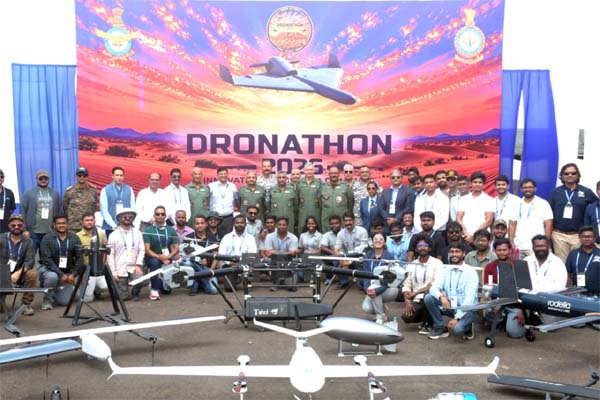
- Air Marshal Ashutosh Dixit inaugurates first Dronathon-2026 at Pokhran Field Firing Range in Jaisalmer
- Over 20 defence companies, start-ups, MSMEs, DPSUs and innovators showcase unmanned technologies under realistic operational conditions
- Surveillance, autonomy, swarms, electronic warfare and counter-drone systems put through demanding and contested scenarios
- IAF releases UAS Roadmap to align industry, academia and research with future capability priorities
- Indigenous ‘Vayu UTtaM’ demonstrates real-time tracking of military and civil drones,
- opening wider possibilities for airspace safety and public security
NE DEFENCE BUREAU
NEW DELHI, SEPT 14
The Indian Air Force has moved its unmanned warfare agenda from the laboratory to the range, with the inaugural Dronathon-2026 at Pokhran putting indigenous drone technologies through realistic operational trials—while its home-grown ‘Vayu UTtaM’ system demonstrated the ability to detect and track military as well as civil unmanned aircraft in real time.
Air Marshal Ashutosh Dixit, Vice Chief of the Air Staff, inaugurated the first Indian Air Force Dronathon-2026 at the Pokhran Field Firing Range, Jaisalmer, on Monday. The three-day event, being held from September 14 to 16, brings together more than 20 leading defence companies, start-ups, MSMEs, DPSUs and innovators from India’s rapidly expanding unmanned systems ecosystem.
The inaugural ceremony was attended by senior functionaries of the Ministry of Defence, Headquarters Integrated Defence Staff and representatives of the Indian Army and BSF.
Beyond the drone airframe
Dronathon-2026 reflects the IAF’s growing view that unmanned systems are no longer simply experimental platforms but force multipliers that can complement manned aviation and provide commanders with additional options to enhance the reach, persistence, responsiveness and flexibility of air operations.
Participating companies and innovators are demonstrating Unmanned Aircraft Systems (UAS) and associated technologies at the Pokhran range, with the emphasis firmly on what these systems can deliver in operational environments.
The demonstrations span surveillance and reconnaissance, autonomous operations, swarm technologies, electronic warfare and Counter-Unmanned Aircraft Systems (CUAS).
The central thrust is to move “from technology demonstration to operational effect”—assessing not merely whether a system works, but whether it can deliver reliable and effective performance in demanding, contested environments while adapting to changing operational requirements and emerging threats.
IAF opens its future UAS playbook
In a significant move to give industry a clearer direction, the VCAS also released the ‘IAF UAS Roadmap’ during the event.
The roadmap is intended to provide greater clarity to Indian industry on the IAF’s future capability priorities and facilitate focused innovation. It will also enable the unmanned airborne systems industry, academia and research organisations to align their efforts with the operational requirements of the IAF.
The message is clear: the next phase of India’s drone revolution will have to be driven not just by individual products, but by technologies capable of delivering integrated battlefield effects.
‘Vayu UTtaM’ takes centre stage
The opening day also witnessed a significant indigenous technology demonstration as the IAF successfully showcased a key capability of “Vayu UTtaM”, its indigenously developed multi-mode Unmanned Traffic Management (UTM) system.
During the real-time demonstration at Pokhran, Vayu UTtaM detected and tracked both military and civil UAS.
The system is designed to facilitate the coordinated management of unmanned aircraft operations in increasingly congested airspace while supporting the identification and timely mitigation of unauthorised or rogue drones.
Its significance extends beyond military operations. With the rapid proliferation of UAS, the technology could have potential applications in airspace safety, critical infrastructure protection, civil aviation and public safety.
Atmanirbharta moves beyond the airframe
Dronathon-2026 also underlines the IAF’s commitment to Atmanirbharta in unmanned systems, with the indigenous push extending well beyond the drone itself.
The ecosystem being developed encompasses propulsion, sensors and payloads, communications, autonomy, electronic warfare, countermeasures and airspace management.
In effect, Pokhran is becoming a proving ground not merely for India’s next generation of drones, but for the architecture of an unmanned battlespace in which sensing, decision-making, communications, autonomy and counter-drone capabilities converge.
The significance of Dronathon-2026, therefore, lies in its operational philosophy: India’s drone future will be judged not by how advanced a platform looks, but by how effectively it performs when the battlefield gets contested.