- 1,183 atomic sites mapped in monolayer amorphous carbon, revealing promising routes to metal-free hydrogen production
- Structural distortions, irregular bond angles and surface ripples emerge as potential catalytic advantages
- Machine learning and DFT uncover hydrogen-adsorption sweet spots across one-atom-thick carbon sheet
- Finding could open new design pathways for next-generation catalysts while reducing reliance on platinum and iridium
- Researchers caution that computational evidence now needs experimental validation before real-world deployment
NE ENERGY BUREAU
GANDHINAGAR, SEPT 16
Can disorder become an advantage in the quest for affordable green hydrogen? An IIT Gandhinagar study offers an intriguing answer: the very structural imperfections traditionally viewed as undesirable in materials may create the atomic environments needed to make hydrogen production more efficient.
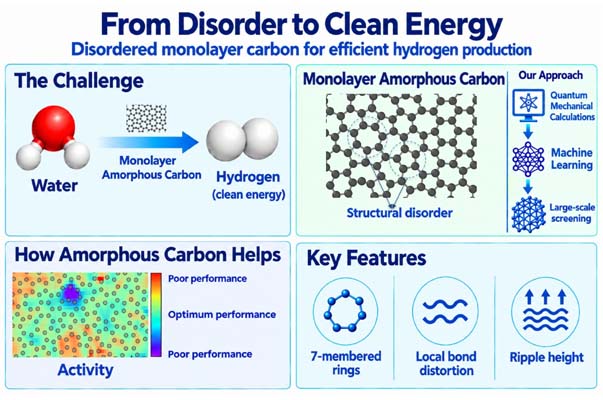
Researchers at IIT Gandhinagar (IITGN) have computationally investigated Monolayer Amorphous Carbon (MAC)—a one-atom-thick, structurally disordered form of carbon—and found that its irregular atomic architecture can generate a diverse range of potentially favourable sites for hydrogen adsorption.
Published in npj 2D Materials and Applications, the study mapped 1,183 potential reaction sites and found that around 15% had hydrogen adsorption free-energy values below +0.25 eV, indicating potentially favourable catalytic behaviour. The finding could point towards a future generation of metal-free carbon catalysts, potentially reducing dependence on scarce and expensive metals such as platinum and iridium.
The case for ‘perfect imperfections’
Unlike graphene, whose carbon atoms form an orderly hexagonal lattice, MAC contains a disordered network featuring five-, six- and seven-membered carbon rings.
The researchers created the MAC structure computationally using a melt-quench process—heating carbon until its ordered structure became randomised and then rapidly cooling it to retain the disordered arrangement.
This structural disorder creates multiple local environments, including variations in coordination, ring configurations and strain distributions. Rather than treating these irregularities merely as defects, the researchers investigated whether they could become catalytically useful sites.
The distinction is important because efficient water-splitting catalysts require hydrogen to bind neither too strongly nor too weakly to their surfaces.
“It is crucial to find the right balance. If the hydrogen from the raw material sticks too tightly to the surface of the catalyst, it becomes difficult to release hydrogen molecules. On the other hand, if it barely sticks at all, the reaction cannot proceed efficiently,” said Sreehari M S, first author of the study and a third-year PhD scholar in the Department of Materials Engineering at IITGN.
Finding the hydrogen-adsorption sweet spot
The researchers used the Gibbs free energy of hydrogen adsorption (ΔGH) to quantify this balance.
“A value close to zero is considered desirable because it would represent an interaction that is neither too weak nor too strong,” Sreehari explained.
The calculations showed a substantial difference among the carbon materials examined. Pristine graphene recorded a ΔGH of about +1.73 electronvolts, while β-graphyne, the best-performing crystalline carbon material studied, recorded approximately +0.34 eV.
The amorphous carbon surface, however, presented a much wider range of adsorption behaviour because of its heterogeneous atomic structure.
1,183 sites put through the computational microscope
Testing every possible hydrogen-adsorption site using high-accuracy computational methods would be extremely demanding. The team therefore combined Density Functional Theory (DFT) with MACE, a machine-learned interatomic potential.
DFT was used to generate high-quality calculations for selected sites, while the machine-learning model was subsequently employed to investigate a much larger number of sites.
“We employed the machine learning model to examine approximately 1,183 different sites on a larger MAC surface. We found that the surface behaved almost like a microscopic map of hills, valleys and neighbourhoods,” explained Ashutosh Krishna Amaram, who graduated with a BTech in Materials Engineering from IITGN and is currently a doctoral student at the University of Illinois, Chicago, and Argonne National Laboratory.
The predicted ΔGH values ranged from −0.91 to +1.70 eV, with approximately 15% of the sites recording values below +0.25 eV.
According to the researchers, these sites suggest potentially favourable catalytic behaviour and demonstrate how machine learning can help identify promising atomic configurations that would be difficult to screen exhaustively using conventional calculations alone.
Where the ‘imperfections’ become an advantage
One of the study’s most striking findings emerged from the analysis of the atomic structures surrounding the promising sites.
The researchers found that greater bond distortion, irregular bond angles and stronger surface rippling were associated with more favourable hydrogen adsorption.
Conversely, sites that retained a more graphene-like atomic distribution showed reduced catalytic efficiency.
In other words, structural irregularity—which is often regarded as a material imperfection—could actually become an asset for catalysis.
“This research provides a possible design blueprint for next-generation catalysts. While we provide computational evidence that MAC can efficiently generate hydrogen, there is a need for further experimental validation,” said Dr Raghavan Ranganathan, Associate Professor, Department of Materials Engineering, and Principal Investigator, Computational Molecular Engineering Group, IITGN.
“That said, machine learning could help researchers screen and design catalytic materials more efficiently, narrowing down promising structures before they are synthesised and tested experimentally,” he added.
From supercomputing to India’s hydrogen ambition
The research carries particular relevance as countries seek ways to reduce the cost of producing clean hydrogen through water splitting.
Conventional approaches can depend on scarce and costly metals such as platinum and iridium. A potentially low-cost, metal-free carbon catalyst could therefore offer an alternative direction for catalyst design, although the present findings remain computational and require experimental confirmation.
The study is also aligned with the objectives of India’s National Green Hydrogen Mission, which seeks to strengthen the country’s capabilities in producing, using and exporting green hydrogen while promoting technologies that improve efficiency and cost competitiveness.
Its broader implications extend beyond MAC itself: the research demonstrates how atomic-scale disorder can be deliberately studied and potentially engineered rather than automatically eliminated.
The authors acknowledged the use of IITGN’s Param Ananta supercomputing facility for carrying out the simulations reported in the study.