NE ENTERTAINMENT BUREAU
AHMEDABAD, SEPT 22
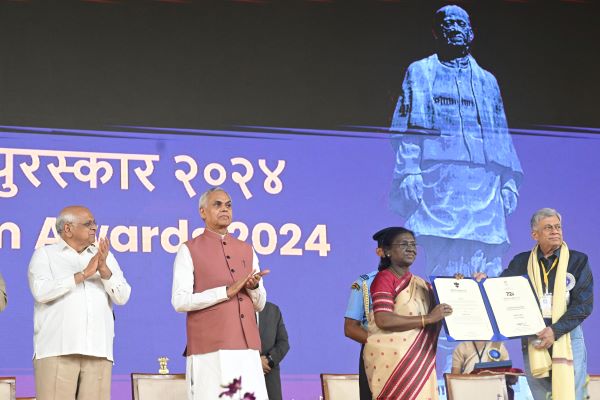
Can Indian cinema celebrate its extraordinary diversity while accepting a greater responsibility towards society, its workforce and the millions who look up to its stars? That compelling question resonated at the 72nd National Film Awards in Gujarat, where the rich storytelling traditions of Gujarati and Tamil cinema shared the national spotlight with President Droupadi Murmu’s clarion call to artists: use the power of cinema and celebrity to spread light, uphold dignity and inspire young people.
राष्ट्रपति श्रीमती द्रौपदी मुर्मु ने एकता नगर, केवड़िया, गुजरात में आयोजित समारोह में 72वें राष्ट्रीय फिल्म पुरस्कार प्रदान किए। उन्होंने श्री अनंत नाग को वर्ष 2024 का दादासाहेब फाल्के पुरस्कार भी प्रदान किया। pic.twitter.com/p6RCa4K6YV
— President of India (@rashtrapatibhvn) September 22, 2026
From Gujarati film Maaran to Tamil cinema’s Raayan, Amaran and Captain Miller, the awards showcased the reach of regional filmmaking. The ceremony, held at Ekta Nagar, Kevadia, on Monday, also marked a significant milestone in the National Film Awards’ journey beyond Delhi.
- President Droupadi Murmu presents 72nd National Film Awards at Ekta Nagar, Gujarat, and confers Dadasaheb Phalke Award 2024 on Anant Nag
- Gujarati cinema’s Maaran and Tamil cinema’s Raayan, Amaran and Captain Miller highlight the breadth of regional storytelling
- President calls for dignity and social security for workers, small artists, assistants and struggling members of the creative economy
- Urges women’s participation in every regional jury and asks popular stars to shun endorsements of products harmful to health
- Mammootty and Kartik Aaryan share Best Actor honours; Yami Gautam wins Best Actress for Article 370
- Awards move beyond Delhi, with future ceremonies envisaged across states and cities to showcase India’s cultural diversity
President Murmu presented the awards and conferred the Dadasaheb Phalke Award for 2024 on veteran actor Anant Nag, recognising his outstanding contribution to Indian cinema.
Addressing the gathering, she congratulated the award winners, commending their exceptional talent and hard work in earning national recognition.
‘Indian cinema embodies the dreams, traditions and struggles of people’
The President said Indian cinema reflects the country’s diverse languages, regions and cultures, embodying “the dreams, traditions, and struggles of the Indian people, as well as the possibilities for the future.”
She appreciated the choice of Ekta Nagar, near the Statue of Unity and the Wall of Unity, as the venue for the ceremony. The setting, she said, evoked the presence of Sardar Vallabhbhai Patel, architect of India’s unity, as though he were blessing a festival celebrating the country’s cultural unity.
The President said the quality of films being made in India strengthened her belief that Indian cinema could set world-class standards.
Gujarati and Tamil cinema take their place on the national stage
The awards brought regional storytelling into sharp focus, with Gujarati cinema’s Maaran receiving the Best Gujarati Film award. Directed by Abhishek Jain and produced by Cineman Productions Limited, the film represented Gujarat’s contribution to the national cinematic landscape.
Tamil cinema also secured recognition across multiple categories. Raayan, directed by Dhanush and produced by Sun TV Network, was named Best Tamil Film.
Amaran earned the Best Direction award for Rajkumar Periasamy, while G. V. Prakash Kumar received recognition for its background music. Captain Miller, directed by Arun Matheswaran, won the award for Best Feature Film Promoting National, Social and Environmental Values, with Dhanush also receiving a Special Mention.
The awards illustrated how films rooted in different languages and cultural settings can engage audiences across the country.
Beyond the Eighth Schedule languages, Garhwali and Tulu cinema also received national recognition. Dholi won Best Garhwali Film, while IMBU was named Best Tulu Film. Santhali film Angen received the Best Debut Film of a Director award in the non-feature category.
The recognition of films from diverse linguistic traditions reinforced the role of the National Film Awards as a platform for India’s many cinematic voices.
‘A true star spreads light, not darkness’
The President’s address went beyond cinematic achievement to underline the social responsibility accompanying popularity and influence.
She said popular film artists possess immense potential to influence people, particularly children and young people. When successful artists speak about the benefits of a disciplined lifestyle, millions of youngsters emulate them.
She urged celebrities not to endorse products harmful to health, emphasising that a true star is one who spreads light, not darkness.
The President also appreciated the award-winning films for engaging with important social and national concerns. She noted that Article 370 presented a vivid account of challenges facing the country’s unity and their solutions; Bhangaar explored dimensions of life and death, meaning and meaninglessness; Swatantrya Veer Savarkar offered an artistic tribute to Savarkar’s life; and Bhakshak raised awareness about women’s safety.
She said national recognition for Santhali film Angen encouraged outstanding filmmaking while fostering cultural diversity and social inclusion.
Dignity and social security for the creative workforce
The President underlined that filmmaking is a collaborative effort and urged award winners to convey her appreciation to every member of their teams whose contributions made their achievements possible.
She called for respect and sensitivity towards every member of the film industry, urging representatives of the creative economy to ensure that workers, small-scale artists, assistants and struggling members of the creative community receive due respect and social security.
She also commended the jury members for selecting films addressing significant societal and national issues.
Calling for women’s participation in every regional jury, she said a holistic human perspective in any field could be developed by incorporating women’s viewpoints.
Anant Nag: A lifetime of storytelling honoured
The Dadasaheb Phalke Award for 2024 was conferred on Anant Nag in recognition of his distinguished contribution to theatre and cinema.
The President praised his natural, restrained and authentic performances, describing his acting as a synthesis of the finest elements of theatre and cinema. She said he set an ideal example for future generations of artists.
Accepting the honour, Anant Nag expressed gratitude for the immense love he had received from people across the country.
Recalling his early years, he said he grew up in an ashram before being sent to Mumbai, where he got an opportunity to act in a play. Theatre became the foundation of his career, and he went on to perform in around 50 plays before entering films.
He subsequently worked in films, including those made by acclaimed filmmaker Shyam Benegal.
Anant Nag said he consciously chose Kannada cinema and made Bengaluru his karmabhoomi. Recalling that he had received the Padma Bhushan from the President last year, he expressed deep gratitude for receiving the Dadasaheb Phalke Award from her again this year.
Gujarat hosts a new chapter in national film awards
Gujarat Governor Acharya Devvrat expressed gratitude to the Ministry of Information and Broadcasting for beginning the tradition of holding the National Film Awards outside Delhi.
He said it was a matter of pride for Gujarat to host the ceremony at Ekta Nagar, associated with the legacy of Sardar Vallabhbhai Patel. The Governor said Indian cinema had contributed significantly to enriching the country’s diverse languages and cultures.
He urged filmmakers to use cinema to promote natural farming, healthy lifestyles and environmental consciousness, while strengthening values of love, brotherhood and national unity.
Chief Minister Bhupendra Patel welcomed the President and distinguished guests, describing the hosting of the prestigious ceremony at Ekta Nagar as a matter of pride for Gujarat.
He highlighted cinema as a reflection of society, a carrier of culture and a powerful medium for connecting human emotions. He said it could strengthen India’s global identity and soft power.
Highlighting Gujarat’s heritage, diverse landscapes and cultural traditions, Patel invited Indian and international filmmakers to choose the State for shooting films.
Awards to travel beyond Delhi
Union Minister for Information and Broadcasting Ashwini Vaishnaw said the National Film Awards would be taken to important tourist destinations across states and Union Territories to promote India’s cultural heritage and tourism.
He called upon states and Union Territories to propose tourist destinations for future editions.
Vaishnaw said the awards recognised not only those receiving honours but also the many people working behind the scenes. He called upon filmmakers and the film fraternity, with Prasoon Joshi as Chairman of Prasar Bharati, to help identify, nurture and promote raw talent from small towns.
Highlighting the Indian Institute of Creative Technologies as a new talent pool, he said around 380 students had enrolled in 13 courses, with an industry-driven curriculum. He also said the Prime Minister had approved 15,000 Creative Labs across the country to create opportunities for young people to learn emerging technologies and showcase India’s diverse culture.
Vaishnaw invited suggestions and ideas for WAVES 2027, scheduled for October next year, and said combined efforts by the government and creative fraternity could unlock India’s creative potential and help Indian talent reach global audiences.
National honours, many cinematic voices
The 72nd National Film Awards recognised achievements in feature films, non-feature films and writing on cinema for 2024. According to Information and Broadcasting Ministry Secretary Chanchal Kumar, 400 feature films across 34 languages and 161 non-feature films across 24 languages were received, with 22 feature-film and 23 non-feature-film awards conferred.
The major honours included Article 370 as Best Feature Film; Mammootty for Bramayugam and Kartik Aaryan for Chandu Champion sharing Best Actor in a Leading Role; and Yami Gautam winning Best Actress for Article 370.
Amaran won Best Direction for Rajkumar Periasamy, while Kalki 2898 AD was named Best Popular Film Providing Wholesome Entertainment. Randeep Hooda received the Best Debut Film of a Director award for Swatantrya Veer Savarkar.
The ceremony brought together popular cinema, regional storytelling, emerging talent and creative professionals from across India.
At Ekta Nagar, the celebration of cinematic excellence was accompanied by a larger message: India’s many languages and traditions enrich its cinema, while the influence of its artists brings with it a responsibility to society, the creative workforce and future generations.