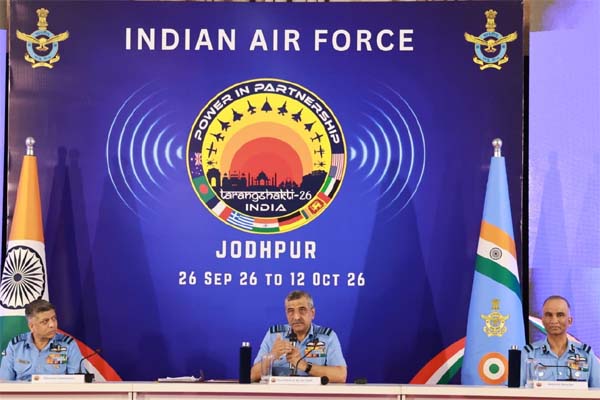
- Seven foreign air forces, 32 observer nations to join IAF’s second Tarang Shakti
- US F-35 to participate in an Indian multinational air exercise for the first time
- Exercise to test multinational operations, interoperability and complex combat missions
- Air Marshal Ashutosh Dixit says India will showcase its growing aerospace and defence capabilities
NE DEFENCE BUREAU
NEW DELHI, SEPT 23
What happens when F-35s, Rafales, F-16s, Tejas and other advanced air assets move from being individual platforms to becoming part of one multinational operational ecosystem? That question will be put to the test over the skies of Jodhpur as the Indian Air Force prepares to host the second edition of Exercise Tarang Shakti 2026 from September 26 to October 12.
The multinational exercise is shaping up as a major test of how different air forces plan, communicate, execute and debrief complex missions together, rather than merely a showcase of combat aircraft. The US F-35 will participate in an Indian multinational air exercise for the first time, while French Rafales and UAE F-16s are among the other advanced platforms expected.
Addressing the media at Jodhpur, Air Marshal Ashutosh Dixit, Vice Chief of the Air Staff, outlined the exercise’s focus on operational learning, interoperability and stronger partnerships.
“For many years, our operational engagement with foreign air forces was largely through bilateral exercises. We learnt to operate with one partner at a time. Tarang Shakti changed that approach,” Dixit said.
He described the 2026 edition as “the next logical step” after the first Tarang Shakti in 2024, when multiple air forces were brought together under one exercise framework.
Seven foreign air forces, 32 observers
The 2026 edition will bring together seven Friendly Foreign Countries participating with air assets, while 32 nations will attend as observers. The participating countries reported by the IAF include Australia, Bangladesh, France, Germany, Sri Lanka, the United Arab Emirates and the United States.
The exercise will cover a broad spectrum of air operations, including counter-air operations, air defence, combat, reconnaissance, airlift, air-to-air refuelling and other complex mission sets. Beyond Visual Range and Within Visual Range combat missions, dynamic targeting and combat search-and-rescue operations are also part of the operational canvas.
The exercise is designed to expose participating forces to realistic contemporary battlespace conditions and enable them to identify tactically viable solutions while comparing operational doctrines, procedures and best practices.
F-35’s first multinational exercise in India
The participation of the US F-35 fifth-generation stealth fighter has added a significant dimension to the exercise.
“For the first time, we are going to exercise with the F-35. It is coming. It had come to India earlier. It was part of Aero India, and then another UK-owned F-35 got stuck in Thiruvananthapuram. Now we will exercise with it,” Dixit said.
The multinational exercise is expected to feature a wide mix of platforms, including India’s Rafale, Su-30MKI, Tejas, Mirage-2000, Jaguar and MiG-29, besides foreign aircraft including US F-35s, French Rafales and UAE F-16s.
But the Vice Chief stressed that the exercise is not simply about assembling sophisticated aircraft.
“Tarang Shakti is not about the aircraft display alone. It is about what happens when these aircraft operate together, along with those who are behind these machines,” he said.
From bilateral drills to integrated operations
The IAF sees Tarang Shakti as an evolution from its traditional model of conducting largely bilateral exercises.
The maiden edition in 2024 involved 11 countries participating with air assets, with 45 aircraft flying 76 missions and generating more than 800 sorties, according to reports on the Vice Chief’s briefing.
The 2026 edition seeks to take that experience further by putting multiple air forces into a common operational environment.
The emphasis is therefore on interoperability—the ability of different forces, platforms, communications systems and operational doctrines to function together effectively.
Dixit said the exercise has three broad objectives: operational learning, greater interoperability and stronger military partnerships.
India’s aerospace industry gets a global window
Beyond operational training, Tarang Shakti also offers India an opportunity to present its expanding indigenous aerospace and defence ecosystem to international partners.
Dixit said the multinational exercise provides India an opportunity to showcase the “growing capabilities of Indian aerospace and defence industries” to friendly partner countries.
The timing is significant as India continues to pursue greater domestic capability in fighter aircraft, sensors, weapons, unmanned systems and other defence technologies.
The exercise also comes amid growing emphasis on lessons from recent conflicts, including the importance of precision, integrated air defence, unmanned systems, information dominance, space-based capabilities and multi-domain operations.
LCA Mk-1A, AMCA also in focus
The Vice Chief also provided an update on India’s indigenous LCA Mk-1A programme, saying earlier engine-supply constraints had been addressed and that testing was progressing.
He said only “two or three technical points” remained to be proven and indicated that induction could begin within a month or two, subject to completion of the remaining processes.
On the Advanced Medium Combat Aircraft (AMCA), the IAF has indicated support for indigenous development while simultaneously working on capabilities to detect and counter fifth-generation aircraft.
Tarang Shakti 2026, therefore, is set to be more than a gathering of advanced fighters. It will be a test of how effectively diverse air forces can learn, plan, communicate and operate together in a complex battlespace—while giving India a high-visibility platform to demonstrate its own evolving aerospace capabilities.