- NDDB launches Eastern Region initiative with IIT Kharagpur to strengthen oilseed production, aggregation, processing and market linkages
- MoU brings together NDDB’s cooperative and farmer-institution experience with IIT Kharagpur’s research, engineering and technology capabilities
- Mustard, groundnut, sunflower and sesamum cultivation targeted to raise farm incomes and reduce post-harvest losses
- Seed minikits distributed as field interventions begin; ICAR, BARC, KVKs and agricultural universities to provide technical support
- West Bengal explores stronger farmer-centric branding and direct market linkages for edible oils
- Initiative seeks to connect small farmers with storage, processing, finance, insurance, technology and organised markets
NE AGRICULTURE BUREAU
AHMEDABAD, SEPT 23
What if the biggest opportunity for India’s oilseed farmer is not merely to grow more seeds, but to capture more value after the harvest? That question lies at the heart of a new NDDB–IIT Kharagpur initiative that seeks to take Eastern India’s edible-oil economy beyond cultivation to aggregation, storage, processing, branding and market access—potentially changing how small oilseed growers participate in the value chain.
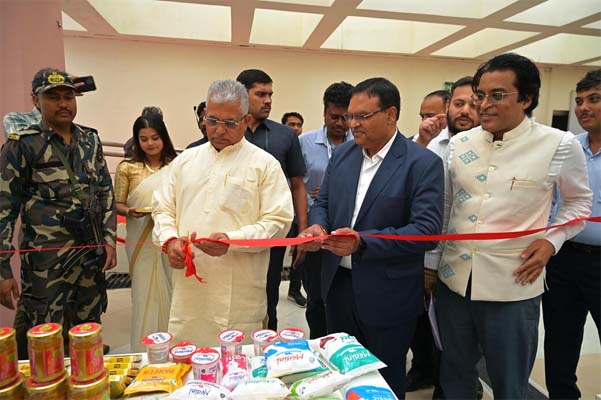
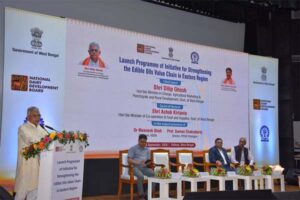
Dilip Ghosh, Minister-in-Charge, Agricultural Marketing & Panchayats and Rural Development, Government of West Bengal, on Wednesday launched the National Dairy Development Board’s (NDDB) Initiative for Strengthening the Edible Oils Value Chain in the Eastern Region at IIT Kharagpur Research Park, New Town, Kolkata.
The initiative brings together NDDB’s experience in building farmer institutions, cooperatives and Farmer Producer Organisations (FPOs) with IIT Kharagpur’s capabilities in research, engineering, technology, data analysis and post-harvest systems.
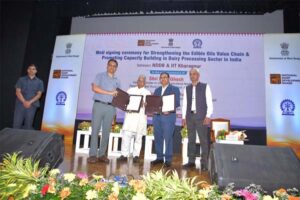
A Memorandum of Understanding (MoU) between NDDB and IIT Kharagpur was signed at the programme to facilitate collaboration in research, technology development, field validation, capacity building, post-harvest management, processing and value addition in the edible-oils sector.
Prof Suman Chakraborty, Director, IIT Kharagpur, joined virtually, while Dr Meenesh Shah, Chairman, NDDB, Ashok Kirtania, Minister of Cooperation & Food and Supplies, Government of West Bengal, senior officials of the state government, ICAR, NABARD and NDDB, besides representatives of dairy cooperatives, FPOs and farmers, attended the programme.
The farmer-income pivot
The initiative is designed to move oilseed farmers up the value chain rather than leaving them dependent solely on the sale of raw produce.
Ghosh highlighted West Bengal’s objective of increasing farmers’ incomes through cultivation of mustard, groundnut, sunflower and sesamum. The state Agricultural Marketing Department will work towards improving farmers’ access to aggregation, storage, processing and marketing infrastructure, with the twin objectives of reducing post-harvest losses and creating greater rural employment.
He also stressed the importance of integrating oilseed cultivation with the existing dairy cooperative network so that farmers can diversify their livelihoods.
The Minister highlighted the need for training, loan assistance and insurance facilities for oilseed growers, while underlining the role of cooperatives in giving small farmers stronger bargaining power.
The NDDB–IIT Kharagpur partnership, he said, would facilitate access to affordable technologies as well as procurement and marketing mechanisms for edible oils. He also indicated that the people of West Bengal are looking towards NDDB to strengthen the state’s agricultural infrastructure.
The state is also considering a West Bengal edible-oil brand, with the proposed initiative expected to provide stronger market linkages for oilseed farmers. Ghosh said such a move could also strengthen the cooperative sector and help address edible-oil prices.
From farm gate to processing gate
The MoU gives the initiative a wider technological canvas. NDDB will bring its experience in farmer-owned institutions, cooperatives, FPOs and field implementation, while IIT Kharagpur will contribute research, engineering, technology, data analysis and post-harvest expertise.
Technical support is also expected from ICAR, BARC, Krishi Vigyan Kendras (KVKs) and State Agricultural Universities.
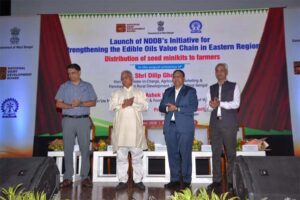
Seed minikits were distributed to participating farmers at the launch, marking the beginning of field-level interventions.
The focus on post-harvest systems is particularly significant because a stronger oilseed economy depends not only on productivity at the farm level but also on what happens between harvest and final consumption—aggregation, scientific storage, processing, value addition, branding and market access.
Cooperatives as the market bridge
Kirtania welcomed the initiative and suggested that a similar model could be considered for pulses, arguing that higher domestic production could help reduce imports and benefit consumers.
He said the shared objectives of the West Bengal Government and NDDB could ensure that the benefits of agricultural value chains reach farmers directly while reducing the role of intermediaries.
Kirtania also encouraged NDDB to develop reliable farmer-centric brands that could help producers increase output and connect more directly with markets and consumers.
That approach could potentially transform the farmer’s role from a supplier of raw material into a participant in a broader value chain spanning production, aggregation, processing and branding.
NDDB’s oilseed playbook
Dr Meenesh Shah said strengthening domestic oilseed production and the associated value chain remains a focused area for NDDB, with the Government of India according high priority to the sector under the National Mission on Edible Oils (NMEO).
NDDB is leveraging its experience in dairy cooperatives and farmer-owned institutions to work with cooperatives and FPOs in oilseeds. Its experience includes Operation Golden Flow, oilseed cooperatives and the Dhara brand.
NDDB has previously outlined a strategy centred on quality seeds, improved cultivation practices, farmer training and extension, oilseed cooperatives/FPOs and forward market linkages. The Board has also highlighted the importance of reducing India’s dependence on imported edible oils through higher domestic production and productivity.
Dairy–oilseed link: a second income stream?
A potentially distinctive feature of the Eastern Region initiative is the proposed integration of oilseed cultivation with dairy farming and allied activities.
Shah pointed to the potential of using oilseed by-products, farm residues and dairy waste within circular-economy models. Such integration could improve resource utilisation while creating additional income streams for farm households.
The broader idea mirrors NDDB’s experience with integrated farming systems, where dairy and multiple farm enterprises are combined to create more diversified and stable sources of income for smallholders.
The Eastern Region initiative, therefore, is not being positioned merely as an oilseed production programme. Its larger ambition is to build an ecosystem in which better seeds lead to better productivity, organised aggregation leads to stronger bargaining power, processing creates value, branding creates market identity and farmer-owned institutions retain a larger share of that value.
The launch of the initiative and the NDDB–IIT Kharagpur MoU mark the beginning of a long-term collaboration aimed at strengthening edible-oil production, aggregation, processing, value addition and market linkages across Eastern India through a farmer-centric and cooperative-led model.