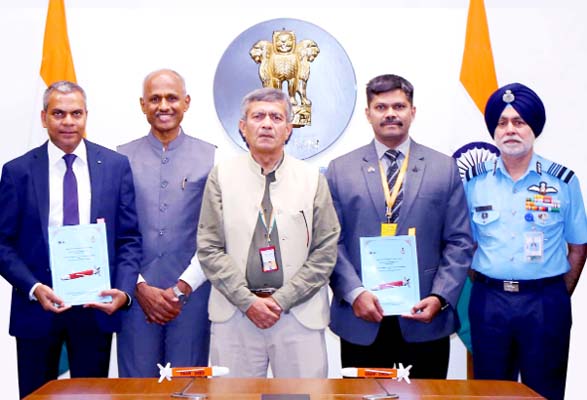
- MoD signs ₹810.79-crore contract with BDL for 160 Satellite Smart Anti-Airfield Weapons and associated equipment
- DRDO-developed precision glide bombs to equip Jaguar, Hawk and Su-30MKI platforms
- 60% indigenous content with further localisation of critical subsystems to deepen defence self-reliance
- Long stand-off capability designed to neutralise enemy airfield assets while keeping launch platforms at greater distance
NE DEFENCE BUREAU
NEW DELHI, SEPT 23
How far can an indigenous precision weapon extend the Indian Air Force’s ability to disrupt hostile airfield operations while keeping its launch aircraft at stand-off distances? The answer is taking shape with the Ministry of Defence’s latest ₹811-crore contract for 160 Satellite Smart Anti-Airfield Weapons (SAT-SAAW)—a DRDO-designed system that adds another layer to the IAF’s precision-strike capability.
The Ministry of Defence on Wednesday signed a ₹810.79-crore contract with Bharat Dynamics Limited (BDL) for procurement of 160 SAT-SAAW systems along with associated equipment for the Indian Air Force under the Buy (Indian–Indigenously Designed, Developed and Manufactured) category.
The contract was signed in New Delhi in the presence of Defence Secretary Rajesh Kumar Singh.
Precision strike from stand-off range
SAT-SAAW is an air-to-ground precision-guided glide bomb designed to be launched from platforms including the Jaguar, Hawk and Su-30MKI.
Its key operational attribute is its ability to engage enemy airfield infrastructure from a long stand-off range, potentially enabling the IAF to target critical airfield assets without requiring the launch aircraft to approach the target as closely.
Earlier DRDO disclosures have described the Smart Anti-Airfield Weapon as a long-range, stand-off precision air-to-surface weapon capable of engaging ground targets, while flight trials have demonstrated its development for operational use.
60% indigenous content
The latest procurement carries a substantial indigenisation component, with SAT-SAAW set to have 60% indigenous content.
The programme also provides for further localisation of key subsystems, including the Initial Measurement Unit, Long Impact Delay Fuse and Twin Store Carrier.
This combination of indigenous design, local content and subsystem indigenisation is intended to deepen domestic capability in precision-guided weapon technologies and strengthen the defence industrial ecosystem.
The procurement falls under the Buy (Indian–IDDM) category, which specifically emphasises indigenously designed, developed and manufactured defence systems.
BDL to deliver from 2027-28
The delivery schedule for the 160 SAT-SAAW systems is spread across 2027-28 and 2028-29.
Once inducted, the weapons are expected to enhance the IAF’s ability to conduct precision operations and maintain operational flexibility while strengthening overall defence preparedness.
The acquisition also adds to a broader recent emphasis on indigenous defence systems and domestic production. The Ministry of Defence has been advancing major procurement proposals under Indian and indigenously designed categories, alongside efforts to expand the capabilities of domestic defence manufacturers.
Aatmanirbharta takes the strike route
For India’s defence industry, the SAT-SAAW contract represents more than an equipment order. It links DRDO design and development, BDL production and IAF induction in a single indigenous weapons programme.
The focus on critical subsystem localisation is particularly relevant to building a deeper domestic technology base for precision weapons, reducing dependence on imported components and strengthening the resilience of the defence supply chain.
With deliveries beginning in 2027-28, the 160-weapon contract is set to translate an indigenous precision-strike technology into a larger operational capability for the Indian Air Force.