R ARIVANANTHAM
CHENNAI, SEPT 23
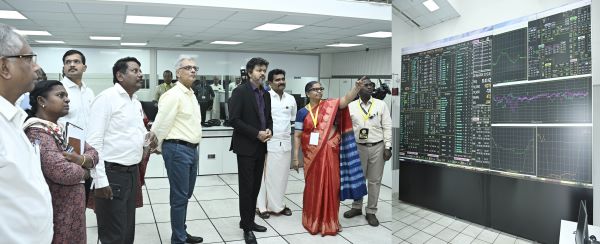
Can Tamil Nadu’s power system keep pace with a state where electricity demand is rising even as heat intensifies—and can the administration convert its ambitious grid-expansion plans into uninterrupted power for consumers? That question acquired fresh urgency on Wednesday as Chief Minister C Joseph Vijay made an on-site inspection of the state electricity utility’s headquarters on Anna Salai amid mounting complaints of unannounced outages and protests in several parts of the State.
The Chief Minister reviewed the functioning of key power-supply and control centres and was briefed on current electricity demand, generation, availability from renewable and non-renewable sources, the gap between demand and available capacity, and the continuing growth in consumption.
- CM Vijay makes surprise power headquarters inspection as unannounced outages trigger protests across Tamil Nadu
- Officials brief CM on generation, procurement, rising demand, distribution network and supply-demand gap
- Government had earlier ordered 231 new substations and recruitment of 15,058 electricity workers
- Minister Nirmal Kumar says demand could rise by up to 4,000 MW as heat and El Niño conditions intensify pressure
- 6,000 transformers slated for replacement as authorities seek to tackle overloaded local networks and recurring faults
- The immediate consumer question: can planned infrastructure expansion translate into uninterrupted supply on the ground?
The inspection came against a backdrop of recurring interruptions reported from Chennai and several districts, with some residents taking to the streets and blocking roads over night-time outages.
Power politics meets power reality
Vijay’s visit brought the immediate consumer problem and the longer-term infrastructure challenge into the same frame.
Electricity Minister C.T.R. Nirmal Kumar, power utility chairman Arun Rai and Green Energy Corporation managing director Sridhar were among those involved in discussions with the Chief Minister, according to the information available on the review.
Officials examined power generation and procurement, distribution constraints, transformer failures, maintenance and the preparedness of the network to deal with continuing demand.
Recent reporting has also pointed to complaints about localised outages and the strain on distribution infrastructure. In Tiruchirappalli, for instance, electricity demand reportedly touched around 550 MW during a period of high temperatures, with officials attributing disruptions to load shedding; more than 200 villagers subsequently staged a road blockade over repeated night-time outages.
4,000-MW demand question
The immediate challenge could become larger.
Nirmal Kumar said the State’s electricity demand could rise by up to 4,000 MW, while shortages were also being witnessed in parts of the country and in the Central generating pool.
The broader national power system is simultaneously facing pressure from unusually high temperatures. Reuters reported that nearly 40% of India’s coal-fired power plants had critically low fuel stocks in September, with heat-related demand and El Niño-linked conditions adding pressure to electricity supply.
For Tamil Nadu, therefore, the issue is not simply how much electricity is generated. It is also whether the transmission and distribution network can deliver available power reliably to the last mile.
₹15,032-crore grid expansion
The Vijay administration had already unveiled a major infrastructure response in June.
Following an Energy Department review, the government announced plans for 231 new substations at an estimated ₹15,032 crore and ordered the recruitment of 15,058 electricity workers to address faults and strengthen field operations.
The government had said that Tamil Nadu had adequate generation and procurement capacity, while attributing localised interruptions in some urban areas to ageing equipment, underground cable faults, increased consumption, maintenance work and accidental cable damage during road works.
The June plan also included around ₹2,275 crore of distribution-infrastructure works in the Chennai metropolitan area, while 121 new or upgraded substations were already being established across the State at a reported cost of ₹10,109 crore.
The administration had additionally announced 77 new Fuse-Off Call centres, seven additional breakdown repair teams, 125 repair vehicles, 10 high-level monitoring committees and two underground-cable fault detection teams to speed up complaint resolution.
The transformer bottleneck
Recent complaints, however, underline the difference between generation adequacy and local supply reliability.
Reports from Chennai have cited an overstretched distribution network, transformer failures and difficulties in the complaint-response mechanism as contributing factors behind frequent outages.
The administration is now looking at transformer replacement as another line of defence. Nirmal Kumar has said 6,000 transformers are to be replaced this year, while the State prepares for further demand growth.
The Minister has also appealed to consumers not to obstruct field personnel responding to faults, saying public frustration over interruptions is understandable but staff should not be prevented from carrying out repairs.
From power plans to power at the plug
The State’s current power challenge is thus unfolding on two tracks.
One is strategic: new substations, additional manpower, distribution upgrades, transformer replacement, renewable-energy expansion and greater procurement capacity.
The other is intensely local: a family waiting for the lights to return at night, a shop losing business, an industrial unit facing disruption or a farmer depending on a reliable supply for irrigation.
The State electricity utility itself maintains a 24×7 power-failure complaint facility, with 94987 94987 listed for consumers.
Wednesday’s inspection puts the administration’s response under sharper public scrutiny. The challenge is no longer merely to announce capacity expansion but to demonstrate that the investments, manpower and operational reforms can translate into faster fault restoration and dependable electricity at the consumer end.
For Tamil Nadu, the defining power question as the heat continues is therefore simple but consequential: will the State’s expanding power infrastructure reach the point where a growing demand for electricity no longer becomes a recurring demand for answers?