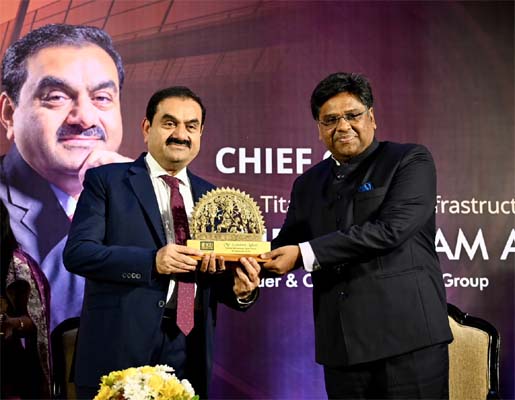
- Adani Group plans to deploy over ₹1 lakh crore across Bengal over the coming decade
- Ports, logistics, power, roads, green cement and hyperscale data centres in investment canvas
- Gautam Adani calls East India critical to India’s next trillion dollars of growth
- 2,000-bed Adani Arogya Mandir planned in New Town, with half the beds for those unable to afford quality care
- From Mundra to Bengal: Adani invokes Gurudev’s vision of an awakened, confident India
NE BUSINESS BUREAU
KOLKATA, SEPT 25
Bengal’s intellectual legacy, strategic geography and industrial heritage could make it a crucial springboard for India’s next phase of economic expansion, Adani Group Chairman Gautam Adani said, unveiling an ambitious vision to deploy over ₹1 lakh crore across West Bengal over the coming decade and calling for the East to become a new centre of economic gravity.
Addressing the Indian Chamber of Commerce (ICC) in Kolkata, Adani linked Bengal’s historic ability to “invoke the mind, challenge the limits of the possible and inspire an entire nation to rise” with what he described as a defining economic moment for India.
“For India’s next trillion dollars of growth, the East must rise. And this is where Bengal becomes essential to fulfil the vision of Viksit Bharat,” Adani said.
The proposed investment programme is expected to span ports, logistics, power generation, power transmission and distribution, roads, bridges and ropeways, green cement and hyperscale data centres.
Bengal as a strategic national node
Adani said Bengal’s location gives it a distinctive role in connecting India’s eastern industrial belt with the Northeast, Southeast Asia and the wider Indo-Pacific.
“To its west lie the mineral and industrial heartlands of Odisha, Jharkhand and Chhattisgarh. To its north and east lies the gateway to India’s Northeast. Through the Bay of Bengal lie some of the fastest-growing markets of Southeast Asia and the Indo-Pacific, with access to 60% of the global GDP and 65% of the global population,” he said.
“In the language of infrastructure, Bengal is not simply just another market. It is a strategic national node waiting for the expansion of its potential networks.”
Adani said the Group’s Bengal commitment would go beyond individual projects, with the proposed investments intended to create interconnected infrastructure and industrial ecosystems.
“Build ahead of demand”
Drawing on the Adani Group’s experience with data centres, Haifa Port and integrated logistics, Adani argued that businesses and governments must prepare infrastructure before demand becomes a constraint.
“We must therefore, now, build ahead of demand. We must create energy capacity before energy becomes a constraint. We must build ports, logistics, and industrial ecosystems before supply chains relocate. We must build digital infrastructure before the next wave of technology arrives.”
He highlighted the Group’s preparations for the rapid growth in AI-related data demand, its investment in Haifa Port and its integrated logistics network connecting 15 Indian ports with roads, rail, warehouses, airports, fulfilment centres and industrial parks.
“Scale creates size networks create strength,” he said, repeating the phrase for emphasis.
Mundra, Khavda offer the template
Adani cited Mundra in Gujarat and the Khavda Renewable Energy Park in Kutch as examples of how large infrastructure assets can evolve into broader economic ecosystems.
Mundra, he said, developed from a port on marshland into an economic ecosystem spread over 40,000 acres, as rail, roads, power, industry and the SEZ expanded its reach.
At Khavda, he said the renewable energy park covers 30 GW across 538 sq km, with renewable energy serving as the anchor for a larger industrial opportunity.
“The larger opportunity is not just the electricity Khavda generates; it is what that energy can attract. Energy infrastructure will no longer simply serve the industrial geography. Instead, energy infrastructure will create the industrial geography.”
He said difficult, capital-intensive projects could ultimately create competitive advantages because “the hardest infrastructure to build eventually becomes the hardest infrastructure to compete with.”
Growth with a human dimension
Adani also emphasised that Bengal’s development should not be measured merely in infrastructure and economic output.
“Development cannot ultimately be measured only in cargo volumes, megawatts, tonnes, or terabytes. Its true measure must remain deeply human.”
He announced the Adani Arogya Mandir, a 2,000-bed world-class medical institute in New Town, with half of its beds to be dedicated to people unable to afford quality medical care.
The Group also plans to support the revitalisation of Kumartuli Ghat, a curated Durga Puja programme celebrating Bengal’s artistes, and conservation of the historic Writers’ Building.
From Mundra to Bengal — a second karmabhoomi
Reflecting on his entrepreneurial journey, Adani recalled starting his journey with Mundra port three decades ago.
“Mundra in the West was to become my first karmabhoomi. Today, with the same humility and sense of responsibility, it is my prayer to Maa that Bengal in the East becomes my second karmabhoomi.”
He stressed that Bengal should not seek to replicate Gujarat.
“Not because Bengal must become another Gujarat — but because Bengal must become the strongest version of Bengal itself, drawing upon its geography, its intellect, its industrial legacy, and its historic ability to awaken the nation.”
Invoking Gurudev’s timeless vision
Adani concluded by invoking Rabindranath Tagore’s celebrated vision of an India where the mind is without fear, the head is held high and knowledge flows freely.
He shared a Hindi rendering of the spirit of Tagore’s prayer, ending with the refrain:
“मेरा भारत जाग जाए।”
The closing message tied together the central themes of his address — Bengal’s intellectual heritage, India’s eastern economic potential and the need to build an India that is “confident, fearless, and awake to its possibilities.”