- Three-year CSR programme targets five Bavla villages after needs assessment of 1,200+ households
- 500,000 CuM water harvesting, 1 MW+ clean-energy capacity and 10,000 indigenous trees on the transformation agenda
- Over 1,000 households to benefit from livelihood opportunities, skilling and women-led entrepreneurship
- SKF India and Ambuja Foundation join hands to build resilient, self-reliant and future-ready communities
- Water, energy, education, livelihoods and ecosystem restoration placed at the heart of integrated village development
NE BUSINESS/CSR BUREAU
PUNE, SEPT 25
Can a village development programme move beyond isolated CSR projects and create a self-reliant rural ecosystem? SKF India (Industrial) Limited and Ambuja Foundation are attempting to answer that question in Gujarat’s Bavla, where a three-year initiative has set itself a formidable transformation agenda across five villages and more than 1,200 households.
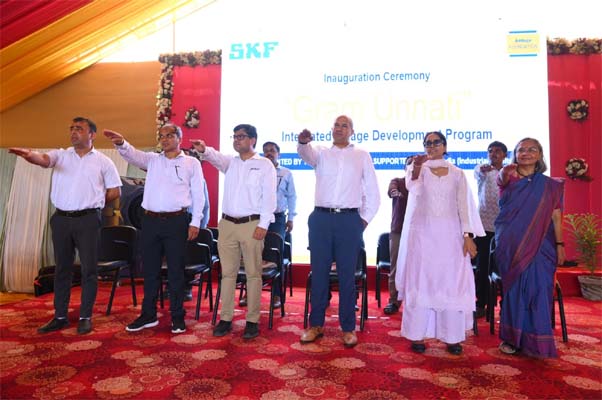
SKF India (Industrial), a technology and solutions provider in bearings, condition monitoring and services, on Thursday launched Gram Unnati, its flagship Integrated Village Development Programme (IVDP) in Bavla, Ahmedabad district, in partnership with Ambuja Foundation.
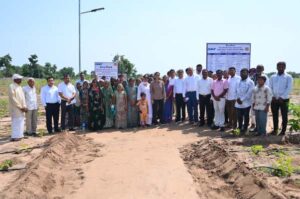
The programme will cover Baldana, Dahengamda, Kochariya, Bhayla and Zekda, with the stated objective of driving sustainable and measurable community development while strengthening local ownership.
And its targets are distinctly measurable: more than 500,000 cubic metres of water harvesting, 1 MW-plus of renewable-energy capacity, 10,000 indigenous trees and enhanced livelihood opportunities for over 1,000 households during the three-year programme.
From water security to economic security
Gram Unnati has been designed around a needs assessment covering more than 1,200 households, identifying water scarcity, limited livelihood opportunities, inadequate infrastructure and dependence on conventional energy sources among key challenges.
The response is deliberately integrated rather than single-sector.
The programme will undertake watershed development, clean drinking-water solutions, afforestation, solar and biogas energy systems, women-led entrepreneurship programmes, vocational skilling, farmer collectivisation and education enhancement initiatives.
Over the next three years, the initiative will focus on strengthening water availability, expanding clean-energy access, improving education outcomes, creating sustainable livelihoods and restoring local ecosystems through community-led stewardship.
“Long-term progress is created when…”
Sujeeth Pai, Managing Director, SKF India (Industrial), said: “At SKF, sustainability goes beyond our operations and extends to the communities around us. Gram Unnati reflects our belief that long-term progress is created when environmental stewardship, economic opportunity and community development advance together. Through this initiative, we aim to improve water security, strengthen education and livelihood opportunities, generate clean energy, and deliver income uplift for participating households, while building a scalable model for inclusive and sustainable rural development. By strengthening the grassroots, Gram Unnati supports India’s broader vision of Viksit Bharat through more self-reliant and future-ready communities.”
Community-led transformation at the core
Chandrakant Kumbhani, CEO, Ambuja Foundation, said the partnership seeks to combine the Foundation’s grassroots experience with tangible and measurable outcomes.
“The launch of Gram Unnati marks an important milestone in our partnership with SKF and reflects our shared commitment to creating sustainable, measurable and community-led rural transformation. Over the next three years, the initiative will work across five villages of Bavla Block of Ahmedabad district, taking an integrated approach to their overall development. SKF’s commitment enables us to combine Ambuja Foundation’s grassroots experience with ambitious, tangible outcomes in water harvesting, renewal energy, infrastructure, education, afforestation, and enhancing livelihood opportunities etc. Through Gram Unnati, our aim is not only to achieve these measurable results, but also to strengthen community institutions and local ownership, building villages that are more resilient, prosperous and self-reliant for the long term.”
Five villages, one integrated development vision
The programme’s intervention areas are designed to reinforce one another. Better water availability can support agriculture and livelihoods; clean energy can reduce dependence on conventional sources; skilling and entrepreneurship can widen income opportunities; and education initiatives can strengthen long-term human capital.
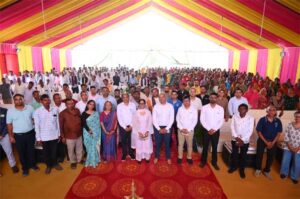
Women-led entrepreneurship, vocational training and farmer collectivisation will form part of the livelihood strategy, while watershed development, afforestation and ecosystem restoration will address environmental resilience.
The programme also complements the Gujarat government’s expanding Van Kavach model under the Hariyali Lok Sabha initiative, which aims to cover 82 sites spanning 600 hectares across Ahmedabad and Gandhinagar this year.
The Gram Unnati model thus places the village—not an individual intervention—at the centre of its CSR strategy, with community participation and local ownership intended to determine whether the three-year effort can translate ambitious targets into lasting rural resilience.