- At Sadu Mata Ni Pol, a centuries-old ritual turns Navratri into a living theatre of memory, penance and devotion
- Men enter the Garba circle in sarees on Ashtami to honour Sadu Maa and fulfil vows
- ‘Ek Gaatha, Ek Garba’ brings the enigmatic Sadumaa story alive through music, theatre and storytelling
- Old Ahmedabad’s pol culture meets immersive performance in a Navratri experience unlike conventional Garba nights
- Gentlemen can arrive in full traditional get-up — saree, jewellery and all — for the October 18 experience
NE ENTERTAINMENT BUREAU
AHMEDABAD, SEPT 25
What if the most intriguing Garba of Ahmedabad is not danced in a glittering party ground, but inside an old pol where men drape sarees, enter the circle and dance in devotion to Sadu Maa? In the labyrinthine lanes of the Old City, Saduma na Garba keeps alive a tradition believed to be more than two centuries old — a ritual wrapped in a legend of a woman, a curse, repentance and faith.
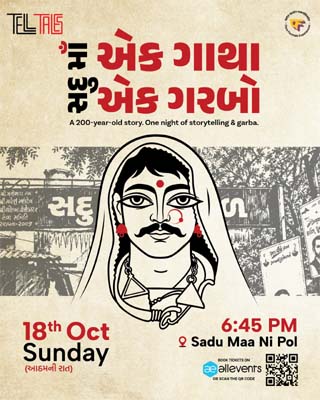
Now, that extraordinary story is set to receive a theatrical retelling through “Ek Gaatha, Ek Garba at Sadumaa Ni Pol”, presented by Tell Tales, blending music, theatre, storytelling and the atmosphere of old Amdavad.
And there is one delightful twist: men attending the event can join the spirit of the tradition by arriving in full get-up — saree, jewellery and all.
The Garba where the costume carries a story
Unlike the familiar Navratri spectacle of coordinated chaniya-cholis, dazzling lights and commercial Garba venues, Sadu Mata Ni Pol has long been associated with a deeply rooted Sheri Garba tradition.
According to local belief, the custom traces its origins to Saduben/Saduba, whose story is linked to a curse placed on the men of the community after they failed to protect her honour. The subsequent saree-clad Garba is regarded as an act of appeasement and atonement.
The tradition is particularly observed on Ashtami, the eighth night of Navratri. Men of the Barot community have traditionally dressed in women’s clothing and performed Garba at Sadu Mata Ni Pol; over time, the practice has also drawn participation beyond the community.
For devotees, however, it is not merely about the striking visual of men in sarees. The ritual is also associated with gratitude for fulfilled wishes, remembrance and seeking the deity’s blessings.
A legend becomes live theatre
It is this unusual intersection of history, oral tradition, faith and performance that Tell Tales seeks to explore through Ek Gaatha, Ek Garba.
Rather than presenting another conventional Garba evening, the programme promises to bring the story of Sadumaa to life through music, theatre and storytelling, with the pol itself providing the atmospheric backdrop.
The result could be less a performance watched from a distance and more an encounter with an old Ahmedabad tradition in its own living habitat.
When the pol becomes the stage
Venue: Sadumata Ni Pol, Old City, Ahmedabad
Date: October 18, Sunday
Tickets: Available through the event booking link provided by the organisers.
Donations, sponsorships and advertisements: Solicited.
For further information, organisers have invited people to contact Prof Preeti Das, award-winning journalist and storyteller, at +91 99090 15983.
A tradition that refuses to disappear
The continuing fascination with Saduma na Garba lies precisely in its mystery. Why do men wear sarees? What happened to Saduben? How did an old legend become a ritual repeated through generations?
The answers live partly in oral histories and local belief, while the ritual itself remains visible year after year. The Indian Express has described the practice as a unique Sheri Garba tradition in which men dress in sarees and dance on Navratri’s eighth night; recent coverage has again highlighted its distinctive character and its more-than-200-year-old legacy.
This Navratri, Ek Gaatha, Ek Garba promises to take audiences beyond the beats of the dhol and into the story behind the circle — where a saree becomes a symbol, a pol becomes a stage, and Garba becomes a living memory of Ahmedabad.