

NE LEGAL BUREAU
NEW DELHI, SEPT 25
That constitutional and statutory question has reached the Supreme Court, with a fresh plea challenging decisions, guidelines and software changes allegedly undertaken by Chief Election Commissioner Gyanesh Kumar without the concurrence of the other two Election Commissioners.
- Plea challenges alleged unilateral decisions, SIR-related directives and software changes attributed to CEC Gyanesh Kumar
- Petitioner invokes Section 18 of 2023 law, says majority view—not individual authority—must govern Commission decisions
- Form 6 alteration, centralisation of electoral-roll systems and Goa and West Bengal cases figure among allegations
- Plea seeks declaration that decisions without required concurrence are unconstitutional, ultra vires and void
- It also seeks criminal proceedings, preservation of digital records and an independent judicial inquiry into the allegations
- ECI maintains SIR decisions were approved unanimously by all three Election Commissioners
- Can the Chief Election Commissioner act independently on matters assigned to the Election Commission—or must decisions of a multi-member poll panel reflect the collective view of its members?
Filed by advocate Shailendra Mani Tripathi through advocate Chand Qureshi, the petition seeks a declaration that decisions allegedly taken without the concurrence of the full Commission, or contrary to its majority view, are unconstitutional, beyond the CEC’s powers and void.
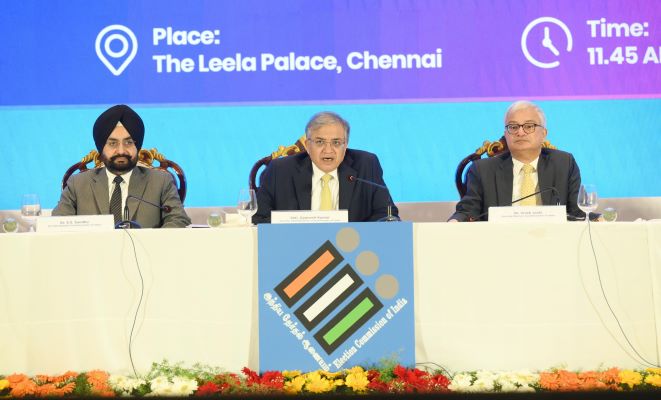
The plea comes amid a wider controversy over the Special Intensive Revision (SIR) of electoral rolls and reports that Election Commissioners Sukhbir Singh Sandhu and Vivek Joshi had recorded objections to several decisions attributed to the poll panel.
The Election Commission, however, has rejected the reported account of internal discord, maintaining that decisions, including those concerning SIR, were taken with the approval of all three Commissioners.
The Section 18 question
At the heart of the petition is Section 18 of the Chief Election Commissioner and Other Election Commissioners Act, 2023, which provides for decision-making by the Election Commission and stipulates that where there is a difference of opinion, the majority view prevails, according to the plea.
The petitioner argues that the CEC is the “first among equals” in the three-member Commission and does not possess a superior vote or veto over the other Election Commissioners.
The petition consequently asks the court to examine whether decisions allegedly initiated, approved or implemented without the required Commission concurrence can stand in law.
It seeks a writ declaring such decisions, guidelines, directives and software modifications “unconstitutional, ultra vires, and void ab initio.”
Form 6 becomes a key battleground
One of the principal issues raised concerns Form 6, used by individuals seeking registration as voters.
The petition alleges that an additional requirement linked to the previous SIR was introduced through the Election Commission’s digital system without the statutory amendment required under the electoral rules.
According to reporting based on internal records, Election Commissioners Joshi and Sandhu had objected to the change, arguing that the statutory Form 6 could not be altered without following the prescribed legal procedure.
The disputed declaration asked new applicants whether their own name, or that of a parent or grandparent, appeared in an electoral roll from the previous SIR.
The Election Commission has offered a different account: it has said Form 6 itself was not changed, describing the additional requirement as a separate Annexure D declaration associated with the SIR process.
That distinction could prove significant to the legal examination of the issue.
From software changes to field-level authority
The plea goes beyond Form 6.
It alleges increasing centralisation of the Election Commission’s digital systems, with potential implications for the statutory role of Electoral Registration Officers and other field-level officials.
It also raises issues relating to electoral-roll revisions in Goa and West Bengal.
In Goa, the petitioner alleges that the software lacked a mechanism to restore 97 eligible electors despite directions for their verification.
In West Bengal, the plea refers to more than 16.10 lakh appeals filed in the name of the Election Commission concerning voters whose names had been restored by judicial officers, alleging that the other two Election Commissioners and the state Chief Electoral Officer were unaware of or had not authorised those appeals. These are allegations in the petition, not judicial findings.
July 28 order also challenged
Another issue concerns a July 28 order relating to allocation of administrative responsibility for the Election Commission’s IT division.
The petition alleges that the order was objected to by the two other Election Commissioners, who subsequently sought its withdrawal and questioned its validity under Section 18 of the 2023 Act.
The petitioner has also sought preservation of server logs, databases, communications and metadata relating to the Commission’s electoral-roll management systems from October 1, 2025 onwards.
Criminal proceedings sought
The plea goes beyond seeking judicial scrutiny of the disputed decisions.
It seeks initiation of criminal proceedings against the CEC and other officials under provisions relating to alleged breach of official duty. The petitioner argues:
“Divested of any statutory or constitutional immunity, the Chief Election Commissioner remains directly accountable under the law — subject to police investigation, evidence gathering, and regular trial proceedings as an ordinary accused.”
The petition also seeks an independent judicial inquiry into the allegations and directions for restoration of the 97 voters in Goa and similarly placed persons.
The New Indian Express reported that the petition additionally seeks action against senior Election Commission officials and an inquiry into allegations concerning the SIR process.
Political battle intensifies alongside legal challenge
The legal challenge comes against the backdrop of an increasingly sharp political dispute over the Election Commission and the SIR exercise.
Leader of Opposition in the Lok Sabha Rahul Gandhi has criticised CEC Gyanesh Kumar and demanded his resignation, while alleging irregularities under the broader “vote theft” charge. The BJP has rejected Gandhi’s allegations and defended the Election Commission’s process and majority-based decision-making.
BJP leaders have also criticised Gandhi’s remarks. Rajya Sabha MP Upendra Kushwaha said: “Such language should not be used. Conflict between two sides is normal. Conflict is not unnatural. The authorities responsible for looking into the matter will take necessary steps. Please let them do their job.”
Jammu and Kashmir BJP MLA Vikram Randhawa and BJP leader Dilip Ghosh also criticised Gandhi’s comments, with Ghosh questioning whether Gandhi could determine who should be arrested.
Meanwhile, Jan Suraaj Party founder Prashant Kishor alleged that the Election Commission’s “partiality” had given the BJP an “undue advantage”, while linking his criticism to his experience during the 2021 West Bengal Assembly election campaign. Those claims are political allegations and are not established findings of a court.
The larger constitutional question
The immediate legal issue may appear technical—whether particular orders, guidelines or software changes were properly authorised.
But beneath it lies a larger institutional question:
In a three-member constitutional election authority, where does individual authority end and collective decision-making begin?
The petitioner says the answer lies in the statutory requirement of Commission decision-making and the majority principle under Section 18.
The Election Commission’s position, as reported, is that its decisions—including those concerning SIR—were unanimously approved.
The Supreme Court’s eventual consideration of the plea, therefore, could bring greater clarity to the legal boundaries governing the CEC, the other Election Commissioners and the manner in which India’s election-management machinery exercises its statutory powers.
For now, the allegations remain allegations. The court’s scrutiny—and the response of the Election Commission and other respondents—will determine how the disputed claims are ultimately tested in law.


