NE NEWS SERVICE
NEW DELHI, SEPT 27
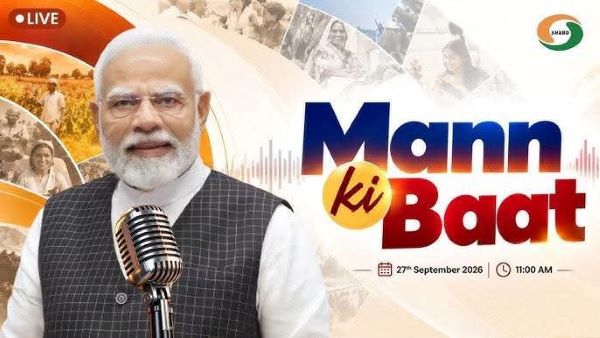
Can a single national conversation connect counter-terrorism, a digital census, heritage conservation, solar energy, wildlife, youth mobilisation, nutrition and village entrepreneurship? Prime Minister Narendra Modi’s 138th episode of Mann Ki Baat on Sunday attempted precisely that, weaving together India’s security experience with a broader message of citizen participation, technological adoption, cultural continuity and grassroots development.
Do listen to this month's #MannKiBaat as we discuss a range of subjects. https://t.co/uNlANtGly7
— Narendra Modi (@narendramodi) September 27, 2026
With the 10th anniversary of the September 28-29, 2016 surgical strikes falling the following day, Modi opened the programme by recalling the operation and describing it as a new example of India’s counter-terrorism policy. He said India had subsequently demonstrated its response to terrorism through the Balakot airstrike and Operation Sindoor.
- PM marks 10 years of surgical strikes, says India’s counter-terror policy has entered an era of “zero tolerance”
- Census emerges as a “national responsibility” with more than 2.6 crore people already using mobile self-enumeration
- Ashok Singhal remembered on birth centenary; PM links his legacy to Ram Janmabhoomi movement
- From Somnath and Modhera to Manapparai, PM spotlights India’s living heritage and resilience
- Youth-led cleanliness, wildlife conservation and drug-free campaigns form a wider Jan-Bhagidari narrative
- Amla, Moringa, millets and One District One Product become examples of local enterprise meeting national priorities
“Today, India pursues a zero-tolerance policy against terrorism.”
Modi also recalled the September 2008 Delhi serial blasts and the 26/11 Mumbai attacks, while paying tribute to Indian victims of the September 11, 2001 attacks in the United States.
A digital census, a national responsibility
From national security, the Prime Minister shifted to a very different exercise—the Census 2027—describing it as a collective national responsibility.
He said the first phase was nearing completion across States and Union Territories, with data of more than 32 crore families recorded, while work continued in snow-bound and remote areas.
The digital dimension received particular emphasis. Modi said more than 2.60 crore people had already completed self-enumeration through the Census portal using their mobile phones.
The Census of India has officially incorporated self-enumeration and mobile-based data collection into the forthcoming exercise, marking a significant technology-led change in the country’s census methodology.
Modi urged citizens to participate, noting that accurate household information would help create a clearer picture for future planning.
Ashok Singhal remembered
The Prime Minister also marked the 100th birth anniversary of Ashok Singhal, former International Working President of the Vishwa Hindu Parishad, who was born on September 27, 1926.
Modi recalled Singhal’s role in the Ram Janmabhoomi movement and his contribution to social and cultural causes. He also highlighted Singhal’s background as an IIT-BHU graduate who chose to devote his life to social and cultural work.
“This is the hallmark of great individuals.”
The tribute comes amid the wider national attention surrounding the Ram Mandir and the continuing public discussion around India’s cultural and religious heritage.
Somnath, Modhera and the power of continuity
A substantial portion of the address focused on Gujarat’s Somnath and Modhera.
Recalling the 1026 destruction of Somnath and the contemporaneous attack on the Modhera Sun Temple, Modi used the history of reconstruction to underline what he described as India’s civilisational resilience.
He noted that the Modhera Sun Temple was built under King Bhimdev I in 1025, and connected its present identity with modern sustainability.
Modhera, he pointed out, has emerged as India’s first ‘Surya Gram’, with solar energy forming the backbone of its power ecosystem. The Prime Minister also invited citizens to visit the heritage site and experience its cultural attractions.
The reference gives Modhera a distinctive contemporary narrative: a thousand-year-old heritage site becoming a symbol of renewable-energy adoption.
From lost sculptures to living heritage
The PM also highlighted an initiative in Manapparai, Tiruchirappalli, Tamil Nadu, where A. Selvaraju, associated with Tamil studies, has been documenting ancient sculptures and temples after learning about them from a student.
The episode was used to encourage more citizens and researchers to undertake field-based exploration of India’s lesser-known heritage.
The message was clear: heritage need not remain confined to monuments officially recognised or widely visited; local discoveries can also deepen public understanding of India’s past.
Jan-bhagidari moves to the street
With Gandhi Jayanti on October 2 approaching, Modi turned to cleanliness campaigns led by citizens.
He cited river cleaning in Madhya Pradesh, restoration of old wells and stepwells in Andhra Pradesh, weekly beach-cleaning initiatives in Mumbai, waste-segregation awareness in Delhi and cleanliness drives in West Bengal.
“Cleanliness is the most beautiful tribute we can pay to Bapu.”
The Prime Minister described the progression from an individual’s initiative to community participation as Jan-Bhagidari—public participation.
Wildlife, women and the environment
Modi highlighted conservation stories from Assam and West Bengal.
At Sonai Rupai Wildlife Sanctuary, he said elephants had returned after encroachments were cleared from forest land. He also cited the conservation programme for the endangered pygmy hog, whose population, according to his account, has risen to more than 190 from an initial programme involving six animals.
In the Sundarbans, women from Jharkhali were highlighted for planting mangroves that simultaneously provide ecological protection and livelihood opportunities.
The examples were presented as evidence that conservation and community livelihoods can intersect.
Youth, drug-free india and sporting talent
The Prime Minister also called attention to the Nasha Mukt Yuva Abhiyan, a 100-week campaign involving MY Bharat, NSS, educational institutions and social and spiritual organisations.
He urged families and communities to support young people struggling with addiction and asked citizens to reinforce the goal of a drug-free youth population.
Sport received another major spotlight through Rajinder Singh Senior, a 1980 Olympic hockey gold medallist who later coached India’s junior and senior teams and is now working through the RoundGlass Hockey Academy to identify rural talent and improve access to coaching facilities.
Amla, millets and the vocal-for-local push
The final economic thread ran through Pratapgarh’s amla economy.
Modi highlighted women-led self-help groups producing amla candy, juice, preserves, pickles and digestive products, and linked their expanding opportunities to the One District One Product (ODOP) initiative.
He urged citizens to take the same approach to local products across India, connecting village-level enterprise with Vocal for Local and wider markets.
Nutrition also featured prominently, with examples including Chhattisgarh’s Moringa campaign, Gujarat’s millet-based “Vangi Spardha”, Maharashtra’s awareness initiatives and Mizoram’s Poshan Vatikas.
The Prime Minister said nearly nine crore beneficiaries are registered on the digital Poshan Tracker, linking technology with monitoring of nutrition-related services.
A nation’s story, told through its people
The 138th Mann Ki Baat ultimately moved across a remarkably wide canvas—from the battlefield and census forms to temples, solar panels, forests, sports fields, self-help groups and community cleanliness drives.
Its recurring thread was citizen participation.
Whether the subject was documenting a family for the Census, restoring a stepwell, protecting wildlife, cleaning a beach, discovering a village athlete, producing an amla product or supporting a young person away from drugs, Modi repeatedly placed the individual citizen at the centre of the national narrative.
And perhaps that was the most consequential question embedded in the episode:
Can India’s next chapter be written not merely through government programmes, but through millions of citizens turning small initiatives into collective movements?