- IAF launches operational phase of multinational air exercise under the theme “Power in Partnership”
- F-35, Rafale, F-16, A400M and aerial refuellers join India’s frontline combat platforms
- Seven Friendly Foreign Countries bring combat, airlift and refuelling capabilities to a common training canvas
- Beyond sorties: mission planning, aerospace safety, industrial exposure and cultural exchanges deepen professional bonds
- Jodhpur becomes a live laboratory for interoperability, mutual learning and multinational air operations
NE DEFENCE BUREAU
NEW DELHI, SEPT 27
What happens when some of the world’s most sophisticated combat aircraft converge on one airfield—not merely to display power, but to learn how different air forces can operate together?
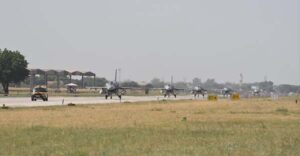
The answer is unfolding over the skies of Jodhpur, where the Indian Air Force has commenced the operational phase of Exercise Tarang Shakti 2026, turning Air Force Station Jodhpur into a multinational training arena where combat aircraft, airlifters, aerial refuellers, mission planners and support crews work towards one objective: “Power in Partnership.”
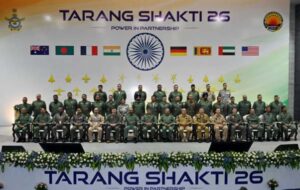
The second edition of the multinational exercise is being conducted from September 26 to October 12, building on the inaugural Tarang Shakti held in 2024. The operational phase brings together the IAF and air forces from seven Friendly Foreign Countries—Australia, the United States, the United Arab Emirates, France, Germany, Sri Lanka and Bangladesh—for advanced joint training and professional interaction.
A skyline of air power
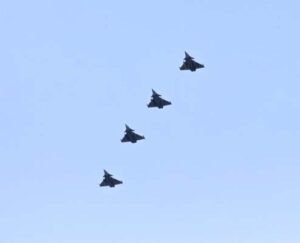
The aircraft participating in the exercise represent a striking cross-section of modern air-power capabilities.
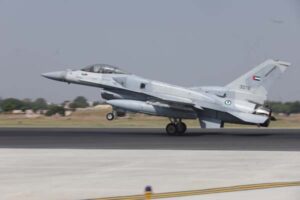
The foreign contingent includes the F-35 Lightning II, Rafale, F-16, A400M, MRTT, C-130, C-130J and KC-30A, bringing together fighter aircraft, strategic and tactical airlift platforms and air-to-air refuelling assets.
The presence of the US F-35 Lightning II, in particular, adds a fifth-generation combat-aircraft dimension to the exercise. The F-35 is making its debut in a multinational Indian-hosted air exercise, after its earlier appearance at Aero India.
But Tarang Shakti is not designed merely as an aerial spectacle.
Its central purpose is to expose participating air forces to multinational planning and execution, interoperability and realistic contemporary operational scenarios.
From cockpit to control room
Modern air warfare is rarely the work of a single aircraft or a single pilot.
Behind every sortie lies a network of mission planners, aircrew, engineers, maintenance specialists, controllers and operational-support teams.
Tarang Shakti creates opportunities for these professionals to interact, compare procedures and understand how partner air forces approach mission planning, aerospace safety and operational execution.
The exercise therefore becomes as much about learning what happens before and after a sortie as it is about what happens in the sky.
Participating contingents will operate alongside the IAF in a range of missions, employing frontline combat platforms and support elements, while other Friendly Foreign Countries participate as observers.
The Real Power: Interoperability
The most consequential word in the exercise may not be “combat”.
It is interoperability.
Different air forces bring different aircraft, tactics, operating philosophies, communication procedures and institutional experiences. Bringing them together creates an opportunity to understand where those systems converge—and where greater familiarity is required.
That professional interaction can strengthen the ability of participating forces to operate alongside one another during multinational engagements.
Tarang Shakti 2026 thus extends the IAF’s growing engagement with partner air forces through complex multinational training. Earlier this year, the IAF participated in Exercise Pitch Black in Australia, operating Rafale aircraft alongside air forces from more than 20 nations, followed by Exercise Udara Shakti in Malaysia.
When culture takes to the airbase
There is another dimension to Tarang Shakti.
The exercise extends beyond flying operations to include seminars, industrial visits, the Sekhon Marathon, heritage tours and yoga sessions.
The objective is to create space for informal interaction and cultural understanding alongside professional exchange.
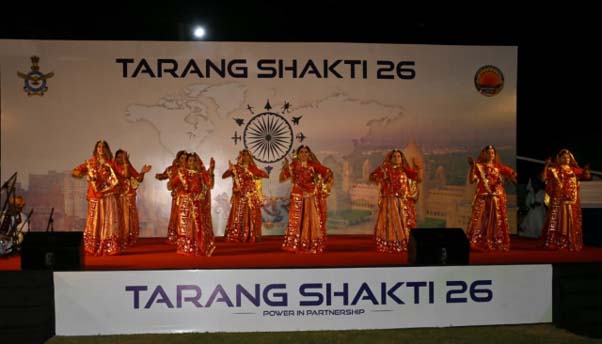
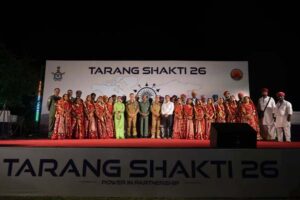
The vibrant Rajasthani cultural programme at Jodhpur added colour to an otherwise technology-intensive military engagement, with cultural artists interacting with personnel from friendly foreign countries.
In that sense, the exercise is not confined to aircraft and airfields.
It is also about people.
India’s aerospace story on display
For the IAF, Tarang Shakti offers an opportunity to demonstrate operational capabilities and professional standards while showcasing the country’s expanding indigenous aerospace and defence ecosystem.
The exercise also provides foreign contingents exposure to India’s aerospace and industrial capabilities through planned industrial interactions.
The first edition in 2024 had already established Tarang Shakti as a platform for multinational engagement. During its second phase, seven nations participated with air assets while 21 countries joined as observers. The exercise was described by the Defence Ministry as strengthening cooperation, coordination and trust among partner countries.
Jodhpur’s message to the world
From the F-35 to the Rafale, from airlifters to refuellers, Tarang Shakti 2026 brings together aircraft designed for very different missions.
Yet the larger lesson is remarkably simple.
Air power may begin with aircraft—but effective multinational operations depend on people understanding one another.
As the aircraft rise over Jodhpur, the real test is therefore not simply how high or how fast they fly.
It is how effectively different air forces can plan together, communicate, learn together and operate together.
That is the deeper meaning of “Power in Partnership.”