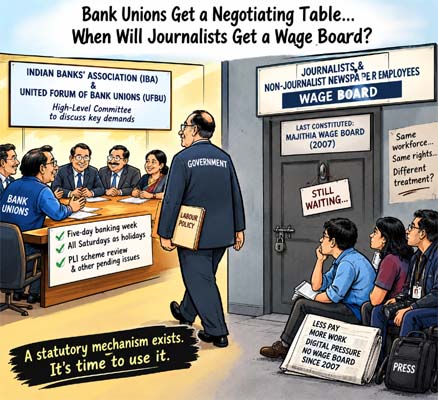
- Three-day bank strike deferred after IBA assurance on five-day week
- High-level panel promised to examine remaining Saturday holidays
- Journalists and newspaper employees have had no fresh Wage Board since Majithia
- A statutory wage-fixation mechanism lies dormant while the media workforce awaits a new review
NE BUSINESS BUREAU
NEW DELHI, AHMEDABAD, SEPT 28
The Government and bank unions have once again demonstrated that organised employee demands can bring the negotiating machinery to the table. The three-day nationwide bank strike has been deferred after the Indian Banks’ Association assured the United Forum of Bank Unions of discussions on five-day banking, the Performance Linked Incentive scheme and other pending issues.
But this development raises an uncomfortable question for the newspaper industry:
If the Government can facilitate a high-level mechanism to address the demands of bank employees, when will it activate the statutory Wage Board mechanism meant specifically for journalists and non-journalist newspaper employees?
The comparison is particularly relevant because the Working Journalists and Other Newspaper Employees (Conditions of Service) and Miscellaneous Provisions Act, 1955 expressly provides for Wage Boards for these categories. Sections 9 and 13C deal with Wage Boards for working journalists and non-journalist newspaper employees respectively.
Majithia remains the last chapter
The Government’s own Ministry of Labour record shows that the Majithia Wage Boards were constituted on May 24, 2007, submitted their final report on December 31, 2010, and their recommendations were accepted by the Centre on November 11, 2011. They were the sixth Wage Boards constituted for working journalists and non-journalist newspaper employees.
Since then, no fresh Wage Board has been constituted.
That means the last Wage Board exercise dates back nearly two decades, even as the newspaper industry has undergone a fundamental transformation—from print-dominated establishments to multimedia, digital, portal and platform-driven news operations.
The Government’s own documentation records the sequence clearly: Divatia, Shinde, Palekar, Bachawat, Manisana and finally Majithia in 2007.
A statutory mechanism—but no fixed timetable
There is, however, an important legal nuance.
The 1955 Act provides for the constitution of Wage Boards, but the Ministry of Labour itself states that the Act does not lay down any periodicity for constituting them. Therefore, the issue is not that the Government has violated a statutory timetable by not setting up a new Board every few years.
The sharper public-interest question is different:
Why has the Government not exercised the statutory mechanism for almost two decades despite the profound changes in employment patterns, technology, remuneration structures and working conditions in the newspaper and news-media sector?
Bank employees vs media employees
The present bank-union episode provides a striking contemporary comparison.
For bank employees, the IBA and UFBU have agreed to constitute a high-level committee to examine the demand for declaring the remaining Saturdays as holidays, while other contentious matters are also being taken up for discussion.
For journalists and newspaper employees, by contrast, the statutory Wage Board route has remained dormant since the Majithia exercise.
This does not diminish the legitimacy of bank employees’ demands. Rather, it highlights a larger labour-policy question:
Shouldn’t employees covered by a special statutory wage-protection framework also receive periodic governmental attention when their industry and employment conditions have changed dramatically?
The digital newsroom has changed everything
The media workplace of 2026 bears little resemblance to that of 2007.
Journalists today increasingly work across print, websites, mobile applications, social-media platforms, video, audio and multiple digital formats. Working hours, workload, skill requirements, employment classifications and revenue models have all evolved.
Yet the last comprehensive statutory Wage Board exercise belongs to the pre-smartphone, pre-social-media era.
That raises questions not merely about salary revision, but also about classification of modern media employees, contractualisation, workload, working hours, job security, professional skills, digital responsibilities and appropriate wage structures.
A question Parliament and Government must answer
The issue therefore deserves to move beyond periodic representations by journalist organisations.
Will the Union Government consider constituting a fresh Wage Board for working journalists and non-journalist newspaper employees—or establish an appropriate statutory mechanism to periodically review their wages and service conditions?
The bank strike may have been deferred because dialogue has begun.
For journalists, perhaps the next step should similarly be dialogue rather than silence.
The question is not whether one employee group deserves more than another.
It is whether a statutory mechanism created specifically to protect newspaper employees should remain unused for nearly 20 years while the profession it was designed to protect undergoes unprecedented transformation.