- National workshop under Vikas Saptah 2026 brings research, innovation and commercialisation into one forum
- Parallel programmes explore trustworthy AI, medical devices, electric drives and 3D technologies
- Fusion track delves into plasma science, tokamaks, cryogenics and remote handling
- 150 school students get an early glimpse of IPR, scientific models and India’s innovation ecosystem
NE SCIENCE & TECHNOLOGY BUREAU
AHMEDABAD, OCT 2
Advanced technology is increasingly being defined not merely by what laboratories can invent, but by how effectively those innovations can move into society and strengthen strategic capabilities. IITRAM’s latest national workshop in Ahmedabad sought to bridge precisely that gap, bringing research, commercialisation, emerging technologies, fusion science and intellectual property into a common platform.
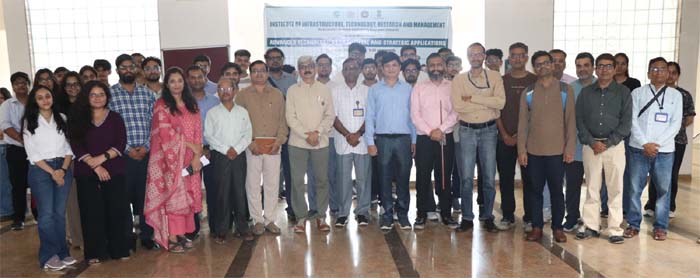
The Institute of Infrastructure, Technology, Research and Management (IITRAM), Ahmedabad, organised two parallel one-day programmes under the National Workshop on “Advanced Technologies for Societal and Strategic Applications” as part of Vikas Saptah–2026, with the support of the Knowledge Consortium of Gujarat (KCG), on Thursday.
The initiative brought together around 100 students, faculty members, researchers and professionals, while a separate IPR outreach exhibition exposed about 150 school students to scientific models, demonstrations and the fundamentals of intellectual property.
The programmes were held under the patronage of Dilip Kumar Rana, IAS, Commissioner, Higher & Technical Education, Government of Gujarat and CEO, KCG; Dr Yogesh Yadav, Joint CEO, KCG; and Prof. P. K. Jain, Director General, IITRAM.
From laboratory research to the marketplace
The common inaugural session marked the beginning of two parallel programmes — “Research, Innovation and Commercialization” and “Plasma Science, Fusion Technology and IPR Outreach.”
The first track focused on a critical question confronting academic research today: how can promising ideas move beyond papers and laboratories to become commercially viable technologies and solutions?
Expert sessions covered Computational Intelligence in Electric Drives, Research Commercialization, Medical Devices, Trustworthy and Explainable AI, Innovation and Entrepreneurship in Academics, and 3D Printing, Augmented Reality (AR) and Virtual Reality (VR) in Orthopedic Oncology.
The breadth of subjects reflected the increasingly interdisciplinary character of technology, where artificial intelligence, healthcare, advanced manufacturing and entrepreneurship are converging to address real-world challenges.
IITRAM’s academic ecosystem itself places emphasis on advanced engineering and emerging technologies, including robotics, automation, advanced manufacturing and specialised research areas. (IITRAM)
Where plasma science meets strategic technology
The second programme moved into a more strategic technology domain, examining plasma science, tokamak research, cryogenics for fusion technology and remote handling technologies, along with inverse heat transfer, sustainable machining and advanced materials for defence applications.
IITRAM’s own description of the plasma and fusion seminar highlights the importance of creating awareness among students, researchers and faculty about plasma physics, fusion technology and emerging areas of advanced engineering, with expert sessions involving tokamak research, cryogenic systems and remote handling technologies.
The programme therefore provided participants with exposure to technologies that sit at the intersection of fundamental science, advanced engineering and strategic applications.
IPR outreach takes innovation to school students
A particularly significant component was the IPR Outreach Exhibition, where around 150 students from nearby schools visited IITRAM and its IPR Gallery.
Instead of limiting innovation awareness to researchers and engineering students, the initiative introduced younger minds to intellectual property, scientific research, technological development and innovation models through demonstrations and exhibits.
The exposure was aimed at encouraging school students to look at science and technology not merely as academic subjects but as pathways to invention, problem-solving and entrepreneurship.
Building a research-to-impact ecosystem
The workshop also created opportunities for knowledge sharing, expert interaction, research-industry engagement and exposure to emerging technologies with societal and strategic applications.
Its significance lies in bringing seemingly different technology domains into the same conversation — from trustworthy AI and medical devices to fusion technology, advanced materials and intellectual property.
For Gujarat’s higher-education and research ecosystem, such platforms can help strengthen the link between academic discovery, technological innovation, intellectual-property creation and eventual commercial or strategic application.
The larger IITRAM initiative is also consistent with its stated emphasis on advanced technologies and interdisciplinary engineering research, including robotics, automation, advanced manufacturing and other emerging fields.