
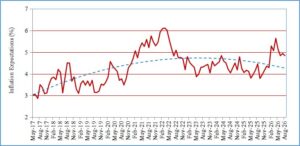
- One-year-ahead business inflation expectation slips to 4.84% in August from 4.94% in July
- CPI inflation expectation edges up to 4.63%, while uncertainty remains elevated
- More than 53% firms report normal or better sales as margin pessimism eases
- Cost pressures send mixed signals, with sharpest cost increases moderating
NE ECONOMIC BUREAU
AHMEDABAD, OCT 5
Indian businesses are beginning to see a more constructive operating environment, with one-year-ahead business inflation expectations easing below 5% for the third consecutive month even as sales and profit-margin expectations continue to improve, according to the August 2026 round of the Business Inflation Expectations Survey (BIES) conducted by the Misra Centre for Financial Markets and Economy, IIMA.
The survey, based on responses from around 1,100 companies, primarily from the manufacturing sector, presents a nuanced picture of the economy: inflation expectations have moderated marginally, sales sentiment has strengthened for three consecutive months and profit-margin pessimism has receded significantly. However, persistent uncertainty surrounding both business costs and consumer-price inflation suggests that companies are not yet ready to declare the inflation battle over.
The August 2026 survey is the 112th round of BIES, which has been conducted monthly since May 2017.
Business inflation stays below 5% for third straight month
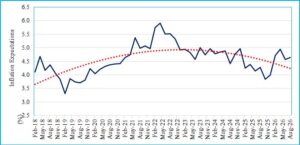
The one-year-ahead business inflation expectation declined by 10 basis points to 4.84% in August 2026, from 4.94% in July, based on the mean of firms’ individual probability distributions of expected unit-cost increases.
The latest moderation means business inflation expectations have remained below the 5% mark for three consecutive months, offering a potentially encouraging signal for the cost outlook facing Indian companies.
Yet the improvement comes with a significant caveat. The uncertainty surrounding business inflation expectations, measured through the square root of the average variance of firms’ individual probability distributions of unit-cost increases, has remained above 2% for eight consecutive months.
In other words, firms may be expecting relatively contained inflation, but the range of possible outcomes remains wide.
CPI outlook inches higher despite softer business expectations
The survey’s additional question on one-year-ahead CPI headline inflation, asked every alternate month in line with the RBI’s bi-monthly monetary policy cycle, reveals a slightly different direction.
Businesses expect CPI headline inflation to reach 4.63% one year ahead, marginally higher than the 4.56% recorded in June 2026, an increase of seven basis points.
More importantly, uncertainty around CPI inflation expectations has remained above 1% from February through August 2026.
The divergence between slightly softer business inflation expectations and a marginally higher CPI outlook underscores the complexity confronting policymakers. While companies appear to see some moderation in their own unit-cost pressures, they continue to attach considerable uncertainty to the broader consumer-price trajectory.
Cost pressures remain a mixed bag
The cost picture provides no straightforward all-clear signal.
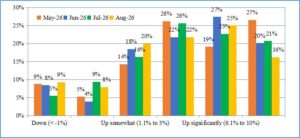
The proportion of firms perceiving a significant cost increase of 6% to 10% rose from 23% to 25%, making it the modal response in August.
At the same time, however, the proportion reporting very significant cost increases of more than 10% fell sharply from 21% to 16%.
The middle category also weakened: firms reporting costs as “up moderately” — more than 3% but below 6% — declined to 22% from 26% in the previous round.
The numbers suggest that while some businesses continue to face meaningful cost escalation, the intensity of the most extreme cost pressures appears to be moderating.
Sales momentum and margins offer the brighter signal
Perhaps the most encouraging element of the August survey is the improvement in firms’ assessment of sales.
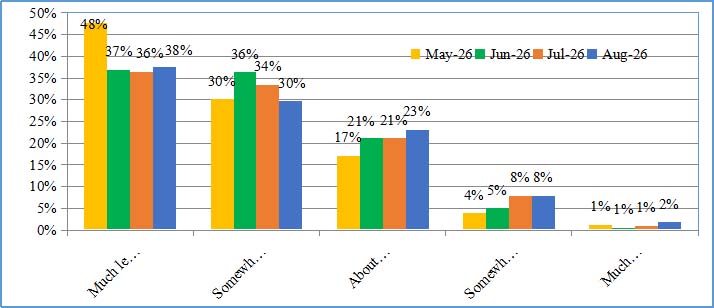
More than 53% of firms reported sales at “about normal” or higher in August, compared with 50% in July. This marks the third consecutive month of improvement in sales expectations.
The profitability picture has also strengthened.
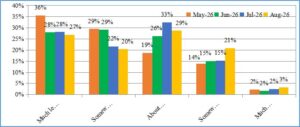
The proportion of firms reporting “somewhat less than normal” or below-normal profit-margin expectations declined to 68% in August, from a considerably higher 78% in May.
The 10-percentage-point improvement over three months indicates that the profitability outlook, although still subdued for a sizeable share of businesses, is gradually becoming less pessimistic.
The economic signal: resilience without complacency
Taken together, the August BIES results offer a cautiously positive message for the Indian economy.
Businesses are expecting inflation to remain relatively contained, sales expectations are improving and fewer firms are reporting below-normal profit-margin expectations. At the same time, the persistence of elevated uncertainty means the improvement cannot yet be interpreted as a broad-based return to pricing stability.
The most important takeaway may therefore lie not in any single number but in the direction of travel: firms appear increasingly confident about demand and profitability, even as they continue to hedge against unpredictable inflation and cost shocks.
For policymakers and corporate decision-makers alike, the August survey points to an economy showing greater resilience on the demand side while inflation-related risks remain a live variable.