
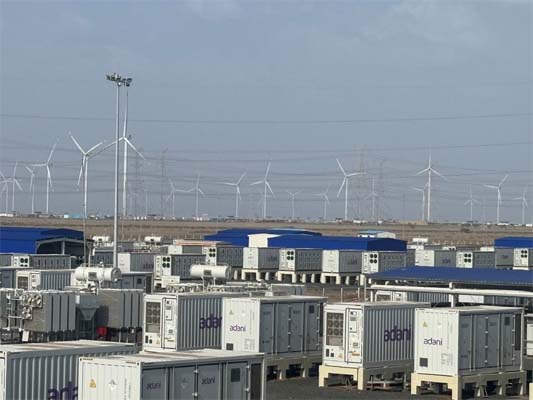
- Energy major strengthens grid-scale storage footprint as India accelerates renewable-energy integration
NE ENERGY BUREAU
AHMEDABAD, OCT 5
Adani Green Energy has expanded its battery energy storage capacity to 6.63 GWh, giving the company a footprint accounting for more than 50% of India’s operational Battery Energy Storage System (BESS) capacity and reinforcing its position in the country’s rapidly evolving clean-energy landscape.
The milestone assumes significance as India’s renewable-energy expansion increasingly shifts the focus from generation capacity alone to the availability of reliable, dispatchable and round-the-clock power. Battery storage is emerging as a critical technology for balancing intermittent solar and wind generation, improving grid flexibility and supporting peak-demand management.
With its operational BESS capacity now at 6.63 GWh, Adani Green Energy has emerged as a dominant player in India’s utility-scale battery storage segment. The development also underlines the growing importance of energy storage in the country’s transition towards a renewable-led power system.
Storage moves to centre stage
India’s renewable-energy ambitions have created a parallel requirement for large-scale energy storage. Solar generation peaks during daylight hours, while electricity demand often rises during evening periods. Battery storage can bridge this gap by absorbing electricity when renewable generation is abundant and releasing it when required.
The expansion of Adani Green Energy’s BESS portfolio therefore represents more than an increase in installed storage capacity. It points to a broader shift in the architecture of India’s power sector, where renewable generation, storage and grid management are increasingly being planned as an integrated ecosystem.
More than half of operational BESS capacity
The company’s 6.63 GWh storage capacity accounts for more than 50% of India’s operational BESS capacity, highlighting the scale at which Adani Green Energy is building its energy-storage platform.
The development places battery storage alongside renewable generation as a strategic pillar of the company’s clean-energy portfolio.
As India adds large volumes of solar and wind capacity, the ability to store electricity and dispatch it at the right time is expected to become increasingly important for maintaining grid stability and improving renewable-energy utilisation.
From renewable generation to firm power
The rapid emergence of BESS is also changing the commercial proposition of renewable energy. Instead of renewable electricity being available only when the sun shines or the wind blows, storage can help make clean power more flexible and predictable.
For developers, this opens the possibility of offering power in time blocks aligned with demand, while for grid operators it creates an additional tool for balancing supply and demand.
Adani Green Energy’s storage expansion comes against this backdrop, strengthening the company’s ability to participate in the next phase of India’s energy transition.
A strategic advantage in India’s energy transition
The latest milestone also highlights how energy storage is moving from being a supporting technology to becoming a strategic asset in India’s power market.
With renewable capacity continuing to expand, the country will require substantial additional storage infrastructure to manage variability, reduce curtailment and improve the reliability of clean electricity.
Adani Green Energy’s 6.63-GWh operational BESS footprint places the company at the forefront of this emerging market and signals an increasingly storage-intensive future for India’s renewable-energy sector.