
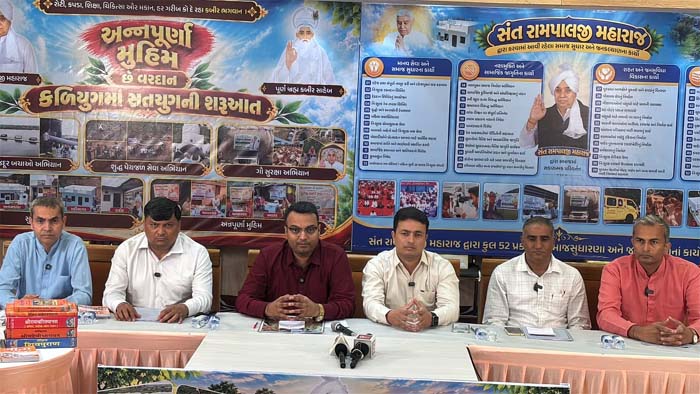
- Annapurna Muhim provides free ration and essential commodities to 160-plus needy families across Gujarat
- ‘Sudama Ka Mahal’ initiative extends permanent housing support to vulnerable families in five Gujarat districts
- Valsad village gets drinking-water infrastructure with pipelines, motor, wiring and 5,000-litre storage tanks
- Banaskantha flood-relief campaign targets waterlogged farmland and affected farmers with large-scale drainage support
- Organisers say welfare assistance is based on need, not religious identity, and spans food, shelter, water, healthcare and education
NE SOCIAL AFFAIRS BUREAU
AHMEDABAD, OCT 5
Can spiritual service become a practical instrument of social welfare? In Gujarat, an array of initiatives being showcased under the Annapurna Muhim of the Sant Rampalji Maharaj organisation is attempting to answer that question on the ground—with free ration for needy families, housing for vulnerable households, drinking-water infrastructure in villages and relief for farmers hit by floods. The organisers say the central principle is simple: assistance should follow need, not identity.
At a media briefing in Ahmedabad on Monday, office-bearers of the organisation highlighted a series of welfare initiatives being undertaken under the guidance of Sant Rampalji Maharaj, with a particular focus on Gujarat.
According to the organisers, the Annapurna Muhim is currently providing free ration and other essential commodities to more than 160 needy families in Gujarat. The monthly assistance includes foodgrains and other household requirements, with more than 22 categories of ration and essential materials being made available depending on the needs of beneficiary families.
The initiative, they said, is not confined to followers or disciples. Assistance is extended to needy people on the basis of their requirements, with the stated objective of providing sustained support rather than one-time relief.
From food security to a roof over the head
The organisation’s ‘Sudama Ka Mahal’ initiative focuses on providing permanent houses to families unable to afford adequate shelter.
According to the details presented at the briefing, housing assistance has been extended in five Gujarat districts—Vadodara, Banaskantha, Valsad, Mahisagar and Dahod.
The support does not stop with construction of a house. Beneficiaries may also receive essential household and livelihood-related items, including ration supplies, cots, mattresses, quilts, gas cylinders, stoves, clothes, footwear, school bags and school books, among other materials.
The organisers described the approach as an attempt to make housing support more meaningful by addressing the immediate requirements of a family after it receives a roof over its head.
A village water project goes beyond the tap
The Clean Drinking Water Campaign is another component of the welfare programme highlighted in Gujarat.
In Moti Korda village of Valsad district, the organisation has listed infrastructure provided for drinking-water supply, including 1.5-inch pipelines extending to about 1,890 feet, a 2 HP motor and starter, 836 feet of electrical wiring and two 5,000-litre water tanks.
The initiative reflects a larger national campaign under which the organisation says submersible pumps, pipelines and other water-supply infrastructure are being provided in villages according to local requirements.
For rural communities, such interventions can have an impact extending beyond drinking water—from reducing the daily burden of fetching water to strengthening basic village infrastructure.
Banaskantha: relief aimed at getting farms back to work
The Gujarat-focused presentation also highlighted flood-relief operations in Banaskantha, where waterlogging has affected agricultural land and rural households.
According to the organisers, water has been drained from around 1,000 acres of flood-affected farmland, while relief has been extended to a large majority of affected farmers.
For flood-hit agricultural communities, the priority is not merely removing stagnant water from residential areas but restoring farmland to cultivable condition. The organisers said drainage equipment and pipelines have therefore been deployed as part of the relief effort.
The presentation also cited work in Kundaliya village, where 270 pieces of 12-inch pipes, covering about 5,400 feet, along with other pumping and drainage-related equipment, were provided for flood-relief operations.
The organisation said its broader flood-relief efforts have also covered affected areas outside Gujarat.
Farmers, cattle and social reform
The welfare programme also includes a Kisan-Mazdoor Bachao Abhiyan, under which eligible small farmers—particularly those owning 2.5 acres or less—are provided seeds, fertilisers and medicines after verification, according to the organisers.
The stated objective is to protect crops from pests and diseases while reducing the immediate financial burden on vulnerable farmers.
A Cow Protection Campaign has also been cited, with the organisation claiming that thousands of quintals of fodder have been supplied through service registrations in parts of Haryana and Rajasthan. Support is also extended for gaushala sheds and drainage arrangements, it said.
Beyond material assistance, the organisation highlighted dowry-free ‘Ramaini’ marriages, claiming that more than one lakh such marriages have been conducted so far. Its followers are also encouraged to stay away from alcohol, tobacco, bidis, cigarettes and other forms of addiction.
The larger message: service beyond boundaries
The organisation said its welfare activities also include assistance for school toilets, sports infrastructure and people requiring medical treatment, education or housing.
At Dhanana Dham, the organisers said, assistance is provided wherever possible to people approaching the centre for surgeries, medical treatment, education, housing and other essential requirements, irrespective of whether they are disciples.
The larger message emerging from the Gujarat initiatives is therefore not merely about charity but about building a support system around vulnerable families and communities.
The organisation attributes the welfare initiatives to the teachings of Sant Rampalji Maharaj, which, according to his followers, emphasise human values, equality, compassion, discipline and social reform, while opposing dowry and addiction.
Its stated philosophy is encapsulated in the campaign’s own message: “Roti, Kapda, Shiksha, Chikitsa aur Makan”—food, clothing, education, healthcare and housing.
For Gujarat, where rural distress, water security, housing vulnerability and flood-related agricultural losses periodically intersect, the significance of such initiatives will ultimately be measured not by publicity but by their reach, transparency and verifiable impact on beneficiaries.
The organisation has said that media representatives may independently verify the published service details, regional press notes and available data with beneficiaries.