
- VBF’s 18-day sporting movement spans all 105 Sanand villages, identifies latent talent and awards 336 medals
- Arjuna Awardee Sathiyan Gnanasekaran calls for sustained nurturing of sporting talent beyond the festival
- 45,000+ children participate across 23 events in girls’ and boys’ categories
- VBF seeks stronger corporate CSR support to build world-class sporting infrastructure in Sanand
- Experts use sport-specific drills, physical tests, data models and predictive analytics for talent identification
- With Ahmedabad hosting Commonwealth Games in 2030, Sanand eyes a pathway from village playgrounds to global sport
R MANICKAVASAGAM
SANAND, AHMEDABAD, OCT 7
Sanand may be racing towards becoming one of Gujarat’s major industrial and urban hubs, but its biggest emerging asset could well be found on its village playgrounds. With more than 45,000 children from 150-plus schools across all 105 villages participating in the 18-day Khele Sanand Sports Utsav 2026, the Vijayi Bharat Foundation (VBF) has turned grassroots sport into a mass movement—and opened a larger question: can rural sporting talent be systematically nurtured all the way to the national and international arena?
The festival, launched on September 17 and concluded at Sanskardham on Wednesday, witnessed participation across 23 sporting events, culminating in 336 Gold, Silver and Bronze medals. More significantly, VBF says the initiative has created an extensive pool of sporting data and observations that could help identify promising young athletes well beyond the closing ceremony.
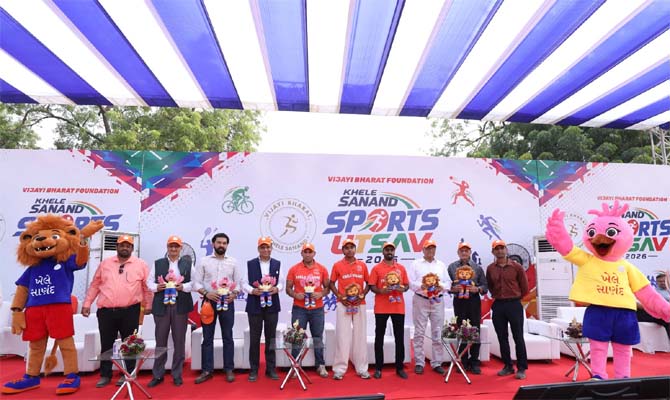
The valedictory function brought together Arjuna Awardee and table tennis player Sathiyan Gnanasekaran, MMA fighter Pawan Maan Singh, cricketer Vedant Trivedi and VBF Directors Jalaj Dani, Dhanraj Nathwani and Durgesh Agarwal, besides hundreds of young athletes, coaches, schools and community representatives.
45,000 children—but the real test begins after October 7
The sheer participation may be impressive, but the more consequential question is what happens to the children who have demonstrated exceptional ability.
Asked how many genuine sporting talents had been identified through Khele Sanand Sports Utsav 2026 and what mechanism would be put in place to nurture them after the festival, Sathiyan said the event had already helped VBF discover a significant reservoir of latent sporting ability.
“This event has helped the VBF to identify large number of latent talents in Sanand taluka. The Foundation will certainly take constructive measures to nurture them well to become full-fledged sports persons,” he said.
The response puts the spotlight on the transition from mass participation to sustained athlete development—arguably the most difficult stage in grassroots sport. Identifying a child through a village-level competition is only the beginning; regular coaching, access to facilities, competition exposure, nutrition, sports science and financial support ultimately determine whether raw ability develops into elite performance.
Khele Sanand’s talent-identification programme was designed around this larger objective. Coaches, scouts and sports experts observed participants through sport-specific drills, physical tests and performance parameters, while statistical data models and predictive analytics were used to supplement the assessment process.
Can Sanand build a sporting ecosystem to match its industrial ambition?
With Sanand undergoing rapid industrialisation and urbanisation, another challenge is whether its sporting infrastructure can keep pace with its economic transformation.
The question becomes particularly relevant for a taluka spread across 105 villages, where promising athletes may still lack access to quality grounds, athletics tracks, indoor facilities and professionally trained coaches.
Sathiyan made a direct appeal to the corporate and industrial community to become long-term partners in this transformation rather than restricting CSR intervention to individual tournaments.
“Apart from the government and VBF, I urge the corporates in and around Sanand to lend a helping hand with generous CSR fund, which will create better sports infrastructure and exceptionally talented sportsmen from this rural area,” he said.
His call assumes added significance because Sanand’s industrial landscape places it in a potentially powerful position to develop a corporate-backed rural sports ecosystem, with CSR resources supporting permanent facilities, coaching programmes and athlete development rather than one-off events.
From a village dream to an Olympic pathway
The ultimate measure of Khele Sanand, however, may not be the number of medals won during the festival but whether a child from a remote village can eventually make it to the international stage.
Asked what concrete pathway could be assured if a Sanand child today dreams of representing India at the Commonwealth Games or Olympics, Sathiyan pointed towards the convergence of VBF’s grassroots initiative, government support and the opportunity created by Ahmedabad’s hosting of the 2030 Commonwealth Games.
“With VBF’s initiative and state government’s thrust, upcoming Commonwealth Games in Ahmedabad 2030, all stakeholders will help the budding sports stars to excel in global sports arena,” added Sathiyan.
The statement gives Khele Sanand a larger horizon: the creation of a sporting pipeline in which children are identified in villages, trained systematically, exposed to higher levels of competition and eventually connected to state, national and international sporting pathways.
Sathiyan: Sport teaches children more than winning
Sharing his impressions of the festival, Sathiyan said the enthusiasm of the participating children demonstrated the potential of grassroots sporting initiatives.
“It is wonderful to see the enthusiasm among the children and the platform that Vijayi Bharat Foundation has created for them through Khele Sanand. This is closely aligned with the vision of making sport more accessible and creating opportunities at the grassroots. Seeing the energy here, I truly believe this is the right time to be in sports. I would encourage every child to keep playing, because sport teaches you dedication, discipline and teamwork. Whether you win or lose, what matters is that you continue to play and keep improving.”
MMA fighter Pawan Maan Singh said the scale of the facilities and platform created through Khele Sanand was encouraging.
“The scale of the facilities and the platform created through Khele Sanand is immense, and it is encouraging to see children being given such opportunities at an early age. Initiatives like this can make sport a meaningful part of a child’s journey by giving them access, encouragement and the confidence to compete. It is heartening to see VBF creating an environment where children are being encouraged to take up sport and pursue it seriously,” he said.
Cricketer Vedant Trivedi said Gujarat could take pride in the attention being given to grassroots athletes.
“Being from Gujarat, it makes me really proud to see VBF giving grassroots athletes the attention and opportunities they need to grow. Sporting talent can emerge from anywhere, and what matters is having the right platform, guidance and support to nurture it. Seeing so many children participate through Khele Sanand gives me confidence that initiatives like this can help create a stronger sporting culture and give young athletes the opportunity to take their talent forward,” he said.
23 events, 336 medals and a movement beyond competition
The closing-day programme saw the chief guest interact with U-17 60m finalists, U-14 50m cycling and U-8 softball participants, besides witnessing the U-11 Kids Javelin and U-14 and U-17 Tug of War finals.
The valedictory programme also featured the felicitation of medal winners and recognition of participating schools and students. The organisers unveiled Veer and Garvi, the mascots of Khele Sanand, symbolising the movement’s attempt to bring children, schools and communities together through sport.
The initiative is part of VBF’s larger effort to strengthen grassroots sport by creating structured opportunities for children before sporting talent is lost because of inadequate access to established sporting centres.
The use of data-driven assessment alongside conventional sporting evaluation also seeks to move talent identification beyond subjective selection, potentially enabling promising athletes from less-visible rural backgrounds to receive attention based on measurable performance.
The larger message emerging from the 18-day sporting movement is therefore not simply about competition or medals. It is about whether 45,000-plus children can become the foundation of a sustainable sporting ecosystem in Sanand.
As the curtains came down on Khele Sanand Sports Utsav 2026, its defining challenge now moves from the playground to the policy table: to ensure that the most promising children identified during the festival do not return to obscurity once the medals are distributed.
“Every Child. Every School. A Sporting Movement. A Vibrant Sports Taluka.”