
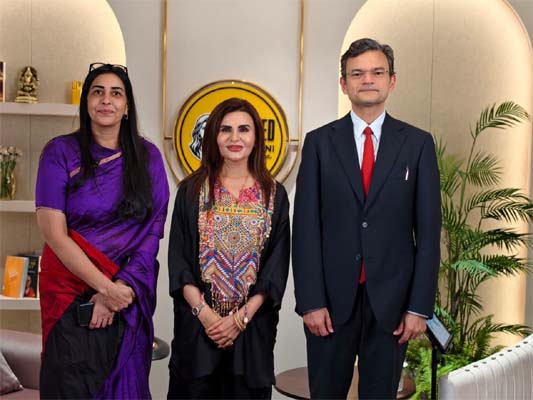

- JNU scientists Anand Ranganathan and Shailja Singh spotlight AI’s promise, research gaps and India’s innovation imperative at GLS University
- ‘We want to save at least one life’: Ranganathan calls for science that moves beyond academic papers to practical healthcare solutions
- COVID-19 lessons underline the urgency of stronger vaccine development and malaria research
- ‘Learning by doing’: Singh champions hands-on science education, critical thinking and problem-solving
- Decoded with Chandni Kapadia explores AI, youth mental health, women in science and India’s technological future
NE EDUCATION BUREAU
AHMEDABAD, OCT 13
Can India’s scientific talent deliver breakthroughs that save lives, can Artificial Intelligence (AI) accelerate discovery without diminishing human potential, and can the country overcome research bottlenecks to emerge as a global innovation powerhouse? These compelling questions animated an episode of Decoded with Chandni Kapadia at GLS University, Ahmedabad, featuring scientist and author Dr. Anand Ranganathan and JNU professor and scientist Dr. Shailja Singh in conversation with Dr. Chandni Kapadia, Executive Director, GLS University.
The engaging exchange moved beyond scientific theories and technological predictions to examine a fundamental challenge: how can knowledge generated in laboratories translate into solutions that improve lives, strengthen public health and shape India’s future?
From personal inspiration to life-saving science
Reflecting on the journeys that brought them into research, Dr. Shailja Singh spoke about her father’s dedication to medicine and her early exposure to the impact of infectious diseases. These formative experiences helped shape her commitment to scientific inquiry and its potential to address real-world challenges.
The conversation converged on the need to bridge the gap between scientific discovery and tangible public benefit.
Emphasising the human purpose of research, Dr. Anand Ranganathan said, “We want to save at least one life.”
The statement captured the larger message of the discussion: scientific achievement must be measured not merely by publications, but also by its capacity to make a meaningful difference to society.
Drawing lessons from the COVID-19 pandemic, Ranganathan highlighted the importance of translating research into practical healthcare solutions, particularly in vaccine development and malaria research. The exchange underscored the need for scientific institutions to connect discoveries with applications that can address urgent health challenges.
Can India’s research ecosystem break free of its constraints?
India’s scientific ambitions, the speakers noted, must be matched by sustained investment and an enabling research environment. Inadequate infrastructure, administrative hurdles and limited research support can constrain researchers seeking to convert promising ideas into workable solutions.
Strengthening research and development, encouraging private-sector participation and creating greater institutional support for young scientists emerged as important priorities.
The larger question was whether India can build an ecosystem that gives researchers the freedom, resources and collaborative opportunities needed to pursue ambitious ideas—and take them from the laboratory to the wider world.
AI: a scientific revolution or a test of human potential?
Artificial Intelligence emerged as a central theme, with Ranganathan exploring its potential to reshape scientific discovery, drug development and employment. The discussion also highlighted the importance of developing India’s own AI capabilities rather than remaining dependent on technological advances created elsewhere.
As AI tools increasingly influence research and industry, the challenge for India will be to combine technological adoption with indigenous innovation, scientific rigour and human judgement.
For students preparing to enter a rapidly changing employment landscape, the conversation raised an important consideration: technological competence must go hand in hand with independent thinking, adaptability and the ability to solve unfamiliar problems.
‘Learning by doing’: reimagining science education
Dr. Shailja Singh emphasised “learning by doing” as an essential principle of science education. Practical engagement, experimentation and hands-on experience, she indicated, can help students develop critical thinking and problem-solving abilities that go beyond textbook knowledge.
The discussion also turned to mental health concerns among young people and the importance of addressing them without stigma. The exchange highlighted the responsibility of educational institutions to create environments that support both intellectual development and student well-being.
Women’s representation in science, governance, media responsibility and the role of universities in preparing students for a technology-driven future further broadened the conversation.
Through candid exchanges and thought-provoking rapid-fire questions, the speakers reflected on India’s missed opportunities, technological progress and the importance of questioning established assumptions.
A conversation that challenges students to think beyond the obvious
The episode concluded with Dr. Shailja Singh describing the interaction as “A discussion to think”—an apt summation of a dialogue designed to encourage students to question, explore and look beyond conventional perspectives.
Through Decoded with Chandni Kapadia, GLS University continues to bring voices from science, academia and public life into conversation with students and wider audiences.
The interaction carried a message extending well beyond the university auditorium: India’s scientific future will depend not simply on producing talented researchers or adopting emerging technologies, but on building an ecosystem that converts knowledge into innovation and innovation into measurable public good. The ultimate test of scientific progress, the discussion suggested, is not how much a nation knows, but how much that knowledge can do for humanity.