
- Ninth edition of student-led quiz turns conventional classroom thinking on its head
- 32 students, eight teams compete in an intellectual contest spanning logic, observation and lateral thinking
- Inspired by Shah Rukh Khan’s 2008 television show, initiative promotes curiosity over rote learning
- SAC initiative encourages future engineers to challenge assumptions, embrace unconventional approaches
- Team ezpz clinches the title; Girl Gang finishes second and Hasan & Co. takes third place
NE EDUTAINMENT BUREAU
GANDHINAGAR, OCT 31
What if the biggest obstacle to finding the right answer is the way you have been trained to think? At the Indian Institute of Technology Gandhinagar (IITGN), 32 students discovered that cracking a problem is not always about applying a familiar formula, recalling a textbook concept or arriving at an answer fastest. Sometimes, the real test lies in questioning the question itself.
What happens when a tennis ball is placed on top of a basketball and both are dropped simultaneously? How many doors remain open when 100 people successively toggle the state of 100 doors? And what if a sequence of numbers follows a pattern that has little to do with a conventional mathematical formula?
These intriguing challenges formed part of the ninth edition of Kya Aap Barhvi Paas Se Tez Hai?, an unconventional student quiz organised this month at IITGN. Loosely translating into ‘Are You Smarter Than a Class 12 Student?’, the competition challenged some of the country’s brightest engineering aspirants to step outside familiar problem-solving methods and put their reasoning, observation and intellectual flexibility to the test.
The title is a playful nod to Kya Aap Paanchvi Pass Se Tez Hai?, the 2008 television show hosted by Shah Rukh Khan, which pitted adults against questions designed for primary-school students. At IITGN, however, the participants were students who had already conquered one of India’s most competitive entrance examinations. The challenge was to discover whether their academic conditioning would always help them—or sometimes stand in the way of fresh thinking.
Organised by IITGN’s Student Academic Council (SAC), the initiative was launched in 2016 by Harsh Gupta, then a BTech student and the council’s Academic Secretary. This year’s edition unfolded in two stages: an online preliminary round on October 10, open to the entire student community, followed by an on-campus contest on October 13.
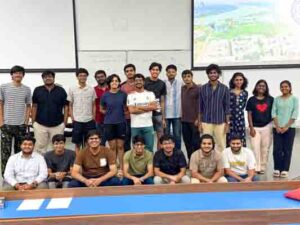
The final brought together 32 students in eight teams of four, representing all four years of the BTech programme as well as first-year MSc Cognitive Science students.
When conventional answers are not enough
For students who have spent years preparing for demanding competitive examinations such as the Joint Entrance Examination (JEE), rigorous training develops speed, accuracy and the ability to recognise familiar problem patterns. Yet, real-world engineering challenges rarely arrive in the neat, predictable formats of textbook exercises.
The quiz sought to bridge this gap by encouraging students to pause, question their assumptions, explore unconventional possibilities and recognise when their first approach might be inadequate.
For Akshat Shah, a second-year BTech student in Electrical Engineering and a member of SAC, the competition offered a refreshing departure from the examination-oriented preparation that preceded his entry into IITGN.
“The quiz introduced me to the spirit of IITGN as a fresher. The focus was not solving numericals, but asking the right questions, trusting our reasoning, and being willing to rethink our answers,” he said.
Making curiosity the driving force of learning
Beyond the competition itself, the initiative seeks to nurture a campus environment where intellectual rigour, creativity and playful exploration complement one another.
Aditya Prachand, Academic Secretary of SAC and one of the organisers, said, “Through Kya Aap Barhvi Paas Se Tez Hai?, we wanted to create a space where students could challenge their thinking in unconventional ways and rediscover the joy of learning out of curiosity rather than compulsion.”
The importance of questioning assumptions became evident in the experience of Nupoor Assudani, a fourth-year BTech student in Computer Science and Engineering. Recalling a question involving a sequence of numbers, she said her initial instinct was to search for a mathematical formula. However, the solution depended on how the digits were arranged.
The experience reinforced an important lesson: the ability to recognise a familiar pattern is valuable, but the willingness to abandon it when circumstances demand can be even more important.
Learning beyond grades and classrooms
The initiative also reflects IITGN’s emphasis on complementing formal academic instruction with student-led intellectual engagement.
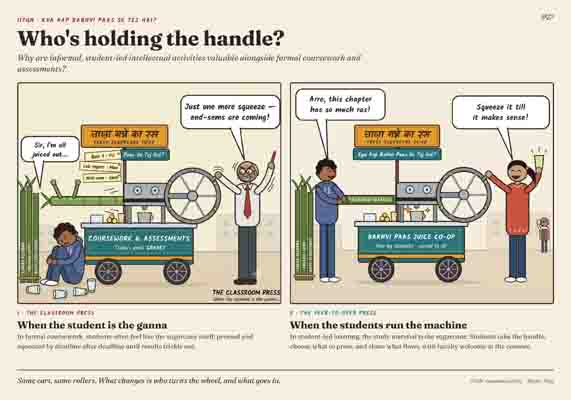
Prof Bhaskar Datta, Dean of Academics at IITGN, said, “Such student-led intellectual activities are a useful complement to coursework and assessments. They encourage students to take ownership of learning, think critically, ask questions, and learn from one another. They also create opportunities for curiosity and collaboration beyond the classroom.”
In an academic environment where performance is often measured through grades, competitive examinations and technical proficiency, such initiatives offer students an opportunity to develop qualities that cannot always be captured by conventional assessments—open-mindedness, collaborative reasoning, intellectual courage and the ability to look at familiar problems from unfamiliar perspectives.
Celebrating teamwork and intellectual agility
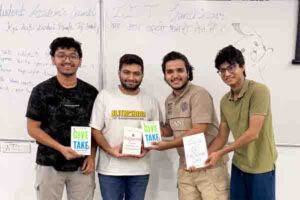
The ninth edition concluded with Team ezpz, comprising final-year BTech students, emerging as the winner. Team Girl Gang, representing the third year, secured the second position, while Hasan & Co., also comprising final-year students, finished third.
The winners may have taken home the honours, but the larger takeaway extended well beyond the leaderboard. For aspiring engineers and innovators, the ability to question established assumptions, think independently and approach unfamiliar challenges with an open mind could prove as valuable as mastering technical concepts.
After all, the most important question in engineering is not always how quickly one can find an answer. It is whether one has understood the problem correctly in the first place.