
- Innovation takes centre stage: Two-day technical summit brings together students, researchers, industry leaders and technology enthusiasts under the theme ‘Strands of Eternity’
- Defence meets discovery: Major General AK Mohla urges students to develop user-centric innovations and turn promising prototypes into practical solutions
- Semiconductor ambitions: Industry experts spotlight indigenous materials, advanced manufacturing, skilled talent and India’s technological self-reliance
- Competition fever: More than 130 teams enter Boeing National Aeromodelling Competition as robotics, AI, automotive displays and esports energise the campus
NE SCIENCE & TECHNOLOGY BUREAU
GANDHINAGAR, NOV 1
From cutting-edge robotics and artificial intelligence to semiconductor breakthroughs, defence applications and high-octane engineering competitions, IIT Gandhinagar’s campus transformed into a vibrant innovation arena as the 17th edition of Amalthea ’26 opened to an enthusiastic turnout. Bringing together academia, industry and emerging talent, the two-day student-run technical summit is celebrating the enduring power of ideas under the theme ‘Strands of Eternity’.
The opening day on Saturday witnessed an impressive convergence of students, academics, business leaders, researchers and technology enthusiasts, with a packed programme of exhibitions, expert interactions, competitions, demonstrations and knowledge-sharing sessions.
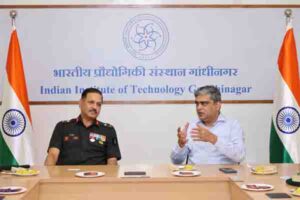
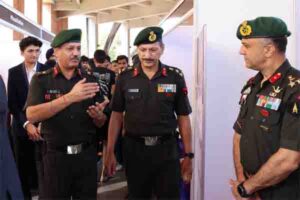
The inaugural ceremony was attended by H. S. Jattana, expert from Semiconductor Laboratory (SCL), Chandigarh; Deputy Director of IITGN; Prof. Bhaskar Datta, Dean of Academic Affairs; and Prof. Sameer Dalvi. The flagship Tech Expo was inaugurated by Major General AK Mohla, General Officer Commanding (GOC), 11 RAPID (H), through a ribbon-cutting ceremony.
Defence innovation meets young minds
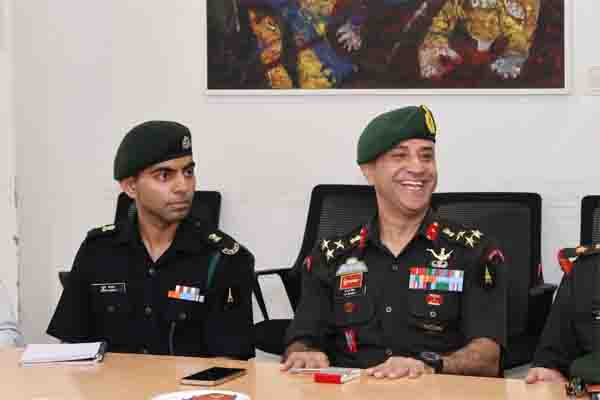
During his visit, Major General Mohla interacted with students, discussing the operational requirements of the Indian defence forces and the potential of innovation to address real-world challenges. He encouraged young innovators to develop solutions grounded in actual user requirements and practical applications.
Emphasising the need for stronger collaboration among the armed forces, universities and industry, he called for innovative concepts to progress beyond prototypes and become market-ready products.
“Yesterday’s solutions are also today’s problems,” he observed, underscoring the importance of translating innovation into practical outcomes. Good ideas and promising innovations, he pointed out, would have little impact unless they reached the public. “Innovations must be commercialised to have a meaningful impact.”
His interaction highlighted the growing importance of connecting academic research with national priorities, particularly in defence technology, where indigenous solutions and close institutional collaboration can accelerate technological capabilities.
Tech expo and auto showcase draw crowds
The Tech Expo emerged as one of the major attractions, featuring innovations and demonstrations from the Institute for Plasma Research (IPR), IITGN’s Robotics Lab, Quantum Materials and Devices Group, Kapidhwaj AI, Maker Bhavan, Centre for Creative Learning (CCL), PlaceStation, ATSN AI, InsideHunt, LingoLabs, arnobots and PrimeUAV, among others.
The exhibits offered visitors a glimpse into emerging technologies and the creative possibilities of research, engineering and entrepreneurship.
The Auto Expo added a distinctive attraction to the technical showcase, drawing automobile enthusiasts with an eclectic display of vehicles, including Land Rover, Ford Roadster, Morris Minor, BMW M2, Fiat Select, Ford Mustang, Nissan Jonga and Mercedes W.
The Open Day further brought IITGN’s research ecosystem closer to the public through demonstrations by laboratories and student researchers working in robotics, artificial intelligence, renewable energy, maritime engineering, smart chemical sensing and power electronics.
Semiconductor conclave spotlights india’s self-reliance
The Semiconductor Conclave and Symposium brought together industry specialists and researchers for discussions on semiconductor research, fabrication careers, chemical mechanical polishing (CMP) materials and electronics manufacturing.
Highlighting the multidisciplinary expertise required to build a career in the sector, Dr. Vinay Sharma, Principal Engineer, Tata Electronics, said, “To build a successful career in semiconductors, you need broad, T-shaped knowledge across device design, manufacturing, packaging and customer needs before you go deep into one speciality.”
He also drew attention to the critical infrastructure required for semiconductor manufacturing, including ultra-pure water, uninterrupted power supply and dependable domestic chemical supply chains.
Dr. Nagendra Prasad, Co-founder and CEO, Indinano Technologies Pvt. Ltd., stressed the strategic importance of developing indigenous semiconductor materials.
“Localising semiconductor materials such as CMP slurries in India is not only about demonstrating supply-chain resilience and providing fast technical support, but also about proving that indigenous products can meet global manufacturing standards,” he said.
Highlighting opportunities for hardware startups, Vishal Tejwani of Electronics Prototyping & Manufacturing said, “Tabletop electronics assembly tools can enable local startups to rapidly prototype and build right here.”
The conclave’s focus on domestic capabilities culminated in an address by H. S. Jattana, expert at Semiconductor Laboratory (SCL), Chandigarh, who outlined India’s efforts towards technological self-reliance, including the development of indigenous manufacturing equipment.
“The primary role of SCL is to ensure the technological autonomy of the country. Developing defence and military applications, such as radiation-hardened electronics, is our utmost priority,” he said.
He also encouraged students to explore analogue and radio-frequency (RF) circuit design, identifying these as areas where India needs a larger pool of skilled professionals.
Prof. Amit Prashant, Dean of External Relations, IITGN, highlighted the scope for stronger partnerships among educational institutions, students and industry.
“If we work together and share ideas, there are opportunities for innovation and to move ideas from prototype to practical application. This requires more research, technical support and industry collaboration,” he said.
National competitions, esports add to the excitement
The Boeing National Aeromodelling Competition attracted more than 130 teams, with the first attempts successfully completed on Day One, setting the stage for the remaining rounds.
The keynote address by Ayush Kumar, Founder of the Indian Inter-College Programming Contest (IICPC), was followed by the IICPC Hackathon, bringing programming talent and competitive problem-solving into the spotlight.
The sporting and gaming dimension of Amalthea ’26 came alive through Bushido esports competitions featuring BGMI, Free Fire and Rocket League. Technical contests, including Maze Runner, FlowDynamics, Citython and RC Racing Roborace, provided further opportunities for participants to demonstrate engineering skills, creativity and teamwork.
Day Two: More innovation, competition and music
The second day, November 1, is scheduled to feature the Tech Expo and Auto Expo, the remaining rounds of the Boeing National Aeromodelling Competition and the Bushido esports finals.
Other attractions include Wire to Win, Brainwiz’s offline round, Bridge-a-thon, Pathfinder, Prompts to Profits, NetZero and the Game Jam Exhibition, where participants will showcase games developed over ten days.
The two-day technical celebration will also move to a musical crescendo, with performances by DJ Kabir, followed by a Bollywood set by Ajitanshu and an EDM performance by DJ Rihya.
With its blend of research, technological experimentation, industry engagement and competitive energy, Amalthea ’26 reinforces IIT Gandhinagar’s commitment to creating a platform where young minds can connect ideas with real-world challenges.