
- IIMA survey flags renewed inflationary pressures even as business confidence on sales and profit margins shows a four-month recovery
NE ECONOMIC BUREAU
AHMEDABAD, NOV 10
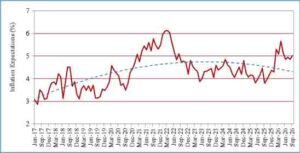
Chart 1: One-year-ahead business inflation expectations (%) — September 2026 survey.
India Inc’s cost pressures are showing fresh signs of intensification, with business inflation expectations climbing above the 5% mark in September 2026 after remaining below that threshold for three consecutive months. However, a sustained improvement in sales expectations and a gradual recovery in profit-margin sentiment offer a counterbalancing signal, pointing to a business environment negotiating the twin challenges of rising costs and improving demand.
The latest Business Inflation Expectations Survey (BIES), conducted monthly by the Misra Centre for Financial Markets and Economy at the Indian Institute of Management Ahmedabad (IIMA), reveals a 17-basis-point increase in one-year-ahead business inflation expectations, from 4.84% in August to 5.01% in September 2026.
The findings present a mixed picture of the corporate economy: inflation uncertainty remains elevated, more firms are reporting very significant cost increases, while sales expectations have improved for four consecutive months and pessimism over profit margins has begun to ease.
Inflation expectations breach 5% threshold again
The mean of firms’ individual probability distributions of expected unit-cost increases places one-year-ahead business inflation expectations at 5.01% in September, up from 4.84% in August.
The latest reading marks a return above the 5% threshold after three months, signalling that businesses continue to anticipate considerable cost pressures over the coming year.
More concerning is the persistence of uncertainty. The survey’s measure of uncertainty, calculated as the square root of the average variance of individual probability distributions of expected unit-cost increases, remained elevated at around 2% for the ninth consecutive month.
This prolonged uncertainty suggests that businesses are yet to gain greater clarity over the future trajectory of their input costs.
More firms report very significant cost increases
The September cost-perception findings point to a marginal intensification of cost pressures, although the distribution across cost-increase categories presents a mixed picture.
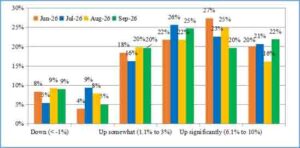
The proportion of firms reporting significant cost increases in the 6%–10% range declined from 25% to 20%. However, the share experiencing very significant increases of more than 10% rose sharply from 16% to 22%.
Meanwhile, the percentage of firms reporting moderate cost increases of over 3% but below 6% increased from 22% to 25%.
The shift towards the highest cost-increase category warrants attention, as sustained input-cost pressures could constrain pricing flexibility and weigh on business margins.
Sales expectations sustain four-month upswing
On the demand front, businesses continued to report encouraging trends. Sales expectations remained buoyant in September, extending the improvement recorded over the previous four consecutive months.
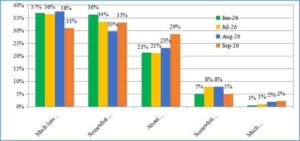
More than 51% of surveyed firms reported sales at about normal levels or higher, indicating a relatively resilient business outlook.
The sustained improvement in sales sentiment offers a positive counterpoint to the renewed inflationary pressures and suggests that demand conditions remain supportive for a sizeable section of businesses.
Profit-margin pessimism begins to recede
Profit-margin expectations have also improved over the past four months, providing another encouraging signal from the survey.
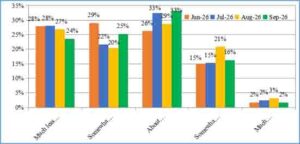
The proportion of firms expecting profit margins to be somewhat less than normal or below declined to 64% in September 2026, compared with 68% in the previous survey round.
Although nearly two-thirds of firms continue to anticipate below-normal or weaker profit margins, the four-percentage-point decline indicates a gradual easing of pessimism.
Taken together, the September findings underscore the complex balancing act confronting businesses: rising inflation expectations and persistent cost uncertainty on one side, and improving sales sentiment and gradually recovering profit-margin expectations on the other.
The coming months will be crucial in determining whether stronger sales momentum can translate into a more durable improvement in corporate profitability without being eroded by renewed input-cost pressures.