

- Birth centenary celebrations begin September 27 with inaugural events across Gujarat
- Thousands of seminars, meetings, service initiatives and exhibitions planned across India and abroad
- VHP says centenary year will carry forward Singhal’s “unfinished work” while highlighting service, organisation and social harmony
- 47 major locations across India to launch centenary programmes between September 27 and October 4
- Gujarat chapter seeks to take Singhal’s “life-message” to wider society and younger generations
NE NEWS SERVICE
AHMEDABAD, SEPT 26
What does a leader leave behind when his life becomes a movement—and what happens when an organisation decides to turn a centenary into a year-long conversation with society? The Vishva Hindu Parishad (VHP) is seeking to answer that question through an extensive programme to mark the birth centenary of its former president Ashok Singhal, with Gujarat preparing to join a nationwide and international calendar of events from Sunday.
Singhal was born in Agra on September 27, 1926, and the VHP’s centenary year formally begins on September 27, 2026. The organisation has announced programmes at 47 major locations between September 27 and October 4, followed by year-long activities at thousands of locations in India and abroad. These are to include service initiatives, social-harmony programmes, public-awareness campaigns, seminars and exhibitions.
Gujarat opens its centenary chapter
In Gujarat, the inaugural ceremony will be held at 10 am on Sunday at Pandit Deendayal Upadhyay Auditorium, Bodakdev, Ahmedabad.
Gujarat Chief Minister Bhupendrabhai Patel will be the chief guest, while Torrent Group Chairman Sudhirbhai Mehta and Ahmedabad Mayor Hiteshbhai Barot will be guests of honour.
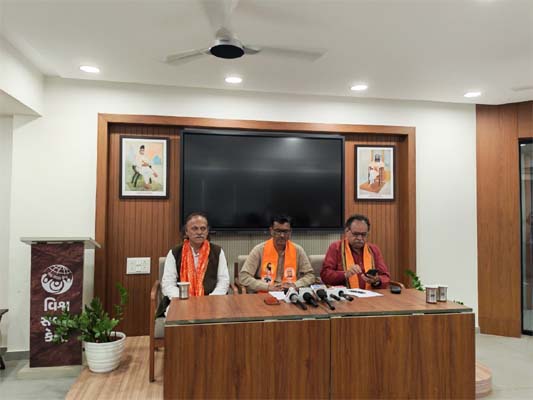
Addressing the media in Ahmedabad on Saturday, VHP North Gujarat Zonal Secretary Nalin Patel and Prachar-Prashar Pramukh Daxsheh Mehta said inaugural programmes would be organised at major locations across Gujarat between September 27 and October 4.
The Gujarat chapter, they said, would seek to communicate Singhal’s life and message to a wider section of society and generate greater engagement with themes the organisation associates with his legacy.
From engineering to organisational leadership
Singhal’s journey began in engineering before taking him into full-time organisational work.
After completing metallurgical engineering from Banaras Hindu University Institute of Technology in 1950, he became a full-time pracharak of the Rashtriya Swayamsevak Sangh and subsequently served as prant pracharak for Delhi and Haryana.
He was deputed to the VHP in 1980, became its joint general secretary and rose to become general secretary in 1984. He later served as VHP president until December 2011.
Singhal became one of the most prominent faces of the Ram Janmabhoomi movement from the late 1980s onwards. He died at a private hospital in Gurugram on November 17, 2015, aged 89.
The VHP’s own historical material documents Singhal’s central role in its Ram Janmabhoomi campaign and organisational activities.
“Inspiring life, visionary thinking”
VHP International President Alok Kumar, announcing the centenary programme, said the organisation would use the year to remember Singhal’s life, ideas and contribution to society.
“On his birth centenary starting September 27, we have decided to honour his inspiring life, visionary thinking and his contributions.”
Kumar described Singhal’s contribution as “unparalleled” and said the organisation would seek to advance what it describes as his unfinished initiatives. These include issues such as opposition to illegal religious conversions, promotion of ghar wapsi, cow protection, propagation of Vedic knowledge and Sanskrit, and temple-related causes. These are VHP’s stated positions and objectives for the centenary year, rather than independent policy conclusions.
“We will honour his memory by accelerating his unfinished initiatives,” Kumar said, announcing thousands of seminars, public meetings and other programmes through the year.
Service, culture and social harmony
According to Patel, the Gujarat programme has a wider social objective beyond remembering an individual leader.
He said the centenary year would seek to convey Singhal’s “life-message” to wider society, foster a “sense of pride” in Indian culture and inject fresh energy into initiatives centred on service, organisation, sanskar and social harmony.
The national programme reflects a similar emphasis. The VHP has said the centenary year’s objective is to take Singhal’s life-message to wider society, promote awareness of Indian culture and strengthen activities associated with service, organisation, values and social harmony.
A centenary with a service dimension
The celebrations will also include service-oriented initiatives.
The VHP and Ashok Singhal Foundation have announced a five-day camp at Karsevakpuram in Ayodhya from September 27 to October 1, where artificial limbs and assistive devices will be provided to persons with disabilities.
The centenary programme will also feature exhibitions and public-awareness initiatives at different locations. A national inauguration is scheduled at Bharat Mandapam, New Delhi, on September 27, with Union Home Minister Amit Shah as chief guest and RSS Sarkaryawah Dattatreya Hosabale as special guest, according to the VHP’s announcement reported by multiple outlets.
The bigger canvas
From Gujarat’s inaugural programmes to events across 47 major locations and thousands of activities worldwide, the centenary is being projected by the VHP as an extended engagement with society rather than a single-day commemoration.
For Gujarat, the immediate focus will be the September 27–October 4 inaugural phase. For the VHP, however, the larger test will be whether the centenary can translate the memory of one of its most influential former leaders into sustained programmes around the themes it has identified—service, organisation, cultural awareness, social harmony and its stated unfinished initiatives.
As Ashok Singhal’s birth centenary begins on September 27, Gujarat’s celebrations will therefore open another chapter in the continuing public debate over culture, identity, social service and the legacy of the Ram Janmabhoomi movement.