R ARIVANANTHAM
CHENNAI, FEB 24
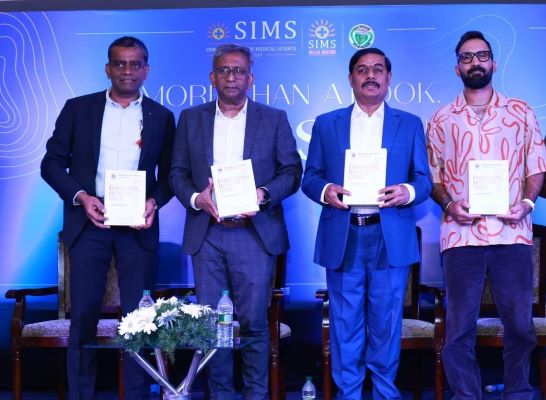
Ina rare confluence/reunion of friendship, science, and social purpose, 50 alumni of the 1984 batch of Madras Medical College (Rajiv Gandhi Government Medical College) have joined hands to craft what they describe as the world’s first comprehensive “owner’s manual” for the human body — The Universal Health Code. The nearly 300-page book was launched in Chennai on Tuesday, symbolising not just a publication milestone but a collective pledge to demystify human health for the public.
The first copies were released by Dr Ravi Pachamuthu, Chairman of SRM Group, and Mohamed Rela, Chairman of Rela Hospital. Former India cricketer and Royal Challengers Bengaluru batting coach Dinesh Karthik and renowned TV Anchor ‘Neeya Naana’ pugazh Gopinath Chandran received the inaugural copies in the presence of compiler Dr Vijay C Bose and representatives of Wings Publications.
- 50 Batchmates of Madras Medical College Transform Shared Legacy into Public Health Mission
- Five-Year Labour of Knowledge Produces World’s First Integrated Guide to Human Body Functioning
- SRM and Rela Leaders Unveil Landmark Volume Celebrating Preventive Health Awareness
- From Classrooms to Community Impact, Alumni Collective Seeks to Empower Everyday Health Decisions
More than a conventional medical guide, the book reflects a deeply human journey — of classmates who, decades after sharing lecture halls and hostel corridors, reunited around a common conviction that knowledge must reach beyond hospital walls. Their collaborative work avoids rigid prescriptions, instead weaving together insights across specialties to help readers understand how their bodies function as an integrated system.
“I extend my heartfelt congratulations to all the authors who contributed, especially Dr. Bose, the compiler of this work. For the first time, we have a universal user manual for the entire human body, offering a holistic view instead of fragmented, compartmentalised guidance that may even contradict across specialties. This book presents one unified truth about the whole body and empowers readers to make informed choices. It is commendable that the 1984 batchmates from Madras Medical College, despite their busy schedules, have committed themselves to enhancing public awareness – particularly in curtailing lifestyle diseases – in the best interest of the society,” said Dr. Ravi Pachamuthu, Chairman, SRM Institute of Medical Sciences (SIMS).
“At the heart of the initiative lies a shared recognition of India’s growing lifestyle disease burden and the confusion many individuals face amid fragmented health advice. The authors sought to bridge this gap by explaining the body’s mechanisms/inner engineering in a simple language, enriched with illustrations and cross-disciplinary perspectives, enabling readers to connect knowledge with everyday living.”
“This book was five years in the making. It has been made possible by the unwavering commitment of my batchmates. The growing burden of lifestyle diseases such as hypertension, diabetes, and heart disease, especially in India, prompted this initiative. While many books today offer silo-based advice for individual conditions, the public is often left confused about what to follow. We believe this is the age of knowledge, where people must be empowered with clear knowledge of the body’s inner workings. Modeled on the concept of a user or owner’s manual, this book enables readers to understand how their body functions so they can make the right lifestyle choices. It is one thing to be disease-free; it is another to achieve optimal health. This book aims to guide people toward that higher standard of well-being,” said Dr. Vijay C. Bose.
Answering media queries, Dr Vijay C Bose said, “The translated version of this book penned by the 1984 MBBS Batch of Medras Medical College (MMC) would be published in Tamil and other Indian languages and also enquiries were received from other countries such Russia to translate in Russian language.”
The launch evolved into a reflective gathering where speakers highlighted how medical education, when combined with empathy and collective purpose, can shape public narratives on wellness. Contributors emphasised that empowering individuals with foundational understanding — rather than prescriptive instruction — may hold the key to preventive healthcare.
For the doctors behind The Universal Health Code, the project stands as both a professional accomplishment and a tribute to enduring camaraderie — proving that the lessons of medical school can ripple across decades to touch countless lives beyond the clinic.