
R ARIVANANTHAM
CHENNAI, OCT 29
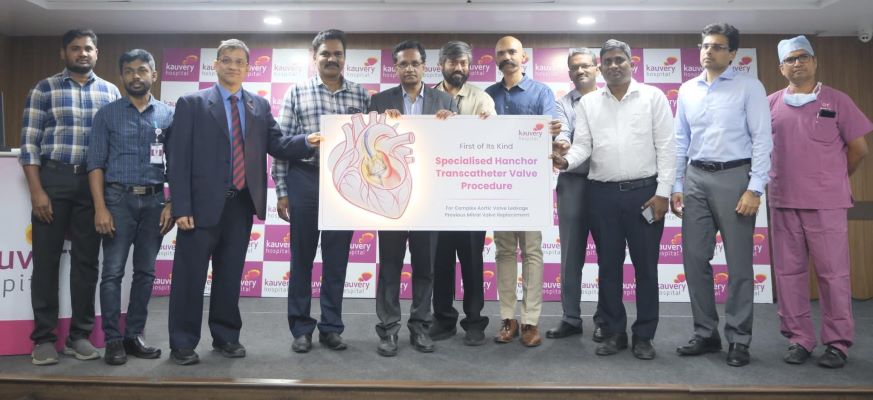
When a heart valve leaks severely and its damaged structure offers little support for a replacement, the challenge is not merely to implant a new valve — it is to ensure that the device remains securely anchored and functions effectively. Kauvery Hospital, Alwarpet, Chennai, reports having successfully treated a 63-year-old man with this complex combination of heart conditions using a specialised HANCHOR valve through transcatheter aortic valve replacement (TAVR).
- Chennai hospital reports a first-of-its-kind procedure using a Chinese-made valve for a challenging case of pure native aortic regurgitation
- 63-year-old patient had severe aortic valve leakage caused by a perforated leaflet and a history of mitral valve replacement
- Catheter-based TAVR procedure avoids conventional open-heart valve replacement surgery in this case
- Specialised anchoring mechanism helps address the challenge of securing a replacement valve when calcium deposits are limited
- Post-procedure assessment reports no residual aortic regurgitation, valve narrowing or leakage around the implanted valve
- Patient discharged after three days; cardiologist says the procedure costs approximately ₹15 lakh to ₹20 lakh and is covered under health insurance schemes, subject to applicable terms
The patient had pure native aortic regurgitation (PNAR), a condition in which blood flows backwards into the heart because the aortic valve fails to close properly. The problem was compounded by a perforation in one of the native aortic valve leaflets and a previous mitral valve replacement, making treatment planning particularly challenging.
According to the hospital, this is the first procedure of its kind in a patient with this combination of clinical factors using the HANCHOR valve. The reported outcome highlights the role specialised valve technology and individualised treatment planning can play in addressing complex structural heart conditions.
Why this case was particularly challenging
The aortic valve regulates blood flow from the heart into the aorta, the main artery supplying blood to the body. When the valve does not close properly, blood leaks backwards into the heart, increasing the burden on the heart and potentially leading to serious complications if left untreated.
In patients with pure native aortic regurgitation, catheter-based valve replacement presents a distinctive technical challenge. Unlike aortic stenosis, in which calcium deposits can help anchor an implanted valve, the native aortic valve in regurgitation cases may have little or no calcification to provide a secure hold.
In this patient, the perforated leaflet added to the complexity, while the existing mitral valve prosthesis required additional consideration during procedural planning.
Specialised anchoring offers a solution
The HANCHOR valve is designed to address the anchoring difficulties associated with pure native aortic regurgitation. It combines a balloon-expandable frame with a dedicated anchoring element made of nitinol, a flexible metal alloy.
The anchoring mechanism is designed to engage the native valve leaflets and help stabilise the replacement valve in circumstances where the surrounding anatomy provides limited support.
During the procedure, doctors delivered the replacement valve through a catheter and positioned it within the patient’s existing aortic valve. TAVR is a minimally invasive alternative to conventional open-heart valve replacement for appropriately selected patients.
Following implantation, the hospital’s post-procedure assessment reported no residual aortic regurgitation, no valve stenosis and no paravalvular leak — leakage around the implanted valve. No significant abnormality in the heart’s electrical conduction was reported. The patient was discharged after three days.
Cardiologist highlights the significance
Dr Rajaram Anantharaman, Senior Consultant, Interventional Cardiology, Kauvery Hospital, Alwarpet, said the case demonstrated the challenges of treating severe native aortic valve leakage through a catheter-based approach.
“Pure native aortic regurgitation can be challenging to treat using a catheter-based approach because the limited calcium deposits in the native valve can make it difficult to secure a replacement valve. Also, the perforation of the aortic valve leaflet, combined with the patient’s history of mitral valve replacement, added further complexity to treatment planning. The HANCHOR valve’s dedicated anchoring mechanism helped us address the challenges of valve positioning. The immediate post-procedure findings were encouraging, with no residual aortic regurgitation or leakage around the implanted valve reported. This procedure demonstrates the importance of individualised treatment planning and specialised valve technology in managing complex structural heart conditions.”
Dr Anantharaman further said that, to his knowledge, the medical literature did not document an earlier implantation of the HANCHOR valve in this clinical setting.
“Nowhere in the medical literature have we found a documented case of the HANCHOR valve being implanted in a patient in this setting. Hence, this is the first procedure of its kind using the HANCHOR valve, which was specifically imported from China after obtaining the required regulatory approvals,” he said.
He added that the procedure costs approximately ₹15 lakh to ₹20 lakh and said it was covered under health insurance schemes, including Central and State Government schemes. Patients should, however, verify eligibility, authorisation and coverage under the specific scheme or insurance policy before treatment.
Kauvery underscores clinical innovation
Dr Aravindan Selvaraj, Co-founder and Executive Director, Kauvery Group of Hospitals, in a statement said:
“At Kauvery, we are committed to advancing patient care through clinical expertise, innovation and the adoption of appropriate medical technologies. Success stories such as this highlight the importance of combining specialised treatment approaches with careful clinical assessment to address complex cardiac conditions. We continue to focus on bringing advanced treatment options to patients while maintaining the highest standards of patient safety and care.”
The reported procedure adds to the evolving range of catheter-based options for selected patients with complex structural heart disease. Its broader significance will depend on continued clinical experience, longer-term follow-up and evidence establishing the durability and safety of the valve in different patient groups.
Dr Iyappan Ponnuswamy, Medical Director, Kauvery Hospital Chennai explained the hospital has adopting latest technologies such as Hybrid catheter laboratory which helps doctors to save patients from challenging situations.
Dr Clive Fernandes, Director of Medical Services, Kauvery Hospital Chennai, Dr Mahesh Kumar K, Medical Superintendent, Kauvery Hospital Alwarpet and a team of cardiologists were also present at the press conference.